How a Little Girl Caught a Critically Endangered Axolotl in First-Ever Wild U.K. Discovery
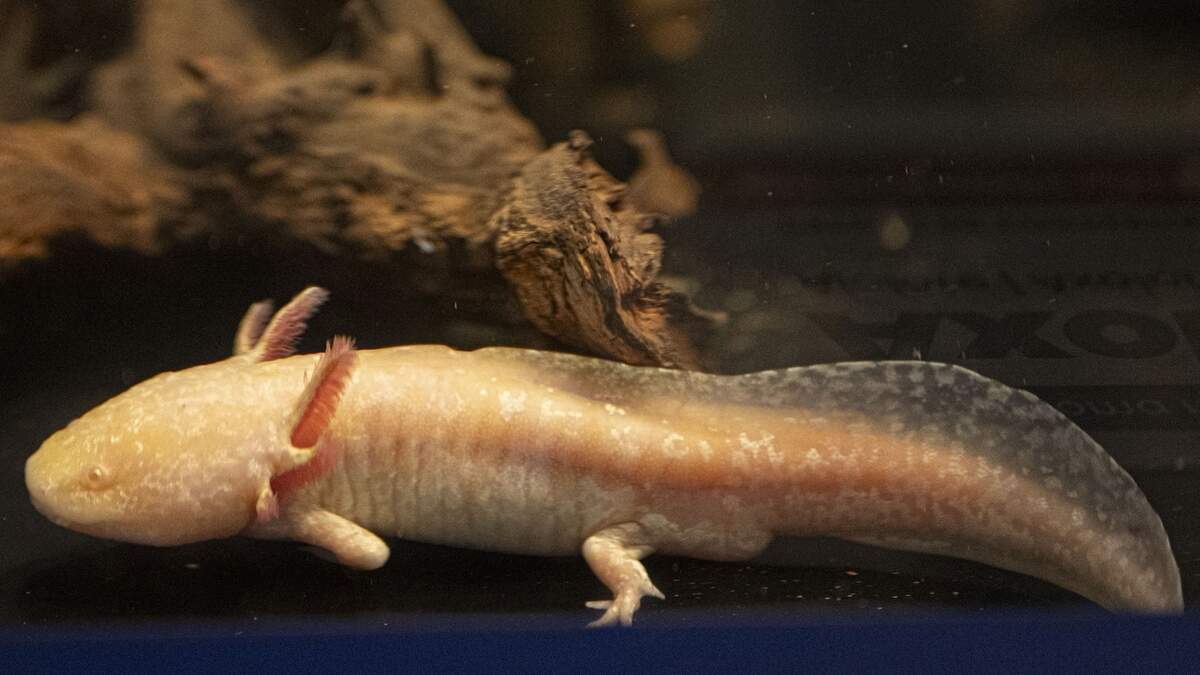
A critically endangered Mexican axolotl has been found in a Welsh river by a 10-year-old girl, marking the first documented discovery of the species in the wild in the United Kingdom. Only 50 to 1,000 axolotls are estimated to remain globally, per BBC. The injured animal, now named Dippy, is getting a second chance at life after the girl caught it and brought it home.
Evie Hill was on holiday with her family when she spotted the 9-inch Mexican axolotl under the Dipping Bridge on the River Ogmore near Bridgend, South Wales. The creature was pale with speckles and looked like it was doing poorly. It had suffered injuries to its tail and stomach, believed to have been caused by a predator, BBC reported.
“I went down to the bank and there was this thing with gills on its head. I was like: ‘That’s an axolotl.’ I was: ‘Mum, there’s an axolotl in the river.’ She went: ‘There’s not. You’re not going back in the water.’ So I went back in the water anyway, because I’d seen it. And then I caught it and brought it back,” Evie told BBC.
Expert Says Rescue Saved the Animal’s Life
Chris Newman, director of the National Centre for Reptile Welfare, credited Evie with the rescue, saying it saved Dippy’s life. He applauded her for catching Dippy, revealing it would have likely been difficult for him to survive wounded and alone.
“This is quite a unique situation, and I think the young female has a keen eye to actually spot it,” he said. “I think she did remarkably to find him.”
In particular, he was impressed with the fact she was able to grab Dippy at all.
“That itself is no mean feat,” he said. “They’re quite slippery, so I think she did really well.”
A Species on the Brink of Extinction
The Mexican axolotl is a rare salamander that, unlike most amphibians, remains fully aquatic throughout its life, according to National Geographic. In the wild, it survives in just one place on Earth: the lake system of Xochimilco, a centuries-old network of canals, small lakes, and seasonal wetlands that also plays a vital role in supplying water to the nearly 18 million residents of Mexico City.
But this fragile habitat has been steadily eroded. As Mexico City has expanded, the Xochimilco water system has shrunk and become increasingly polluted, placing mounting pressure on the axolotl population. Compounding the crisis, invasive species such as carp and tilapia have been introduced into the waterways. These fish compete directly with axolotls for food — and even prey on their eggs — further accelerating the species’ decline.
Neoteny and Regeneration: The Biology Behind the Fascination
Axolotls are defined by a remarkable biological quirk known as neoteny, in which they retain juvenile traits throughout their entire lives, according to National Geographic. While most amphibians undergo a dramatic transformation from water-bound larvae to land-dwelling adults — such as a tadpole becoming a frog — the axolotl never makes that leap. Instead, it remains fully aquatic, keeping its tail and distinctive feathery external gills, a kind of perpetual adolescence beneath the surface.
That evolutionary exception is part of what makes the species so compelling to scientists. Axolotls are also extraordinary regenerators, capable of rebuilding lost limbs with surprising speed — often in about a month, per National Geographic. In their underwater world, this ability serves a practical purpose as well; when threatened or crowded, an axolotl may even bite off the gills or limbs of another, only for both to regenerate over time.
Beyond their strange resilience, axolotls have become a focal point of medical research. Scientists study them in hopes of unlocking the secrets behind their regenerative powers — and whether similar mechanisms might one day be applied to human medicine, including the possibility of regrowing complex tissues or even limbs.
A Second Chance at Life for Dippy
Dippy was brought to the Hill family’s Leicester home. Evie’s mother, Melanie Hill, told the BBC she was stunned when she saw the creature.
“I’ve been telling Evie all this time that those creatures she watches on YouTube, they’re not real,” she admitted. “Here I am with one in my kitchen.”
The family did their own research about taking care of the animal. Overall, they have “no regrets” about taking Dippy home. They also sought expert advice to make sure they were taking all of the right precautions.
“We’ve got a much bigger tank and we plan to get that set up so it can be transferred,” Melanie said of what the future holds.
This article was created by content specialists using various tools, including AI.