Researchers Uncover Massive 5.5 Million Bee Colony Under Historic New York Cemetery
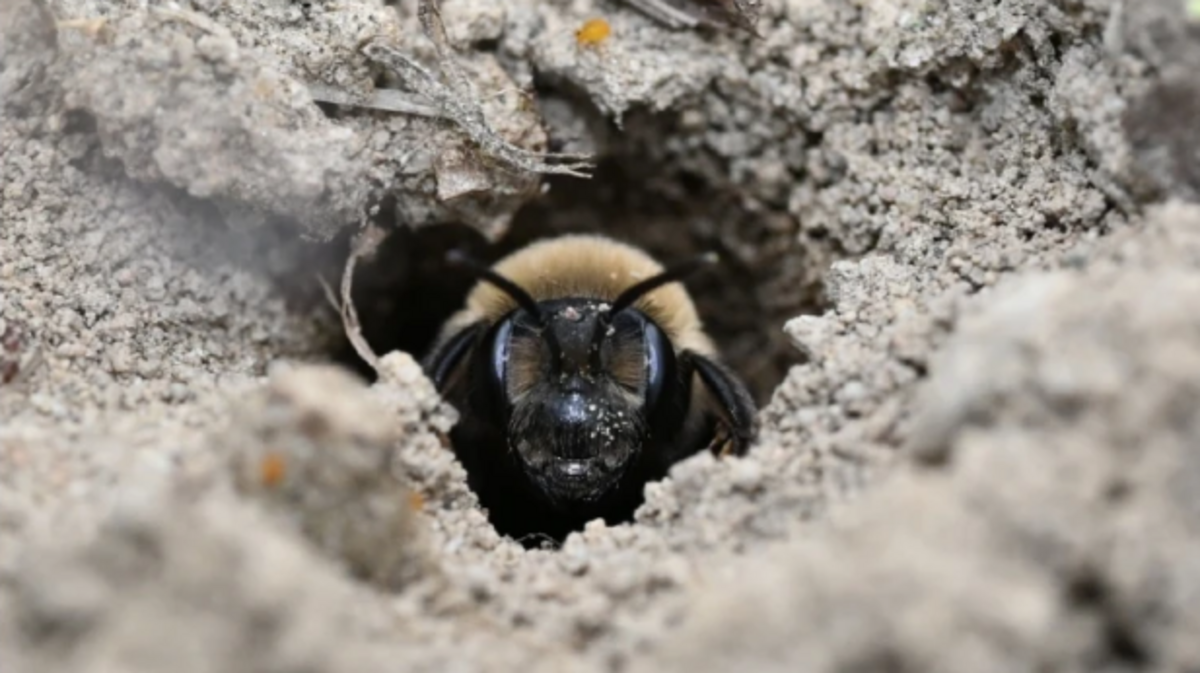
Beneath the headstones and quiet walking paths of a cemetery in Ithaca, New York, something incredible has been happening — completely out of sight.
Millions of bees have been living underground there. Not thousands. Not hundreds of thousands. Millions. And no one realized just how many until one curious lab technician decided to take a closer look.
Rachel Fordyce, a technician at an entomology lab at Cornell University, was walking through East Lawn Cemetery when something caught her attention.
There were a lot of bees. More than you’d expect. More than you’d ignore.
Most people would’ve turned around and walked the other way. Fordyce grabbed a jar.
She collected a few of the bees and brought them back to her boss, Bryan Danforth, a professor of entomology. Together, they identified them as Andrena regularis — a species known as the regular mining bee.
That’s when things started to get interesting.
How Many Bees Did Researchers Find?
Curiosity turned into a full study, published April 13 in the journal Apidologie. The goal was simple: figure out how many bees were actually living there.
The answer wasn’t simple at all. Roughly 5.5 million.
“I was completely floored when we did the calculations,” Danforth told Scientific American.
“I have seen published estimates of bee aggregations in the hundreds of thousands. But I never really imagined that it would be 5.56 million bees,” he added.
To put that in perspective, that’s millions of bees living beneath about 1.5 acres of land — roughly 6,000 square meters. Even lead author Steve Hoge noted that while larger aggregations might exist, this is one of the biggest ever recorded.
How Do You Even Count That Many Bees?
It’s not like you can just dig up the ground and start tallying. In fact, that’s the last thing you would want to do if your main goal is to preserve the bees.
Instead, researchers used something called emergence traps — small mesh tents placed over patches of soil. When bees emerged from underground, they were funneled into collection jars.
Over several weeks in spring 2023, the team set up 10 traps and collected 3,251 specimens representing 16 different species. From there, they calculated how many bees were emerging per square meter — and scaled that up across the entire cemetery.
They came to an estimate between three and eight million bees — or an average of 5.5 million.
A Colony That’s Been There Longer Than Anyone Realized
Here’s the wild part: these bees didn’t just show up recently.
East Lawn Cemetery was established in 1878, and records show A. regularis has been collected there since the early 1900s.
So this isn’t a new colony — it’s one that’s likely been thriving for over a century… just largely unnoticed. And despite how common ground-nesting bees actually are, they haven’t been studied nearly as much as honey bees.
That’s surprising when you consider this: about 75% of all bee species are solitary ground nesters. They don’t live in hives. They don’t swarm. They quietly dig tunnels underground, do their job, and go mostly unnoticed.
Why a Cemetery Is Basically Perfect for Bees
It turns out, cemeteries are kind of ideal for them.
Think about it — there’s minimal ground disturbance, very little development and typically no pesticide use. The soil stays stable, which is exactly what ground-nesting bees need.
Location helps, too.
This cemetery sits about a third of a mile from Cornell Orchards, giving the bees easy access to early spring blooms. Their emergence lines up almost perfectly with apple blossoms and wildflowers — a built-in food supply right when they need it.
Why This Matters More Than You’d Think
Sure, the number alone is enough to grab attention. But the bigger takeaway is what it says about where biodiversity can thrive.
This study not only introduces a new way to estimate hidden bee populations, it also highlights how important overlooked spaces — like cemeteries — can be for pollinators.
“The research elevates the value of solitary ground-nesting bees and shows just how abundant these bees are, how important they are as crop pollinators, and that we need to be aware of these nest sites and preserve them,” Danforth told the Cornell Chronicle.
And the stakes are real.
“These populations are huge, and they need protection,” he added. “If we don’t preserve nest sites and someone paves over them, we could lose — in an instant — 5.5 million bees that are important pollinators.”
It’s a strange thing to think about. Right now, beneath a quiet cemetery in upstate New York, millions of bees are tunneling through the soil, pollinating nearby orchards and quietly supporting an entire ecosystem.
Most people walk right over it. Now, we know what’s underneath.
This article was created by content specialists using various tools, including AI.
This story was originally published April 23, 2026 at 10:15 AM.