Chimpanzees Love Crystals So Much They Had to Be Bribed With Bananas to Return Them
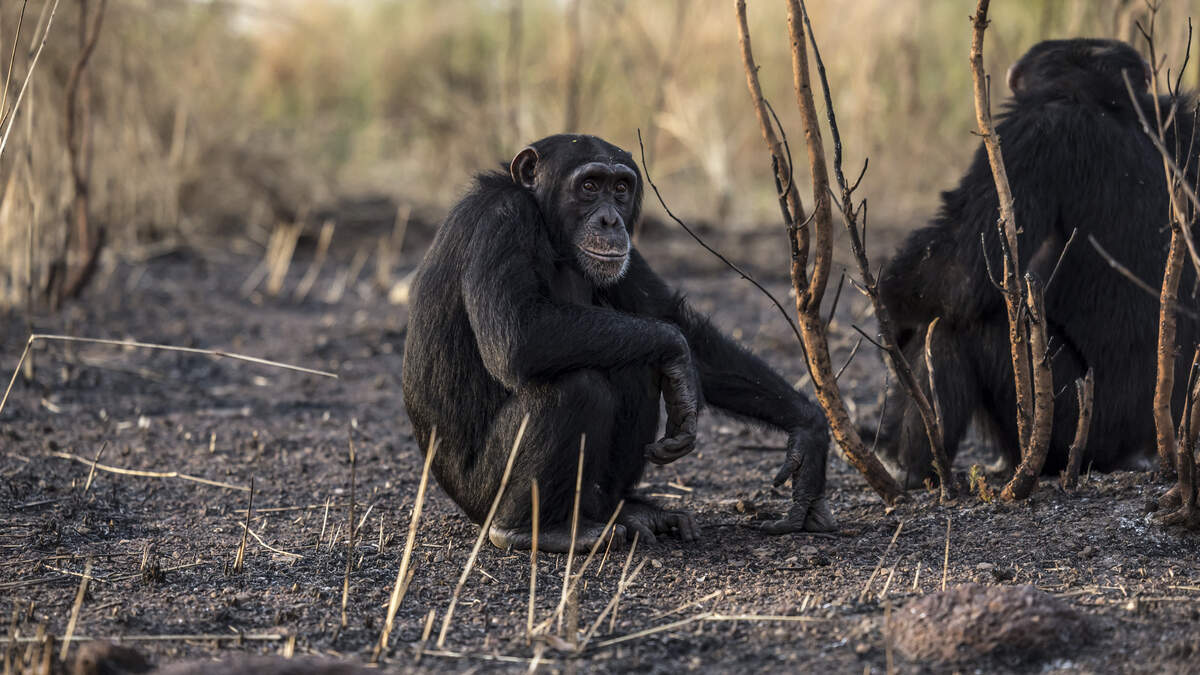
You know that feeling when you spot a really good rock and just have to pick it up? Turns out, chimpanzees get it too — and they might be even more intense about it than you are.
A study published in Frontiers in Psychology on March 3, 2026, found that when researchers gave chimps access to quartz crystals, the animals didn’t just glance at them and move on.
They hoarded them. They carried them around while eating. They slept with them. And when scientists tried to get the crystals back, the chimps demanded bananas and yogurt as ransom.
No, seriously.
Chimps Love Crystals Just as Much as We Do
The study was led by Juan Manuel García-Ruiz, a crystallographer based at the Donostia International Physics Center in Spain whose career has focused on the physical properties of crystals.
He’s also deeply interested in how crystals have shaped the human mind and art history.
His team ran a series of experiments with two groups of chimpanzees at Rainfer Fundación Chimpatía, a primate rescue center near Madrid. The chimps were described as “enculturated,” meaning they had significant prior exposure to humans and human environments.
The first experiment had a delightful name: “The Monolith,” after the iconic object in Stanley Kubrick’s 2001: A Space Odyssey.
Researchers placed a large, multi-faceted quartz crystal — about one foot tall and weighing 3.3 kilograms — on a pedestal in the chimps’ outdoor area. A similarly sized sandstone rock sat on another pedestal nearby.
The chimps were initially curious about both objects. But they quickly lost interest in the sandstone and focused intensely on the quartz.
“The way they ‘studied’ it there, turning it over to observe it from different angles, was amazing,” García-Ruiz said in an interview with IFL Science.
In one group, the alpha female removed the crystal from its pedestal, after which the group rarely let it out of their sight. In the other group, a chimp named Sandy immediately grabbed both objects and took them inside their sleeping corridor.
And here’s where it gets really good: when researchers tried to retrieve the crystal, they had to offer large quantities of bananas and yogurt in exchange for the larger crystals. Some smaller crystals were never recovered at all.
The chimps simply decided those belonged to them now.
The Chimps Sorted Crystals Like Tiny Geologists
In a second experiment, researchers placed pebble piles containing a few small quartz and calcite crystals in the yard. The chimps quickly and deliberately picked the crystals out from among the regular pebbles.
They examined them by rotating them in the light, held them up to their eyes and carried them in their mouths — which is unusual chimp behavior and may indicate they considered the objects precious.
Security cameras later revealed one chimp still holding a crystal while settling into his sleeping area.
A third experiment added pyrite — a more metallic, cubic-shaped crystal — to the pebble piles alongside quartz and calcite.
Sandy, the same chimp who’d previously snatched the monolith, scooped up a mouthful of the mix, climbed to an elevated platform and separated all three crystal types from the regular pebbles.
Since quartz, calcite and pyrite differ in transparency, symmetry and surface sheen, this sorting ability surprised the researchers.
Why Do Chimps Love Crystals So Much?
The chimps appeared to be attracted to the crystals’ geometric regularity and their ability to transmit or reflect light — qualities that are rare in the natural world, where most objects are irregular or curved.
The study noted that “the chimpanzees’ interest in crystals goes beyond novelty.”
García-Ruiz believes crystals, as the only naturally occurring objects with precise geometric shapes, may have played a role in helping early humans develop abstract and mathematical thinking.
“We were pleasantly surprised by how strong and seemingly natural the chimpanzees’ attraction to crystals was. This suggests that sensitivity to such objects may have deep evolutionary roots,” García-Ruiz wrote in a statement.
Here’s the mind-bending part. Chimpanzees share a common ancestor with humans from roughly 6 to 8 million years ago. If both species independently gravitate toward crystals, that attraction could be ancient — embedded deep in primate biology long before anyone was stringing quartz on a necklace or putting amethyst on a nightstand.
“If our results are correct, then we have had crystals on our minds for at least 7 million years,” García-Ruiz told IFL Science.
Archaeological evidence already shows human ancestors were collecting quartz and calcite stones as far back as 780,000 years ago, with no evidence those stones were made into tools or served any practical function. They were seemingly collected just because.
So the next time someone side-eyes your crystal collection, just tell them it’s a 7-million-year-old primate instinct. Science says so.
This article was created by content specialists using various tools, including AI.