Do Octopuses Throw Rocks at Each Other? The Real Science Behind the Viral AI Video
You’ve probably seen it by now: the Instagram reel posted in April 2026 showing an octopus hurling rocks at another octopus, paired with the claim that females chuck debris at males who won’t leave them alone. Millions watched. Millions shared. And here’s the twist — the video is AI-generated, but the underlying claim isn’t exactly false.
The real story is weirder, messier and more fascinating than the tidy narrative making the rounds.
What the Science Actually Says
Back in 2022, researchers at the University of Sydney, led by Prof Peter Godfrey-Smith, published findings in PLOS One documenting something remarkable: wild octopuses gathering debris and forcefully ejecting it underwater — sometimes hitting other octopuses in the process.
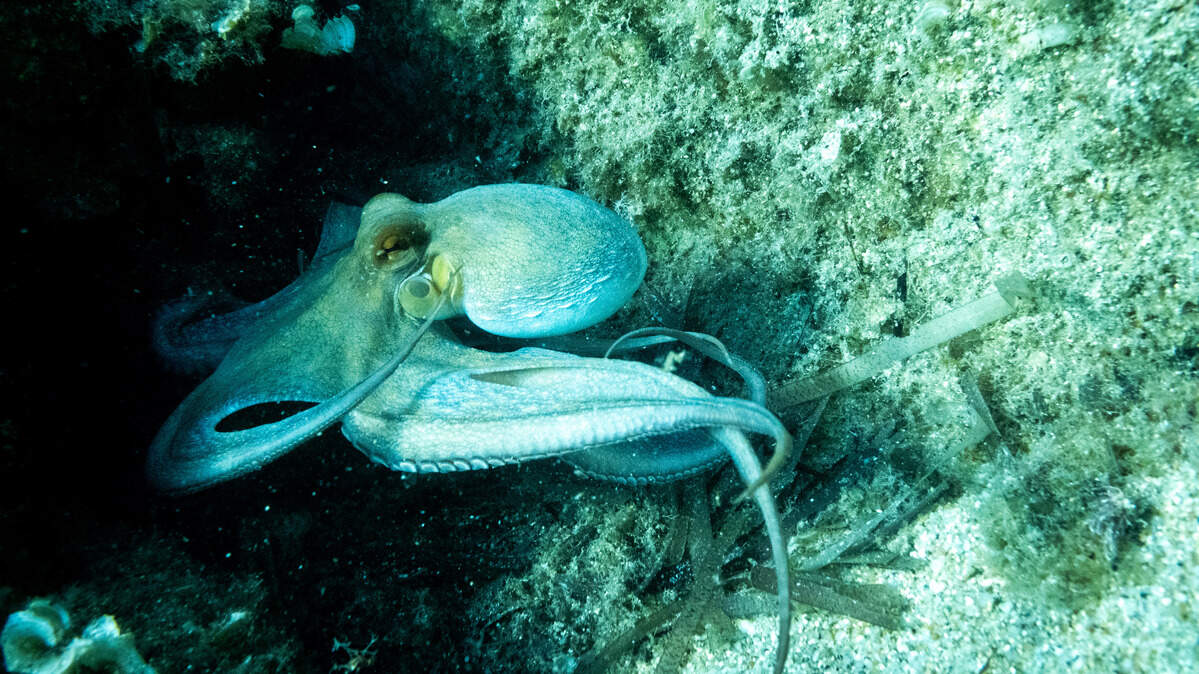
The team studied the common Sydney octopus, Octopus tetricus, using 2015 field recordings from Jervis Bay, New South Wales, Australia. Over 21 hours of underwater video captured by stationary cameras, roughly 10 individual octopuses were observed doing something that most animals simply don’t do.
“The throwing – or propelling, or projecting – of objects that have been gathered and held is rare in the animal kingdom. To propel an object, even for a short distance, under water is especially unusual, and also quite hard to do,” Godfrey-Smith said.
It’s Not Just a Girl-Power Moment
Here’s where the viral framing gets it partly right and partly wrong. Both male and female octopuses were recorded throwing material. However, the majority of throws were performed by females — two females alone were responsible for 66% of the 102 total throws recorded.
And yes, in some cases, females threw things directly at males trying to mate with them. But that’s not the whole picture.
“In quite a few cases, females have thrown material at male octopuses who have been attempting to mate with them … But in other cases, females throw and hit other females,” Godfrey-Smith said.
So the viral claim — that female octopuses throw things at male harassers — isn’t fabricated. It’s just incomplete.
What Were They Actually Throwing, and Why?
The octopuses collected silt, algae and shells, held the material in their arms and web, then expelled it using jet propulsion from their siphon. In some cases, arm extension was also used to propel objects. In one documented instance, “a shell was, at least in part, flung by straightening an arm, and hit another octopus.”
The reasons varied. Of the 102 throws recorded, 32% were linked to den cleaning. Eight percent occurred after feeding, with shells most commonly thrown in that context. But the most intriguing category: 53% occurred within two minutes of a social interaction with another octopus — fighting, mating or grappling. These interaction-linked throws often involved silt.
Of those socially motivated throws, 33% — 17 instances — resulted in material actually hitting another octopus. Several clues suggested some hits were intentional: the octopuses used unusual arm combinations to hold material, threw with higher force and displayed darker body coloration during the throw. Researchers noted that darker coloration had previously been associated with aggressive behavior.
Some octopuses even appeared to react before being hit, raising arms or ducking.
So What’s Really Going On?
The function isn’t fully understood. The researchers found no clear evidence that throws consistently initiated fights or triggered retaliation. Some throws went into empty space entirely.
“I think quite a lot of it is a bit like an assertion of ‘personal space,’” Godfrey-Smith said.
The study suggests possible social signaling or space-keeping behavior — not the clear-cut feminist revenge narrative the internet wants it to be. But the next time someone shares that AI clip, you’ll know the real story: the fake video is selling a simplified version of something genuinely strange that scientists documented years ago.
This article was created by content specialists using various tools, including AI.