This Horned Lizard Feasts on Toxic Ants and Blasts Their Venom From Its Eyeballs
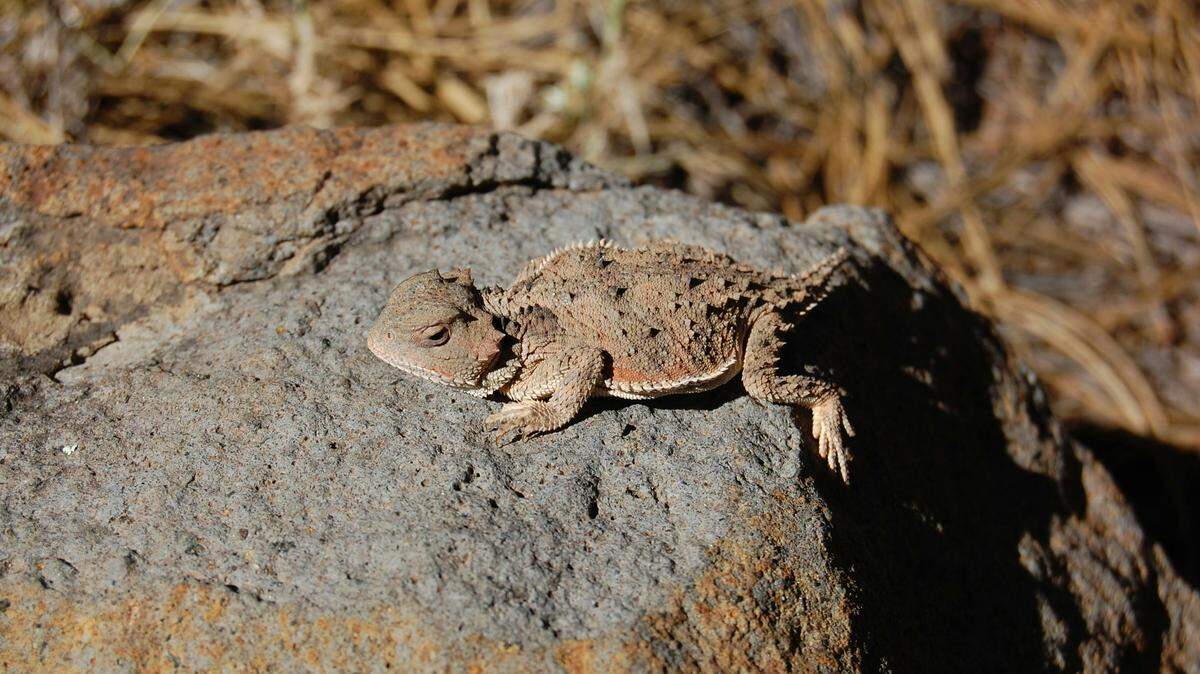
Out in the dry scrublands of the American West, a squat, spine-covered reptile spends its days nearly invisible against the sand, dust and stone.
The greater short-horned lizard (Phrynosoma hernandesi) — Wyoming’s state reptile — looks like a leftover from a prehistoric age, and its first line of defense is simply not being seen.
But when camouflage fails, this unassuming animal unleashes one of the strangest tricks in the vertebrate world — and the secret to why it works is hidden in its lunch.
You Are What You Eat — Especially If You’re a Horned Lizard
Horned lizards are dietary specialists, and their menu revolves almost entirely around harvester ants of the genus Pogonomyrmex.
These are not casual snacks. Harvester ants are aggressive, well-armored and loaded with defensive chemicals, including formic acid. Most predators leave them alone for good reason.
But the horned lizard has built its whole biology around eating them. It swallows the ants whole, and rather than neutralizing their toxic compounds entirely, the lizard’s body absorbs some of those chemicals — or their derivatives — into its bloodstream.
In other words, the lizard becomes chemically armed by what it eats. Every meal is a small deposit into a living defensive reservoir.
And that reservoir is the key to the lizard’s most famous trick.
How the Horned Lizard Turns Lunch Into a Weapon
When a predator gets too close and hiding is no longer an option, the horned lizard does something almost unbelievable: it fires a pressurized stream of its own blood from the corners of its eyes.
Biologists call this ocular autohemorrhaging, and although 19th-century naturalists noted it anecdotally, the behavior wasn’t rigorously documented until the 20th century. Now, it’s something everyone talks about.
The mechanics are as precise as they are bizarre. Blood-filled sinuses ring the lizard’s eyes. When threatened, the animal clamps down on the veins that drain blood from its head while arterial blood keeps pumping in.
Pressure inside those sinuses spikes until tiny vessels near the eyelid rupture, and a fine jet of blood shoots outward — traveling up to roughly one meter, or about 3.2 feet, per a 2024 study from the Annual Review of Chemical and Biomolecular Engineering.
The lizard even aims deliberately too, turning its head toward the threat before firing.
One specimen managed nine separate squirts in 17 minutes without any lasting harm, thanks to tissues that heal unusually fast, per a 2001 study in Copeia.
But the pressure and the aim are only half the story. Without the ant-derived chemistry riding along in that blood, the whole performance would be little more than a startling magic trick.
When that bloody spray hits a predator’s mouth, the reaction is immediate and dramatic.
The compounds concentrated from the lizard’s ant-heavy diet taste horrible and irritate the soft tissues of the mouth. Predators respond with head shaking, gaping, drooling, and frantic licking. Many break off the attack entirely.
This is why diet is not just a background detail in the story of the horned lizard — it is the story. Strip the ants out of the equation and the blood becomes ordinary blood.
The lizard’s entire defensive chemistry is outsourced to the insects it eats, a kind of biological supply chain running from ant mandibles straight into the lizard’s eye sinuses.
The Horned Lizard Takes Evolution to a New Level
Biologists point to the horned lizard as a classic example of exaptation — evolution repurposing existing features for new jobs.
The eye sinuses almost certainly arose first for thermoregulation in a harsh desert climate. Eating harvester ants began as a feeding specialization, not a defense. Neither trait was designed for squirting toxic blood at coyotes.
But over evolutionary time, these separate adaptations collided and combined into a single, coordinated response. It’s a reminder that evolution rarely invents from scratch; it improvises with whatever is already lying around.
For the greater short-horned lizard, what happened to be lying around was a mouthful of angry ants and a head full of blood-filled sinuses. The result is one of the desert’s most memorable defenses — and a vivid illustration that in the natural world, you really can be what you eat.
This article was created by content specialists using various tools, including AI.