Two Rare ‘Doomsday Fish’ Wash Ashore in Cabo San Lucas, Stunning Beachgoers
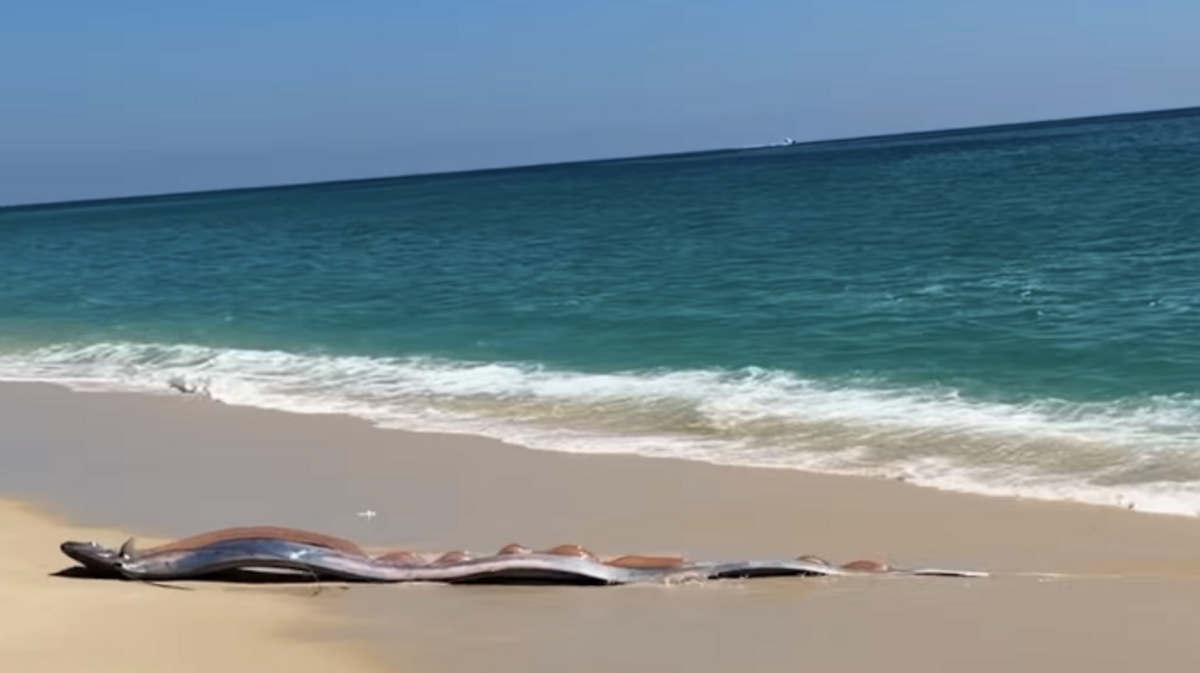
A quiet beach day in Cabo San Lucas, Mexico, turned into an extraordinary wildlife encounter when two deep-sea oarfish — sometimes called “doomsday fish” — washed up in shallow water near the shoreline, drawing crowds of stunned onlookers.
The unusual sighting was captured on video and posted on Instagram on March 4 by Monica Pittenger, whose footage shows the long, ribbon-like fish near the shore as people gathered around them. The video was shared in collaboration with the social media account We Love Animals.
What began as a distant flash of light near the water quickly turned into an experience Pittenger described as almost unbelievable.
‘This Can’t Be Real’
Pittenger said she and others first noticed the animals from a distance. “We saw something in the distance. It was flashing, and it was really bright,” she said in the video.
As the group moved closer, what they found left them in disbelief.
“And when we saw them up close, it was like nothing we’ve seen before, so we were like, ‘This can’t be real,’” Pittenger said.
The video shows one oarfish farther up on the beach while the other remained partially in shallow water nearby. Several people began pushing the fish back toward the ocean — but not without some initial hesitation.
Pittenger said people were reluctant to approach the fish because they did not recognize the species. “I think a lot of people were very hesitant because nobody really knew what it was. It’s not every day that you see that. And I mean, I don’t blame them,” she said.
A Sister Springs Into Action
While many onlookers stood back, Pittenger’s sister wasted no time. According to Pittenger, her sister took charge of the situation, jumping in to push the first oarfish back into the water while others watched from a safe distance.
“Just watching all these men standing around, and she throws me her phone and her drink and her bag, and she’s like, ‘Hold this,’” Pittenger recounted.
After successfully returning the first fish to the ocean, the group continued walking down the beach — only to discover a second oarfish in a similar predicament. Pittenger’s sister once again stepped in, pushing the second fish back toward deeper water.
“It was like something out of a fiction movie. I had never seen anything like it before. I just remember thinking, Is this real?” Pittenger said.
What Are Oarfish?
For most people, oarfish are creatures they will never see in person. These deep-sea fish typically live in the mesopelagic zone at depths of around 1,000 meters (about 3,280 feet), according to the Florida Museum of Natural History. Their long, ribbon-like bodies make them one of the ocean’s more striking and mysterious inhabitants.
Because oarfish inhabit deep water and are rarely seen near the surface, two strandings in the same location are considered unusual. The video description accompanying Pittenger’s post stated that the sisters first noticed “something strange flashing in the distance” before realizing the animals were oarfish, described as a rare deep-sea species that almost never appears near the surface. Seeing even one oarfish near shore is rare, the description noted, and spotting two in the same place is highly unusual.
The ‘Doomsday Fish’ Legend
Oarfish carry a dramatic nickname thanks to a long history of association in folklore with earthquakes and tsunamis.
According to Ocean Conservancy, “The legend is that if you see an oarfish, it is a warning sign from higher powers that disasters such as earthquakes are soon to occur…before Japan’s 2011 earthquake (one of the most catastrophic in history) a total of 20 oarfish washed ashore.”
That folklore has given oarfish sightings an ominous edge in popular culture, and it is easy to see why the appearance of two at once might spark concern among beachgoers or online viewers. Anytime one of these rarely seen deep-sea creatures surfaces, speculation about what it might signal tends to follow.
Scientists Say There’s No Cause for Alarm
Despite the dramatic mythology, the scientific community has not found a connection between oarfish strandings and natural disasters.
Scientists have found no evidence that oarfish sightings predict earthquakes or other seismic events, according to Surfer Magazine. The outlet reported that no seismic activity followed the sighting in Cabo San Lucas.
So while the nickname “doomsday fish” makes for a compelling headline, the actual science offers a far less dramatic conclusion: oarfish occasionally end up in shallow water, and their presence does not appear to be a harbinger of anything catastrophic.
Production of this article included the use of AI. It was reviewed and edited by a team of content specialists.