The Deepest Point in the Mediterranean Sea Is One of Earth's Most Littered Places
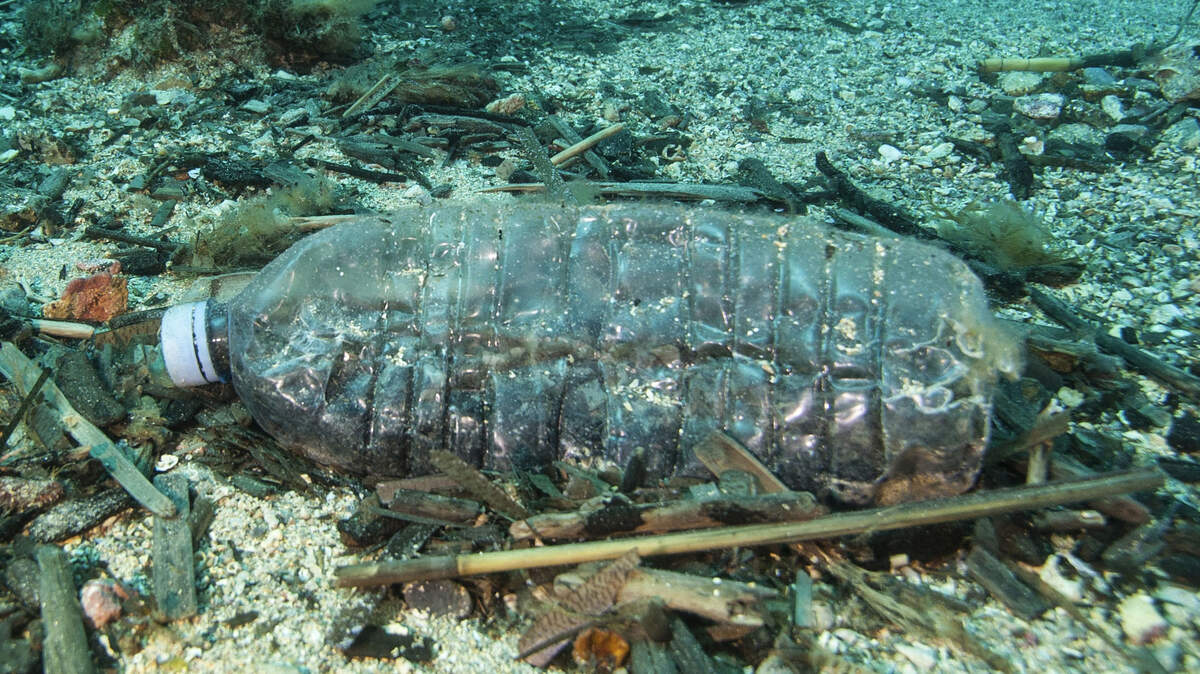
At 5,112 meters beneath the surface of the Ionian Sea, in a place sunlight has never reached, the seafloor is covered in plastic bags, glass fragments, metal objects, and paper waste.
This is the Calypso Deep, the deepest point in the Mediterranean Sea, located roughly 60 kilometers west of Greece’s Peloponnese coast.
A crewed submarine dive there has now produced some of the most detailed documentation ever gathered of deep-sea pollution — and the numbers are stark.
A peer-reviewed study published in 2025 in the journal Marine Pollution Bulletin, led by Miquel Canals from the University of Barcelona’s Faculty of Earth Sciences, recorded one of the highest concentrations of deep-sea litter ever found: 26,715 items per square kilometer.
Plastic made up nearly 90% of all material identified.
How a Submarine Made the Discovery Possible
The data came from the Limiting Factor, a full-ocean-depth-rated crewed submarine built by Triton Submarines.
It is among the most capable deep-diving submersibles ever constructed, designed to withstand the crushing pressures at the bottom of the world’s ocean trenches.
For this mission, the Limiting Factor carried two passengers to the floor of the Calypso Deep. The submarine traveled at approximately 1.8 kilometers per hour — a deliberate pace essential for observation at such extreme depths.
During a 43-minute stay near the bottom, the submersible covered approximately 650 meters in a straight line, capturing high-quality imagery throughout. That footage provided the visual evidence for the study’s quantitative analysis.
Video of what the researchers observed was shared on YouTube in 2020.
Why the Calypso Deep Traps So Much Waste
The trench’s geology explains why litter accumulates in such extraordinary concentrations. Shaped as a “closed depression,” the Calypso Deep, combined with weak local currents, functions as a natural trap.
Lightweight waste — plastic bags, especially — is carried by ocean currents from surrounding coastlines into the depression, where it settles and stays.
Passive transport by currents is not the only mechanism, though. The study confirmed direct dumping by boats, with evidence of bags full of rubbish thrown overboard. Canals described the telltale signs observed from the submarine.
“We have also found evidence of the boats’ dumping of bags full of rubbish, as revealed by the pile-up of different types of waste followed by an almost rectilinear furrow,” he said, per the University of Barcelona.
“Unfortunately, as far as the Mediterranean is concerned, it would not be wrong to say that ‘not a single inch of it is clean,’” Canals added.
Once debris reaches the seafloor, its fate varies by material.
As Canals explained: “Some plastics, such as bags, drift just above the bottom until they are partially or completely buried, or disintegrate into smaller fragments.”
That fragmentation into smaller pieces does not mean disappearance. It means transformation into microplastics, which are even more difficult to track and remediate.
Animals Living Among the Litter
The research team did not find the Calypso Deep devoid of life. Animals were observed at these extreme depths, and they were interacting directly with the litter.
Some organisms were seen ingesting the debris. Others had adapted to the waste in more complex ways, using it as a surface to grow on, to hide within, or to lay eggs upon.
Anthropogenic material, the observations show, has become woven into deep-sea ecosystems even in environments that might seem entirely beyond the reach of human activity.
The researchers describe the deep sea as a “final sink” for pollution — a terminus from which waste, once deposited, is unlikely ever to be recovered or naturally flushed.
The Mediterranean is particularly exposed to this dynamic. It is an enclosed sea surrounded by dense human activity, heavy maritime traffic, and widespread fishing, all of which feed waste into its waters.
A 2018 report by the World Wide Fund for Nature found that “plastic represents 95 per cent of the waste floating in the Mediterranean and lying on its beaches.”
According to that same report, most of the plastic is released into the sea by Turkey and Spain, followed by Italy, Egypt and France.
Treaty Efforts and Their Collapse
The study calls for global policies to reduce marine waste and changes in human consumption habits. Researchers are urging a joint effort among scientists, journalists, media, and public influencers to address the problem.
Some institutional momentum had appeared to build. In March 2022, the UN Environmental Assembly convened in Nairobi, Kenya, to debate the global plastic crisis.
In a historic move, 175 nations voted to adopt a global treaty for plastic pollution. Those negotiations fell through in 2025, according to CNN. The treaty is not currently in effect.
Canals pointed to a difficulty that extends well beyond chemistry or geophysics.
“The ocean floor is still largely unknown to society as a whole, which makes it difficult to raise social and political awareness about the conservation of these spaces,” he said.
The study attempts to confront that gap directly.
By descending in a crewed submarine, documenting findings with rigorous methodology, and publishing the results in a peer-reviewed journal, the research team turned the invisible into something measurable — 26,715 items per square kilometer of it.
The Limiting Factor reached the deepest point in the Mediterranean and returned with proof that no corner of the ocean, however remote, has escaped the reach of human waste.
Production of this article included the use of AI. It was reviewed and edited by a team of content specialists.