Archaeologists Used New RTI Technology to Decode 2,000-Year-Old Pompeii Graffiti
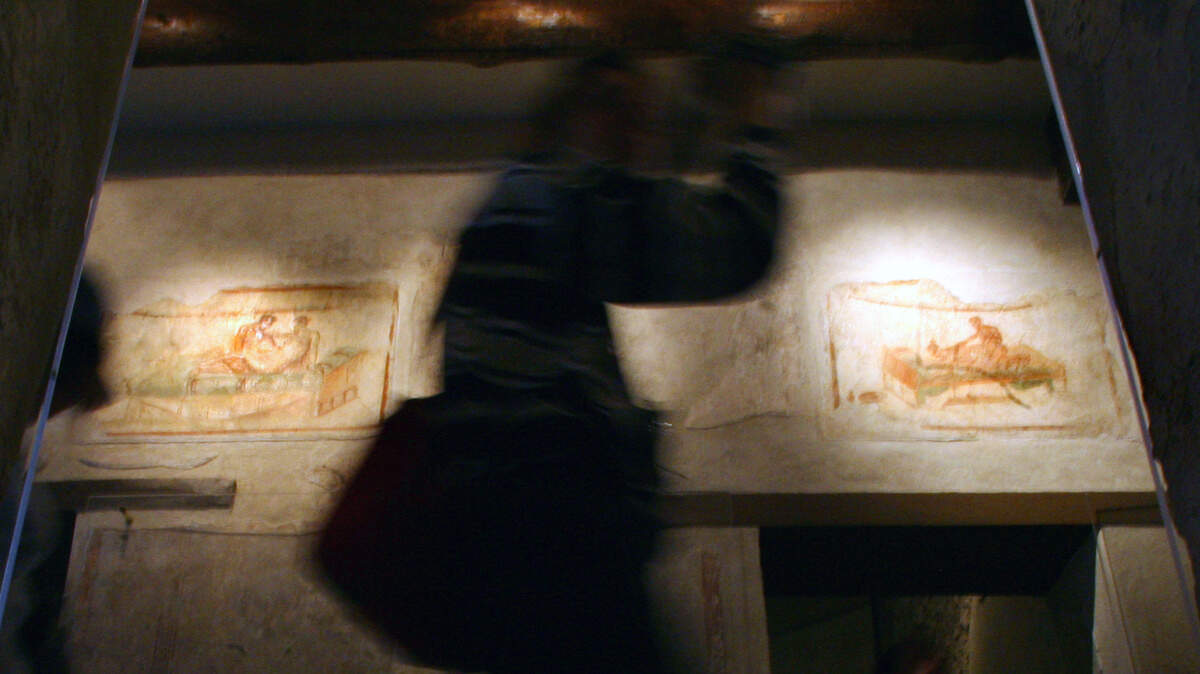
For nearly 230 years, roughly 100 inscriptions carved into a 90-foot-long passageway in Pompeii’s theater district were too faint for the human eye to read.
A photographic technique called Reflectance Transformation Imaging, also known as RTI, has now changed that.
The new technology allowed researchers to decode 79 previously unreadable messages — including love notes, drawings of gladiators, and what may be one of the only known depictions of a female gladiator.
RTI combines many photos taken under different light sources to reveal surface details invisible under normal conditions.
By capturing a single surface from varying lighting angles, RTI generates a composite digital image that lets researchers manipulate light direction interactively. Even the faintest scratches and indentations become legible.
The passageway once connected two theaters in Pompeii’s theater district.
First discovered in 1794, the wall contains roughly 300 surviving inscriptions. About 200 had been recorded by experts over the following centuries, but the remaining messages were too degraded to read — until RTI brought them into focus.
The findings were published in the journal Scavi di Pompei.
A Digital Tool Built From Ancient Walls
The project went beyond imaging. RTI images were combined with metadata and photogrammetry to build a new online tool for examining the inscriptions, set to launch sometime in 2026 and eventually open to the public.
Photogrammetry uses overlapping photographs to construct three-dimensional digital models, adding spatial context to the flat RTI scans so users can explore the passageway’s surfaces in detail.
The project is called Corridor Rumors, led by historian Marie-Adeline Le Guennec of the University of Quebec at Montreal alongside Louis Autin and Éloïse Letellier-Taillefer of the Sorbonne University in Paris, per CBS News.
Gabriel Zuchtriegel, director of the Archaeological Park of Pompeii, framed the work’s significance directly.
“Technology is the key that is shedding new light on the ancient world,” Zuchtriegel wrote in a statement. “Only the use of technology can guarantee a future for all this memory of life lived in Pompeii.”
What the Inscriptions Say: Love, Gladiators, and Everyday Life
Mount Vesuvius erupted in 79 C.E., burying and simultaneously preserving Pompeii. Archaeologists have been excavating the city since the 18th century, per History.com.
Over 11,000 inscriptions have been found across the city, including political commentary, love declarations, sporting slogans, jokes, and poems. The inscriptions are described as the graffiti of its time, almost like an ancient Reddit board.
“It’s a kind of notice board … where people left messages, history, greetings, insults, drawings and much more,” Zuchtriegel said in a video, per a translation by the Art Newspaper.
The passageway functioned as a social hub — a place for passing through, chatting, and socializing. The newly revealed inscriptions add detail to that picture.
Among the most striking finds is a love note from a woman named Erato, who carved “Erato amat” (“Erato loves”) into the wall. The rest of the message and the name of her beloved has been lost to history.
Another inscription reads: “I’m in a hurry; take care, my Sava, make sure you love me!”
An enslaved laborer named Methe wrote that she “loves Cresto in her heart.” She also wrote: “May the Venus of Pompeii be favorable to both of them, and may they always live in harmony.”
RTI also revealed visual artifacts. A newly found sketch shows two armed gladiators, each about four inches tall.
One appears to be leaning back in a feint or parry, described as resembling the perspective of a spectator at the amphitheater.
Perhaps most intriguing for historians: a figure on the south wall, possibly a woman, is depicted wearing a helmet and carrying a shield. Female gladiators are rarely mentioned in ancient documents, making this potentially one of the only known images of one.
Implications That Reach Far Beyond One Corridor
The technology didn’t just enhance what was already known. It surfaced entirely new data from a wall that had been studied for more than two centuries.
“This project highlights urban communication, especially from sections of the population that do not usually appear in literature or official inscriptions,” Le Guennec said in an interview with the Smithsonian magazine.
“It also sheds light on the way theaters were used as public spaces in the Roman world, as well as on the graphic skills and literacy of ordinary people,” Le Guennec added.
If RTI and photogrammetry can extract new information from walls explored since 1794, the potential for applying these techniques to deteriorating cultural heritage sites worldwide is broad.
With the project’s interactive online tool set to open to the public, researchers and curious citizens alike may soon be able to explore these 2,000-year-old messages for themselves.
Production of this article included the use of AI. It was reviewed and edited by a team of content specialists.