A Rare Six-Planet Alignment Will Light Up the Sky This Month — Here’s What to Expect
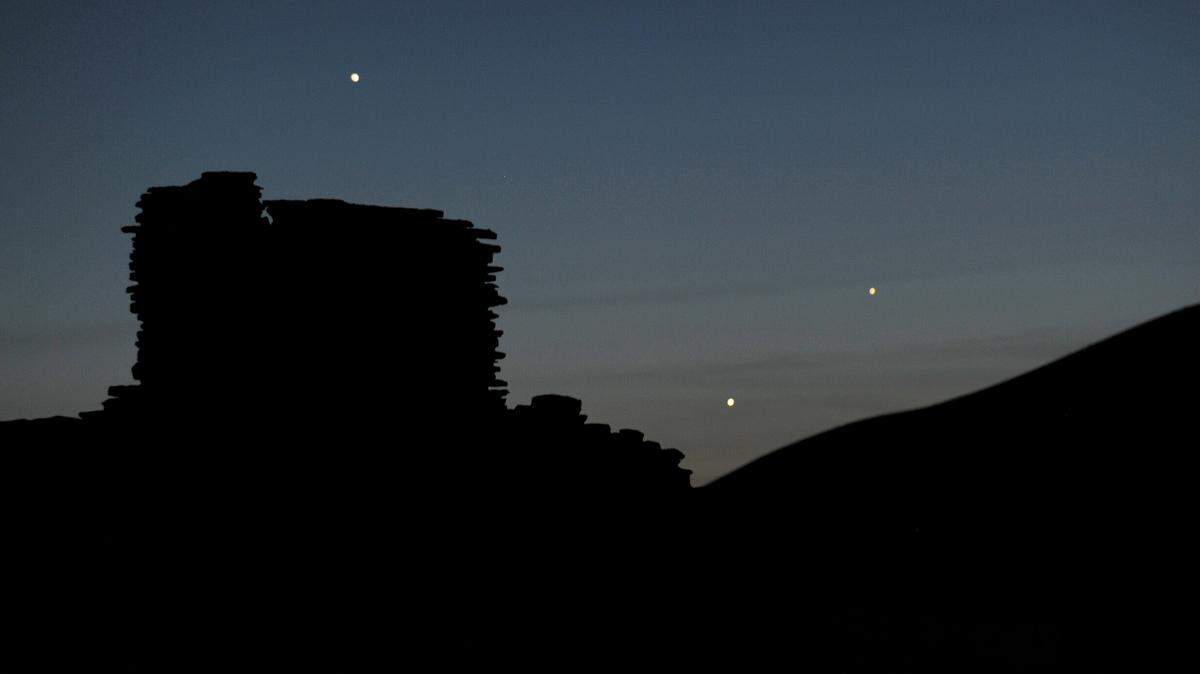
Before the much-anticipated total lunar eclipse on March 3, the night sky has another spectacle in store — though this one comes with a few caveats.
According to NASA, a so-called planetary parade is taking place throughout February. The celestial event, also known as a planetary alignment, will peak on Feb. 28, when six planets — Mercury, Venus, Neptune, Saturn, Uranus and Jupiter — will be aligned in the sky at the same time.
It sounds extraordinary, and in astronomical terms, it is. But before you rush outside expecting a dazzling show, most people will struggle to see more than a few of those planets without the right equipment and conditions.
What Is a Planetary Parade?
A planetary parade occurs when multiple planets appear to line up along a stretch of the night sky as seen from Earth.
The planets aren’t physically lining up in space, though. Their positions along their respective orbits create the visual effect of a cosmic procession — or, as some have described it, a celestial “conga line.”
All six planets will appear shortly after sunset on Feb. 28, according to NASA. But the hype is a little misleading, as seeing all six will be very difficult.
Only those with the right technology and knowledge — and a little luck — will be able to spot them all.
In practice, seeing more than three planets will present quite the challenge.
Why the Planetary Alignment Is So Hard to See
Four of the six planets — Mercury, Venus, Saturn and Neptune — are very close to the Sun, according to Space.com. That means they sit low on the horizon and are visible only briefly in bright twilight.
To have a chance at seeing the full lineup, observers will need a clear view due west, clear skies and binoculars or a telescope. Knowing where to look also helps.
“Four of those planets will be visible to the unaided eye, weather permitting, but only those with optical assistance will be able to view Uranus and Neptune (Mercury can sometimes be harder to spot, too),” writes Alyssa Lee of NASA.
A Planet-By-Planet Guide for Feb. 28
Jupiter will be the easiest planet to see, with a magnitude of –2.3. There’s a chance it’s the only one you see that day unless you have good equipment and timing.
Jupiter reached its peak visibility in January, but it will still shine brightly. By sunset on Feb. 28, it will be high in the eastern sky, higher than the Moon and close to bright stars Castor and Pollux in Gemini.
Uranus, at magnitude 5.7, may be visible with binoculars and will likely be the second-easiest planet to spot after Jupiter. It is located below the Pleiades star cluster in Taurus.
Venus and Mercury are both inferior planets, meaning they sit between Earth and the Sun. Venus, at magnitude –3.8, and Mercury, at magnitude 0.3, will both require binoculars on Feb. 28.
Mercury will be easier to see on Feb. 19 and 20, but Venus will be lower in the sky at that time, so it won’t be as visible. Feb. 28 is a compromise date where both are somewhat visible.
Saturn, at magnitude 1, will be past its best by Feb. 28. Its peak visibility was in early February, and it will be barely visible to the naked eye on that date. You’ll likely see it in a cluster with Venus and Mercury.
Saturn is moving toward solar conjunction on March 25, when it will be temporarily invisible.
Neptune is the toughest challenge. At magnitude 8, it requires a small telescope and will likely be the hardest planet to spot.
The most distant planet in the solar system, Neptune will be low on the western horizon by sunset on Feb. 28, close to Saturn.
Of course, the planets won’t be the only objects worth searching for that evening. A 92%-illuminated waxing gibbous Moon will be high in the eastern sky.
The Beehive Cluster (M44) may be visible below the Moon with binoculars, providing another treat for those who come prepared with optical equipment.
How to Give Yourself the Best Chance
Find a location with a clear, unobstructed view to the west. Buildings, trees and hills along the horizon will block your line of sight to the planets sitting lowest in the sky.
Be ready just after sunset, when the planets near the horizon will be briefly visible in the fading twilight. Bring binoculars at a minimum, and a small telescope if you hope to spot Neptune.
Clear skies are essential. Even thin clouds along the western horizon can obscure the dimmer planets, so check weather conditions before heading out.
A Rare Event — But Not the Last
February’s six-planet parade is rare, but not everyone will get to see it.
If you miss out due to weather, location or equipment limitations, there are future opportunities. For example, a five-planet parade will occur in late October 2028 and another one will happen in February 2034.
For now, the best advice is simple: step outside after sunset on Feb. 28, look west, and see what the sky reveals.
Even spotting just Jupiter blazing high overhead is a reminder of the remarkable celestial neighborhood we all share.
Production of this article included the use of AI. It was reviewed and edited by a team of content specialists.