
This 5,300-Year-Old Ancient Egyptian Tool May Be the World’s Oldest Metal Drill
Production of this article included the use of AI. It was reviewed and edited by a team of content specialists.
A tiny copper tool, barely longer than your thumb and lighter than a paperclip, has quietly rewritten the timeline of Egyptian mechanical technology. And it’s been sitting in a museum collection since the 1920s.
Researchers from Newcastle University and the Academy of Fine Arts, Vienna have identified what may be the earliest known metal drill from ancient Egypt.
The artifact dates to the Predynastic period (Naqada IID), the late 4th millennium BCE — roughly 5,300 years ago. That places its creation more than two millennia before some of the best-preserved drill sets previously documented from Egypt.
The finding, published in the peer-reviewed journal Egypt and the Levant on Jan. 23, suggests Egyptians developed advanced rotary drilling technology far earlier than anyone had assumed.
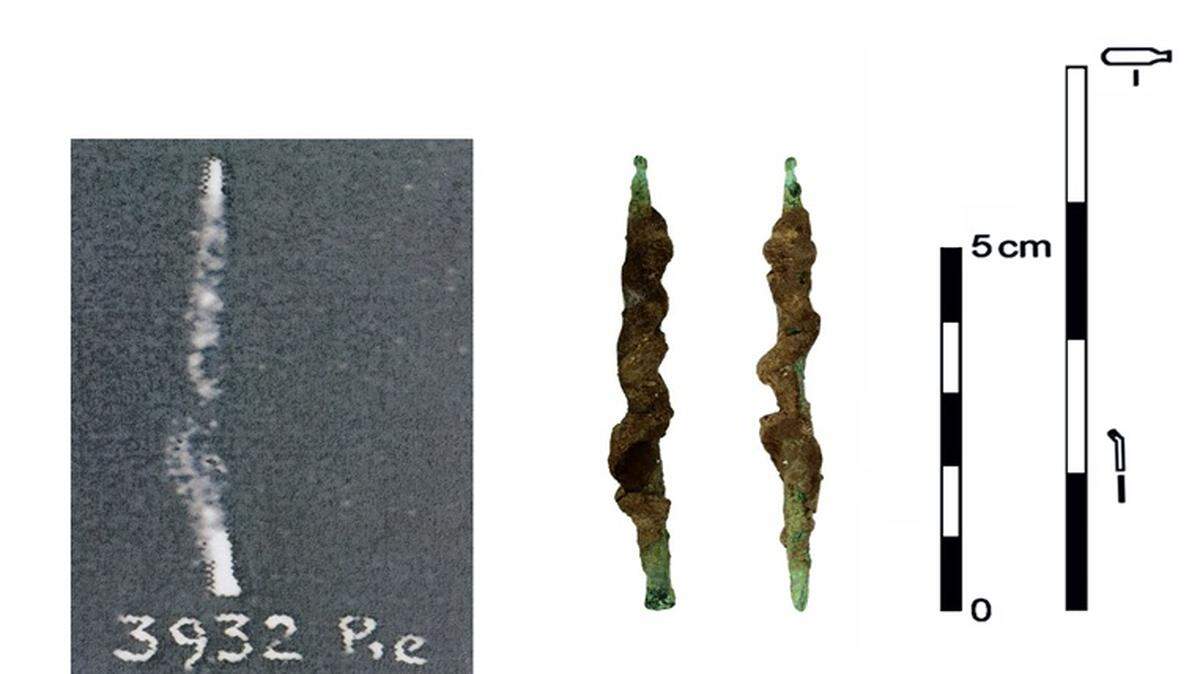
The object measures about 63 mm long and weighs roughly 1.5 grams.
When it was first documented in the 1920s, cataloguers described it simply as “a little awl of copper, with some leather thong wound round it.” That description stuck for decades. Nobody looked closer.
The new analysis tells a different story.
Using microscopic analysis and portable X-ray fluorescence (pXRF), the research team found clear physical evidence of rotary motion on the tool: fine circular wear patterns called striations, rounded edges, and curvature at the working end.
Remnants of six coils of fragile leather thong were also preserved on the shaft.
These features, taken together, point to a specific technology. The tool is now believed to be part of a bow drill.
What Is a Bow Drill?
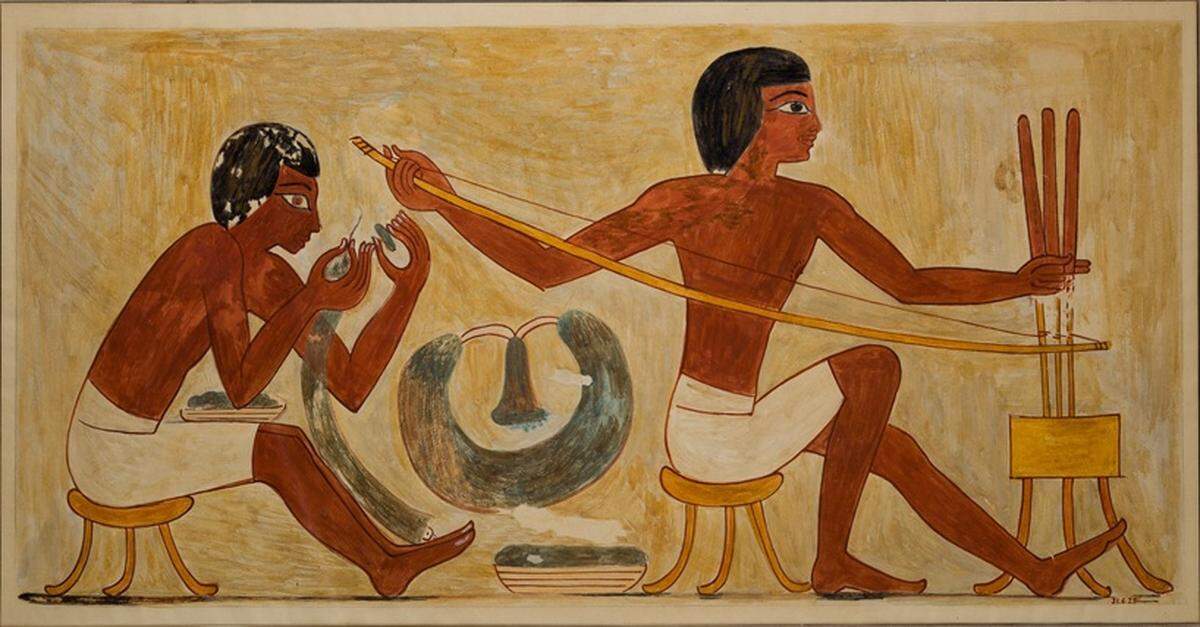
A bow drill converts a simple back-and-forth motion into rapid rotation. A bow moves a string wrapped around the drill shaft, spinning it in alternating directions.
The technique generates faster, more controlled drilling than pushing or twisting by hand — a genuine mechanical advantage that would have transformed craft production.
Bow drills were used to work wood, stone, beads and other materials. For a culture that produced elaborate jewelry, carved furniture and stonework, these ancient tools would have been foundational.
Dr. Martin Odler, Visiting Fellow in Newcastle University’s School of History, Classics and Archaeology and lead author of the study, put the discovery in context in a Feb. 9 press release.
“The ancient Egyptians are famous for stone temples, painted tombs, and dazzling jewellery, but behind those achievements lay practical, everyday technologies that rarely survive in the archaeological record. One of the most important was the drill: a tool used to pierce wood, stone, and beads, enabling everything from furniture-making to ornament production,” he said.
“This re-analysis has provided strong evidence that this object was used as a bow drill – which would have produced a faster, more controlled drilling action than simply pushing or twisting an awl-like tool by hand. This suggests that Egyptian craftspeople mastered reliable rotary drilling more than two millennia before some of the best-preserved drill sets,” he added.
The Metal Used Tells More of the Story
Chemical analysis of the drill revealed it was made from a copper alloy containing arsenic, nickel, lead and silver.
That composition would have made the tool harder and more durable than standard copper — a real functional advantage for a piece meant to bore through resistant materials.
The metal mixture raises its own set of questions.
According to the researchers, the alloy’s composition may indicate deliberate alloying techniques, access to advanced metallurgical knowledge, or possible long-distance trade networks and specialized ore sources.
At 5,300 years old, any of those explanations complicates the conventional picture of how sophisticated Predynastic Egyptian material science actually was.
Where Was the Bow Drill Found?
The artifact was originally excavated about 100 years ago from a cemetery at Badari in Upper Egypt. It came from Grave 3932, the burial of an adult man.
After its initial cataloguing, it essentially disappeared into the broader collection, its significance unrecognized for generations.
That gap between excavation and identification carries its own lesson. The research demonstrates that museum collections can still yield ancient discoveries, even from artifacts studied decades ago.
What changed wasn’t the object — it was the questions being asked and the technology available to answer them. After all, microscopic analysis and portable X-ray fluorescence simply weren’t options in the 1920s.
Why This Ancient Discovery Shifts the Timeline
The bow drill wasn’t just a passing experiment.
According to the study, it remained a core technology for nearly two thousand years after this tool was made. That longevity speaks to how well the design worked and how deeply embedded it became in Egyptian craft traditions.
Pushing the origin of reliable rotary drilling back by more than two millennia forces a reconsideration of what Predynastic Egyptians were capable of, at a time well before the pyramids or the great dynastic building projects.
The tool shows evidence of early engineering skill and material science, reinforcing that ancient Egyptian innovation extended beyond monumental architecture to practical craftsmanship and toolmaking.
If you’re drawn to stories about rediscovery and hidden-in-plain-sight breakthroughs, this one delivers.
A 1.5-gram piece of copper, overlooked for a century, just changed what we know about one of the world’s most studied ancient civilizations. The ancient Egyptian tools behind the spectacle turned out to be centuries more advanced than the existing record showed.
It’s also a reminder that the next big archaeological find might not come from a remote excavation site. It might already be sitting in a drawer, labeled and forgotten, waiting for someone to ask the right question.