Scientists Discover ‘Dragon’ Millipedes Mating on Cave Walls in Thailand — A Species New to Science
Production of this article included the use of AI. It was reviewed and edited by a team of content specialists.
Deep within the shadowy recesses of a cave in northern Thailand, researchers witnessed something remarkable: a creature that looks like it crawled straight out of a fantasy novel, moving deliberately across a damp rock wall toward a potential mate. With its jagged, spiky body segments and long, slender legs, the animal bore an uncanny resemblance to a miniature dragon.
What the scientists observed that day in 2024 would turn out to be a species completely unknown to science — a discovery that highlights just how much of our natural world remains unexplored.
A Cave Expedition Yields an Unexpected Find
The discovery unfolded during fieldwork at Pha Daeng Cave, located in Mae Hong Son Province in northwestern Thailand. A team of researchers had traveled to the region as part of a project to survey wildlife “in unexplored areas of (Thailand), especially karst” rock habitats, according to a study published Oct. 14, 2025 in the peer-reviewed journal Tropical Natural History.
Karst landscapes, characterized by limestone formations, caves, and underground drainage systems, are known to harbor unique species adapted to their specific conditions. These environments often remain understudied simply because of how difficult they are to access and survey thoroughly.
During their expedition, the researchers climbed rock formations inside the cave and made a startling observation: dozens of unfamiliar millipedes clinging to the cave walls and tucked into crevices. The creatures were partially camouflaged against the stone, but their distinctive appearance caught the trained eyes of the visiting scientists.
Meet the Princess Dragon Millipede
After careful examination, the research team confirmed they had found not just one but two new species of dragon millipede. The primary discovery was named Desmoxytes chaofa, which scientists have given the common name “princess dragon millipede.”
The species name carries special significance. According to the study, “chaofa” comes from a Thai word that “signifies a royal princess of the Thai monarchy.” The researchers chose this name to honor Her Royal Highness Princess Maha Chakri Sirindhorn of Thailand, who is “renowned for her dedication to biodiversity research and environmental conservation.”
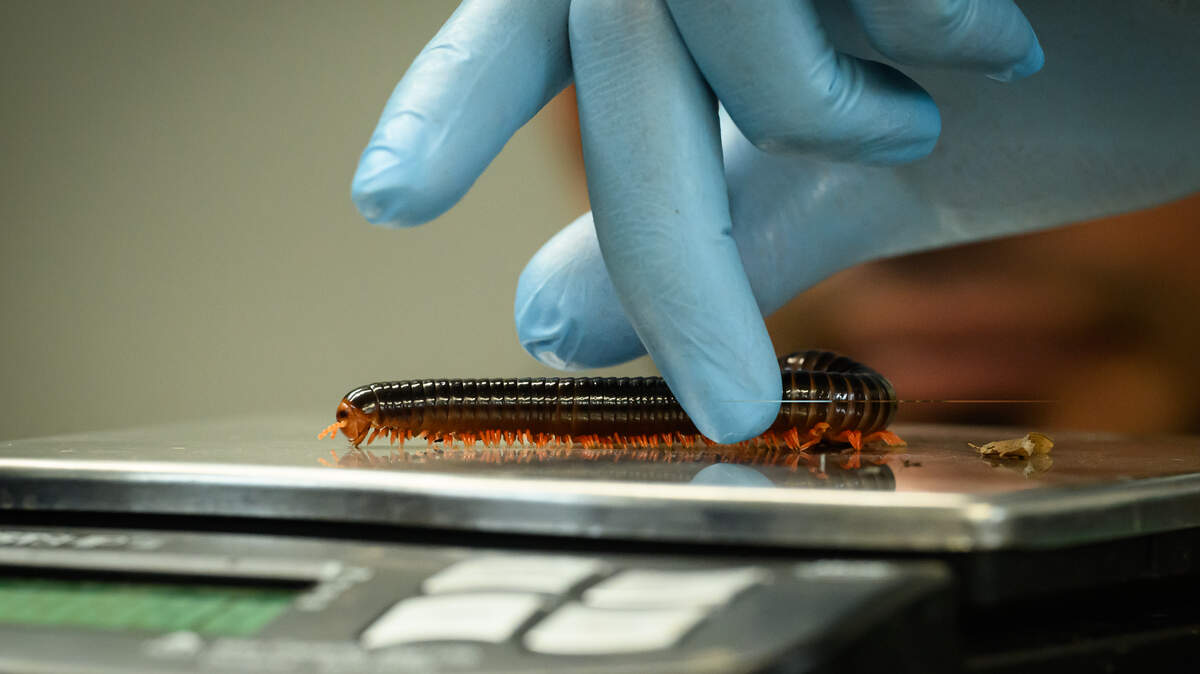
So what exactly does a princess dragon millipede look like? The creatures have about 20 body segments and can grow to just over an inch long — small enough to fit on your fingertip, yet packed with distinctive features that make them instantly recognizable to those who know what to look for.
Their antennae are described as “slender,” and their legs are “long” relative to their body size. But perhaps their most striking characteristic is their armor-like appearance: each body segment features multiple bumps and a pair of “wing-like” spike structures that give them their dragon-like look.
Photos of the species reveal a “dark brown” coloring that serves an important survival function. According to the researchers, this coloring “allows it to blend visually with the brown or black humid rocks, which may contribute to concealment in its habitat.”
Life Inside the Cave
The research team didn’t just find these millipedes sitting still — they observed them engaged in natural behaviors that provided valuable insights into their biology. Scientists watched princess dragon millipedes mating and “moving along rock walls,” according to the study.
The cave environment itself appears crucial to the species’ survival. The researchers described the habitat in detail: “The rocky surfaces in this environment are covered with moisture-retaining mosses, while small herbaceous plants emerge from the crevices, possibly contributing to the overall damp microhabitat essential for the species’ survival.”
This description paints a picture of a specialized creature that has evolved to thrive in very specific conditions — cool, damp, and dark. Such specialization often means a species has a limited range, making it potentially vulnerable to environmental changes.
How Scientists Confirmed a New Species
Discovering a new species requires more than simply finding an unfamiliar-looking animal. Scientists must demonstrate through rigorous analysis that the creature is genuinely distinct from all known species.
For the princess dragon millipede, the research team used multiple lines of evidence. The new species was identified based on its coloring, body proportions, genitalia, and other subtle physical features, according to the study. These morphological characteristics — the physical traits that can be measured and compared — provided the initial evidence that the millipedes were something new.
But the researchers went further, employing modern genetic techniques to confirm their findings. DNA analysis showed the species has at least 10% genetic divergence from related millipedes. In the world of taxonomy, this level of genetic difference provides strong support for classifying an organism as a distinct species.
A Limited Range Raises Conservation Questions
So far, princess dragon millipedes have only been found at Pha Daeng Cave and “a few nearby locations” in Mae Hong Son Province in northwestern Thailand, the study said. This extremely limited known range is both fascinating and concerning.
On one hand, it suggests that Thailand’s karst landscapes may harbor many more undiscovered species waiting to be found. On the other hand, species with such restricted ranges are often considered vulnerable because a single localized threat — whether from habitat destruction, pollution, or climate change — could potentially affect their entire population.
The study was conducted by a team of researchers including Ruttapon Srisonchai, Khanet Srikampha, Theemaporn Benchapong and Somsak Panha. Their work represents the kind of patient, detailed fieldwork that continues to expand our understanding of Earth’s biodiversity.
And the princess dragon millipede wasn’t their only find. The researchers also discovered a second new species of dragon millipede with pink legs during the same study — a reminder that even a single expedition to the right location can yield multiple discoveries.