
Scientists Discover New Dinosaur Species with Never-Before-Seen Spiny Skin
Production of this article included the use of AI. It was reviewed and edited by a team of content specialists.
For more than a century, paleontologists have pieced together the story of dinosaurs primarily from bones — the hard, mineralized structures that endure across tens of millions of years.
Soft tissue, the skin and scales that once covered these animals, almost never survives the fossilization process.
That is precisely what makes a newly described species from northeastern China so remarkable.
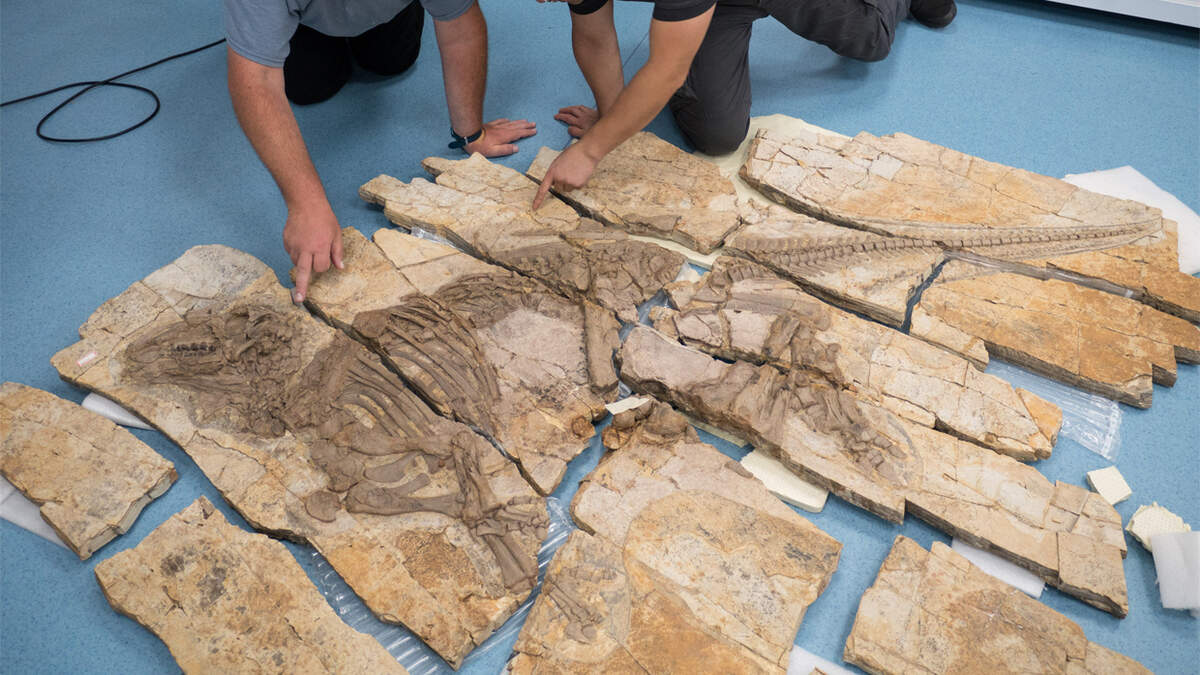
A nearly complete skeleton of a juvenile dinosaur, dating back roughly 125 million years, with fossilized skin preserved in such extraordinary detail that researchers could examine it down to the cellular level.
The specimen, formally named Haolong dongi, is not only a previously unknown species. It also bears skin structures unlike anything scientists have documented in non-avian dinosaurs.
The hollow, cylindrical spikes scattered among its scales, features have prompted researchers to rethink what they know about the diversity of dinosaur body coverings.
The discovery was published on Feb. 6 in the journal Nature Ecology & Evolution.
A Name That Honors a Giant of Chinese Paleontology
The genus name, Haolong, translates to “spiny dragon” in Chinese — a fitting description for a creature armored with an array of small and large spikes. But the species name, dongi, carries a more personal significance.
It honors Dong Zhiming, an influential Chinese dinosaur expert who died in 2024.
Naming a new species after a revered colleague is a longstanding tradition in the sciences, a way of acknowledging the foundational work upon which new discoveries are built.
In this case, the tribute links one of China’s most celebrated paleontologists to a fossil that may reshape understanding of dinosaur integument — the outer covering of their bodies.
What the Dinosaur Fossil Preserves — and Why It Matters
The dinosaur fossil was recovered from the Yixian Formation in northeastern China, a geological deposit renowned for yielding exceptionally well-preserved specimens from the Early Cretaceous period, about 125 million years ago.
Researchers uncovered a nearly complete skeleton of a juvenile dinosaur measuring about 2.4–2.45 meters (around 8 feet) long.
What sets this specimen apart is the quality of its soft tissue preservation.
The fossilized skin reveals detailed structures including small scales distributed across the body, large overlapping scales along the tail, and — most striking of all — hollow, cylindrical spikes scattered among the scales.
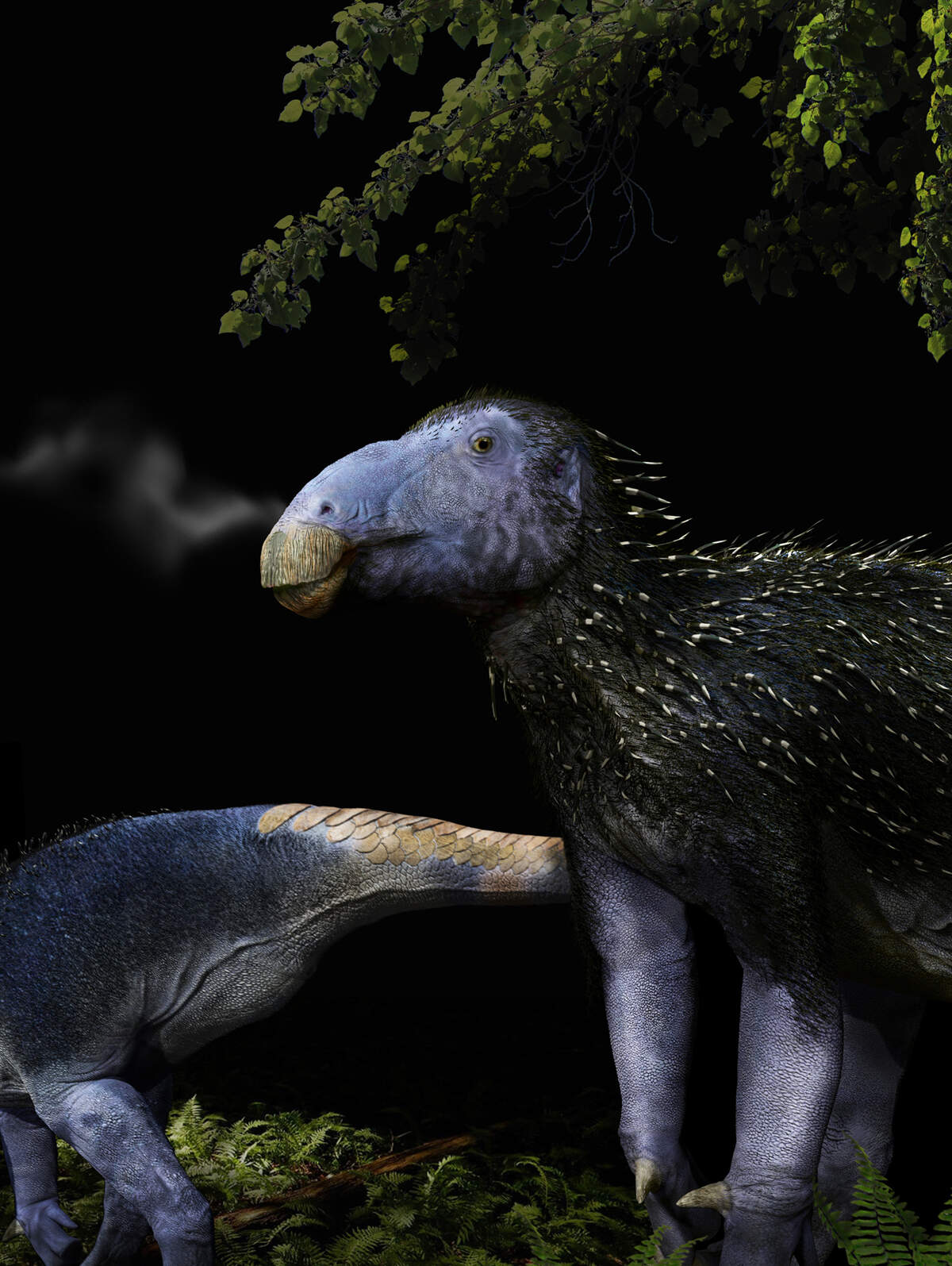
Most of the spines are very small, just 2-3 millimeters (0.08-0.12 inches), but these are mixed with longer ones. The longest preserved spike measures 44.2 millimeters (1.7 inches) long and 7.8 millimeters (0.3 inches) wide at the base.
To put that in perspective, the largest spike is roughly the length of a AAA battery, protruding from the skin of an animal about the size of an alligator.
These spikes are unlike anything previously seen in non-avian dinosaurs.
The researchers determined they were made of multi-layered, hardened skin and preserved down to the cellular level, including keratinocyte nuclei — the cells responsible for producing keratin, the same protein found in human fingernails and animal horns.
That level of cellular preservation in a 125-million-year-old fossil is extraordinarily rare and opens a window into the fine-grained biology of a long-extinct animal.
Advanced Imaging Reveals Hidden Details
To analyze the fossil at such resolution, researchers used advanced imaging and microscopic analysis techniques.
These methods allowed them to examine the internal structure of the spikes and determine that they were composed of multiple layers of hardened skin tissue. The cellular-level preservation gave the team an unprecedented look at how these structures were built, layer by layer, during the animal’s life.
The analysis yielded another significant finding: the spikes appear to have evolved independently, not related to feathers or modern reptile spines.
This distinction matters because it suggests that the evolutionary pathways leading to different types of body coverings in dinosaurs were more varied and complex than scientists had previously appreciated.
“This discovery provides unprecedented insight into the microanatomy of non-avian dinosaur skin and highlights the complexity of skin evolution in ornithischian dinosaurs,” the researchers concluded, per Sci News.
An Evolutionary Bridge Between Herbivore Lineages
Haolong dongi was a plant-eating dinosaur belonging to the iguanodontia group, an important lineage of ornithopods.
For those who follow the branching tree of dinosaur evolution, iguanodontians occupy a particularly interesting position.
Evolutionarily, iguanodontians sit between early small plant-eaters and later duck-billed dinosaurs, known as hadrosaurs — the massive, often elaborately crested herbivores that became widespread toward the end of the Age of Dinosaurs.
Understanding its lineage helps scientists trace how plant-eating dinosaurs diversified and adapted over millions of years. These dinosaurs were among the dominant herbivores during the Cretaceous period, and any new species that fills gaps in their fossil record is scientifically valuable.
A specimen with preserved skin, however, is in a category of its own. It offers direct physical evidence of features that bones alone could never reveal.
What Were the Spikes For?
This is the question that naturally follows any discovery of unusual anatomical structures, and the researchers offered several possibilities grounded in the evidence.
Scientists believe the spikes most likely served as protection against predators, functioning in a manner similar to a porcupine or hedgehog. The juvenile lived in an ecosystem with small carnivorous dinosaurs, making defensive features important for survival.
“These defences did not necessarily provide impenetrable protection against theropod teeth and claws, but they made the prey more difficult and time-consuming to kill and ingest and consequently reduced the likelihood of successful ingestion,” the authors write, per IFL Science.
Beyond defense, the researchers noted the spikes possibly served thermoregulation and possibly sensory functions — though the protective role appears to be the most strongly supported hypothesis given the ecological context.
Questions That Still Need Answers
Because the fossil is from a young individual, scientists don’t yet know if adults also had spikes. It is possible the spikes were a juvenile trait that diminished with age, or conversely, that they became even more pronounced in mature animals.
Without adult specimens, that question remains open — a reminder that even the most spectacular fossil finds leave tantalizing gaps.
What is clear, however, is the broader significance of the discovery. It provides rare insight into dinosaur skin evolution and shows that dinosaur body coverings were more diverse than previously thought.
For decades, the scientific picture of dinosaur exteriors has expanded — from scaly to feathered, from drab to possibly colorful. Haolong dongi adds another dimension entirely: a spiny, multi-layered integument that evolved along its own distinct pathway.
For anyone who has followed the steady accumulation of dinosaur discoveries over the years, this find from the Yixian Formation is a vivid reminder that the fossil record still holds surprises.
And that the ancient world was even more richly textured than we imagined.