
George Toma, legendary groundskeeper, has a wild Super Bowl story and good turf tips
George Toma has a dandelion in his backyard.
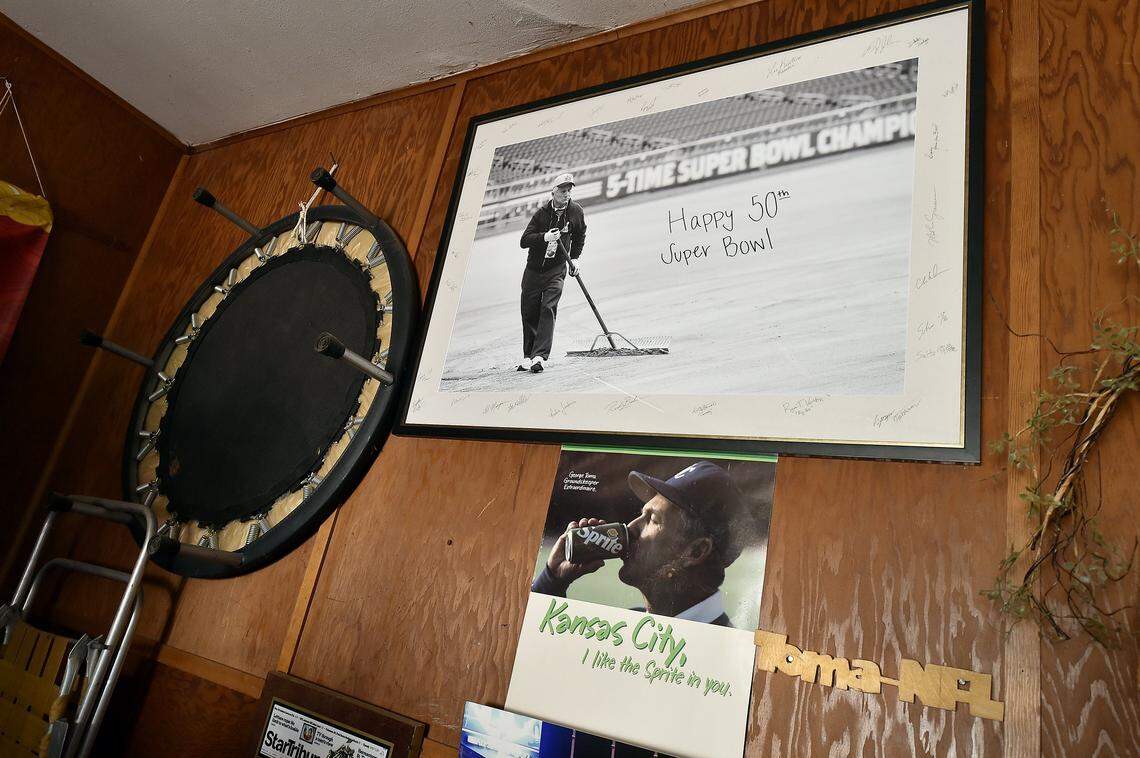
Toma, 89, the renowned groundskeeper for the Royals, Chiefs and 52 Super Bowls, eagerly showed off the fringed yellow bloom one recent afternoon, even posing for a photo with it as though it were a rare orchid or some other priceless flower.
“I keep it so I have something to strive for next year,” he said, jokingly. “A weed-free yard.”
Make no mistake: "The god of sod's" lawn is a solid emerald blanket of lushness, front to back. It's so disarmingly perfect that the street numbers on his modest ranch home seem superfluous — you know it's his lawn as soon as you round the corner onto his Westwood street, south of the Country Club Plaza.
His neighbors' yards would look fine in most other neighborhoods. But next to Toma’s, they are lackluster.
The treeless land surrounding his house has served as a testing ground over the years, having been seeded with a Heinz 57 of grass varieties.
Annual flowers have been freshly planted near the front of the house, and 16 blue buckets sitting along a fence in the backyard hold a variety of tomato plants. He has expertly crafted chicken-wire cages on the railing of his back deck to protect any resultant tomatoes from squirrels as they ripen in the sun later this summer.
We visited Toma to talk grass. But he also reminisced about Super Bowl half-time shows — the biggest bane of his existence, because they allowed him only a few hours a day of field preparation in the week leading up to the game.
There was an upside though. He's gotten to meet Paul McCartney, Bruce Springsteen and Lady Gaga.
All three were super nice and approachable, he recalls, though he was especially impressed with Lady Gaga, who didn’t have an entourage and hung out with the grounds crew between practice sessions.

The Tampa Super Bowl crisis
The most memorable of those jobs, though, was the 1991 Super Bowl when rehearsals left a huge indentation in the middle of the field at Tampa Stadium 24 hours before the big game, right where he was supposed to have the giant logo painted.
“It was bare dirt. Bare dirt!” he practically shouts. “I couldn’t paint the NFL logo there because it was painting dirt and nothing would be left. So I told them we were going to sod it. And they said 'It’s 6 o' clock. Where are you going to get 1,000 square feet of sod?' I said don’t worry about it. We’ll get it done.”
He immediately called his crew over and told some of them to remove a thousand square feet of soil, three inches deep at the center of the field. Any shallower and the players would tear it up with their cleats, he says. Then he ordered the rest of the crew to follow him to the soccer field at University of Tampa.
“I knew the groundskeeper,” Toma says. “We got over there and the crew member for Tampa Bay stadium says, 'The gate’s locked!' I said 'I know it’s locked. Crash it! Go right in there! Break it open!' So he crashed the gate, and we took a 1,000 square feet of grass along the fence all the way around the field.”
They shipped the 1,000 foot-square, three-inch-thick pieces to Tampa Stadium as fast as they could dig it up, he says, and by 2 a.m., the field was ready for game day, logo and all.
"I should have been jailed," he says, noting that the University of Tampa was paid handsomely for its broken gate and missing grass.
Toma's turf tips
Here's what Toma has to offer in the way of turf tips for the average homeowner.
First, anyone with a sparse lawn and lots of weeds should think twice about sowing seed right now.
“Your best bet is to get rid of the weeds, live through the summer with (an ugly lawn) and start in August by aerifying, verticutting, slicing and seeding to be sure you get good soil to seed contact,” he says. “You’ll have a good lawn next year."
He recommends bluegrass seed for sunny areas and spreading 8 pounds to 10 pounds per 1,000 square feet of land.
“For shade you want a fescue,” he said. “Chewing and creeping fescues are the best shade grasses going and some will make it in the drought. Chewing fescue looks like needles. It’s fine-bladed,” he said. “There are also good rye grasses that are shade tolerant, so a combination of the chewing fescue with rye and blue grasses will give you a good lawn.”
After seeding, he said, make sure to immediately flood the yard with water, then keep it moist but not saturated for several days until it germinates.
“The same goes for sod,” he says. “Flood it then keep it moist but not saturated. If it’s getting a dark color or wilted, that’s when it’s time to water. I like to water in the morning and stay away from watering after 6 at night because it goes into the night wet and opens a chance for disease.”
If you’ve got a decent, established lawn that you want to build on, Toma suggests fertilizing three times a year: In May, September and November.
“For lawns with weeds, use a fertilizer with weed control and overseed,” he says. “But aerify it first. Aerating is a must, particularly for high-traffic areas.
“For dog runs or areas where children play, if you aerify the heck out of it and get the seed in the holes, it will come up and they won’t knock it out,” he says.
This story was originally published May 17, 2018 at 12:18 PM with the headline "George Toma, legendary groundskeeper, has a wild Super Bowl story and good turf tips."