
‘There’s been a lot of talk’: Kansas, Missouri Republicans sidestep Trump and COVID
When the Kansas Republican Party’s “Keep Kansas Great” bus rolled into leafy VFW Park in Tonganoxie on Wednesday, U.S. Senate nominee Roger Marshall and other candidates piled out to deliver red meat to the few dozen party faithful gathered under an unseasonably scorching October sun.
The candidates and their surrogates condemned socialism, vowed to uphold freedom and applauded the police. What they had almost nothing to say about was President Donald Trump’s COVID -19 diagnosis and hospital stay.
The only member of the traveling party to acknowledge the events that have upended the 2020 campaign and turned the west wing of the White House into a COVID cluster was Mary Jean Eisenhower, granddaughter of the Kansas Republican icon, President Dwight Eisenhower.
“There’s been a lot of talk with the president’s COVID-positive test,” she said.
And that was that.
Since he tested positive, Trump has told Americans not to be afraid of the virus that has killed 212,000 people. He abruptly shut down negotiations on a new virus relief package and then urged its passage. He pulled out of next week’s scheduled debate with former vice president Joe Biden, citing objections to the virtual format. The New York Times reported Friday that Trump planned to host up to 2,000 people for a rally on the South Lawn of the White House Saturday, his first in-person event since testing positive.
Forced to confront the reality of the president falling ill from the same virus he has repeatedly dismissed, Republicans in Kansas and Missouri are trying to walk a tightrope with voters. Some candidates and surrogates are carefully distancing themselves from the president’s rhetoric, while avoiding any direct criticism. Others continue in lockstep.
Firmly in the lockstep is Marshall, who continues to take hydroxychloroquine, the anti-malaria drug that the president earlier this year touted as a COVID-19 treatment.
Marshall said Wednesday that Trump’s diagnosis doesn’t change his race against Democrat Barbara Bollier, the state senator from Mission Hills. He told voters in Tonganoxie “we’re winning this war, we’re turning the corner” in the fight against the virus.
“I can see the light at the end of the tunnel,” he said.
The comments echo assurances by Trump, who said last month the United States was “rounding the corner”— an assertion disputed by Anthony Fauci, director of the National Institute of Allergy and Infectious Diseases.
State Rep. Willie Dove, a Republican candidate for the Kansas Senate who tested positive last month after becoming exhausted from campaigning, borrowed another line from Trump.
The same age as the president (74), Dove said he recovered after putting himself on a regimen of vitamins and copious amounts of orange and grapefruit juice.
“Actually, I feel better than what I did before I got sick,” Dove said Wednesday, two days after the president tweeted, “I feel better than I did 20 years ago!”
Trump, who returned to the White House on Monday, appears to be recovering. Medical experts, however, warn the course of the disease is unpredictable and those on the mend can quickly reverse course.
For the moment, some conservatives argue the president’s illness may actually help Republicans.
“I think it humanizes the president even more. I mean, it’s an insidious virus even when everyone around you gets tested, it can still affect people,” said Matt Schlapp, a Wichita native and chair of the American Conservative Union, who joined the bus tour through northeast Kansas Wednesday.
Schlapp attended the Sept. 26 Rose Garden event where Trump introduced Supreme Court nominee Amy Coney Barrett. At least 34 White House staff have tested positive for the virus, according to The Washington Post, though it’s not clear how many were infected at the Rose Garden ceremony. Schlapp said he and his wife, Mercedes, a Trump campaign adviser who was also at the White House event, have both tested negative multiple times.
If anything, Schlapp said, Democrats risk a boomerang effect if they attempt to turn Trump’s diagnosis into a political advantage. But polling shows Americans are very concerned with the virus and don’t like the president’s handling of the pandemic.
More than 56 percent of Americans disapprove of Trump’s response to the virus and just under 41 percent approve, according to a polling average from FiveThirtyEight. Over 65 percent are very or somewhat concerned that they, or someone they know, will become infected.
FiveThirtyEight’s average also shows that views of Trump’s response differ sharply by party. More than 80 percent of Republicans approve of his pandemic leadership, while just 8 percent of Democrats give the president good marks.
Roland Hirsch, an 80-year-old Olathe resident who turned out to watch Marshall and other candidates on the bus tour, said Trump’s bout with the virus hasn’t changed his view of him.
“The Trump administration has done an excellent job,” he said.
Hirsch said a vaccine is expected to be ready faster than some early predictions. Trump last week promised a vaccine “momentarily,” but health experts don’t expect one to become widely available to the public until well into next year. U.S. authorities have yet to approve a vaccine for public use.
Trump brings virus to ‘forefront’
Interviews and statements from 20 candidates, elected officials, voters and political strategists across Kansas and Missouri last week reveal a broad — but not universal — belief that Trump’s COVID-19 diagnosis and aftermath will affect races up and down the ballot by focusing voter attention on the pandemic in the final weeks before Election Day.
“It brings back to the forefront the COVID thing. People are thinking Biden is going to do a better job than Trump does with COVID, which I don’t think is true,” said Kansas state Rep. Jim Karleskint, a Tonganoxie Republican who lost his primary in August.
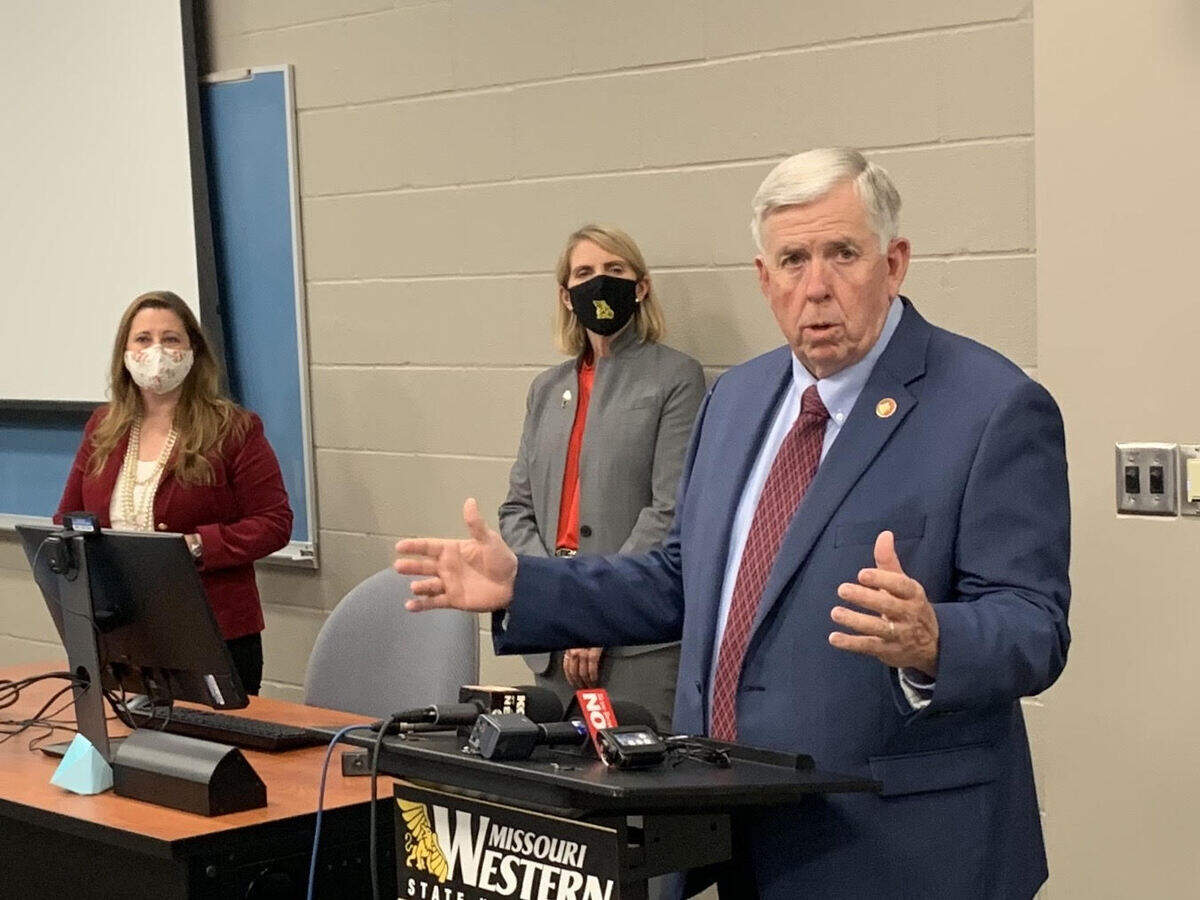
In Missouri, Gov. Mike Parson, who is on the November ballot, put some distance between himself and Trump last week after the president urged Americans not to be afraid of the virus. Parson, who routinely pleads ignorance when asked for a reaction to the latest Trump controversy, acknowledged the seriousness of the virus while steering clear of direct criticism.
“I don’t know what the president’s opinion are but I’m telling you what mine is as the governor of Missouri and I’m concerned about it everyday and what it does to the people of this state,” Parson said, though he gave no sign he is reconsidering his opposition to a statewide mask order.
The virus continues to sweep through Kansas and Missouri. Both states have broken COVID-19 hospitalization records in recent days. The combined death toll for both states stands at nearly 3,000.
Steve Edwards, president and CEO of Springfield-based CoxHealth, said Thursday the hospital began the day with 91 COVID-19 patients, a “high water mark” that likely represented the highest number of virus hospitalizations in the state.
Edwards said CoxHealth is developing three overflow sites in Springfield.
“We are prepared to triage a high volume of respiratory virus patients as we expect the complicated convergance of flu, respiratory and COVID this fall,” Edwards said on Twitter.
Parson’s comments came after he emerged from isolation last weekend following his own COVID-19 positive test. The 65-year-old has said he felt fine throughout his isolation, though first lady Teresa Parson, who also tested positive, had mild symptoms.
Trump’s relatively low approval ratings are providing space for Republicans to distance themselves from the president, said Robynn Kuhlmann, a professor of American politics at the University of Central Missouri.
“Presidential approval ratings are indeed highly tied to down ballot votes, so if they’re low that gives them a lot more wiggle room to kind of retract back any messaging from the president that they don’t want to be tied to,” Kuhlmann said.
Parson is battling Democrat Nicole Galloway, the state auditor, for a full term as governor after taking office in 2018. Public polls have shown Parson holding an advantage in the race, though a poll released by Galloway’s campaign last week showed the Democrat only narrowly trailing the governor.
Missouri state Sen. Dan Hegeman, a Republican who represents northwest Missouri, said he doesn’t expect Trump’s diagnosis to change how Missourians view the virus.
“They’ve had friends and neighbors come down with it. People take reasonable precautions and try to protect themselves,” he said.
Trump stops virus aid talks
While Trump has been recovering from the virus, the chaos surrounding negotiations on additional coronavirus aid are torturing vulnerable Republicans.
House Democratic leadership and the White House have been locked in a stalemate for weeks over trillions in proposed aid to help states, cities. industries and workers grappling with financial damage caused by the pandemic.
Trump on Tuesday backed out of negotiations, only for the White House to reverse course later in the week after Trump faced a wave of criticism for breaking off talks.
The Democratic-controlled House passed a $3 trillion relief bill in May. They passed a similar $2.2 trillion proposal this month. The GOP-controlled Senate has been unable to pass any counterproposal.
Marshall voted against the $2.2 trillion bill and missed a vote on the earlier $3 trillion proposal.
“By offering no real solutions of his own except more delays on much-needed aid, it’s clear that Roger Marshall supports the partisan gridlock that has long infected Congress,” Bollier spokeswoman Alexandra De Luca said in a statement.
Marshall had said in early September that he had expected to pass a relief package before October. On Wednesday, he told reporters that Trump’s moves are “the art of the deal.”
“I can assure you this, that we’re going to do what’s best for America and the Democrats walked away from legislation that we thought was great,” Marshall said.
While talks have resumed, there’s no guarantee an agreement will be reached before the election and waiting could do irreparable damage to Republicans in swing districts.
Republican Rep. Ann Wagner, in a toss-up race against Democrat Jill Schupp in Missouri’s 2nd congressional district, said Thursday that she is committed to “show up to vote at any hour” on a bipartisan bill, a sign of the urgency for Wagner who represents the St. Louis suburbs.
Democrats were already favored to hold the House this year. Trump’s moves are likely making that task easier.
“This was his chance to try to take credit for getting help out to the public,” Rep. Emanuel Cleaver, a Missouri Democrat, said Wednesday after Trump’s initial decision to break off the talks. “That’s going to continue to haunt him and the Republican Party. I think this was a very, very big mistake.”
The Star’s Katie Bernard contributed reporting
This story was originally published October 10, 2020 at 5:00 AM with the headline "‘There’s been a lot of talk’: Kansas, Missouri Republicans sidestep Trump and COVID."