
Only one cop show is run by a Black person, a Kansas Citian with a vision for change
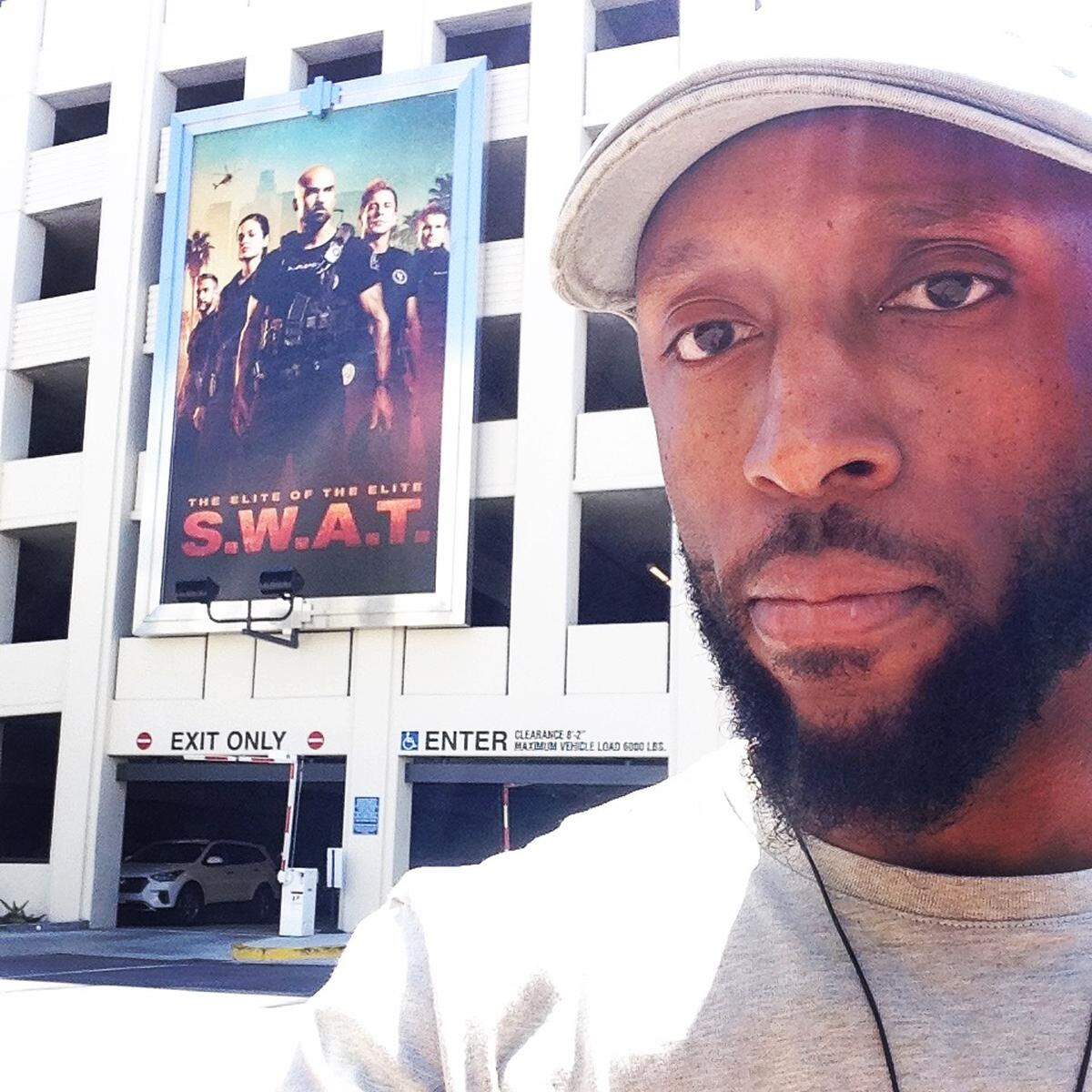
At the end of every episode of the CBS police drama “S.W.A.T.,” the logo for Aaron Rahsaan Thomas’ production company appears. It features a Kansas license plate with the letters WY in the upper left corner, for Wyandotte County.
“The reason why I use that license plate is because driving around as a young Black man in high school, WY was a signifier of what area of the city I was from, which is mostly African American or Hispanic,” says Thomas, creator and executive producer of the series.
“I got pulled over more than a few times in high school, mainly because of that plate and me being a Black kid. Fortunately for me, nothing happened to the point where I was ever in the position George Floyd was in. But what I can tell you is that growing up, I felt a very tangible feeling that my family’s greatest fear was me being in the wrong place at the wrong time.”
As the lone Black showrunner in charge of a network cop series, Thomas is in a unique position that straddles two seemingly conflicting standpoints. How can you support social justice within the Black community and support the police?
The KCK native addressed that issue with a message he and his fellow “S.W.A.T.” writers tweeted last week, saying they’ve explored those two worlds through the eyes of their character Daniel “Hondo” Harrelson, a Black cop.
“We have continued to tell stories that have explored themes of race and policing in minority communities. We also asked questions about what is required to build trust and bridge these two worlds. We are watching recent events in horror and sadness along with everyone else and will continue to mine the truth about these issues in the writing of our upcoming season as we all work towards a fairer, better system.”
The wave of protests after Floyd’s death has already changed television: Two popular police reality shows, the Paramount Network’s “Cops” and A&E’s “Live PD,” are now canceled. And critics question the long legacy of shows glorifying cops.
But “S.W.A.T.” is cut from a far different cloth.
Reflecting the real world
Thomas originally pitched the show as one where the lead character understood both sides of the Black Lives Matter and Blue Lives Matter debate. But Thomas, who has written or produced such hits as “Friday Night Lights,” “Sleepy Hollow,” “CSI: NY” and “The Get Down,” was somewhat surprised it was CBS that greenlighted the series, a network with a reputation of appealing to older, more conservative viewers.
“In the beginning, I had my questions as to just how far we’d be able to go into our subject matter and how deep into issues that are considered a little more controversial. But CBS has been a great partner creatively,” Thomas says.
Now he actively embraces the network’s audience.
“I look at it as a tremendous opportunity to reach viewers who honestly may not know very many people like Hondo or those from his background … meaning Black people. And to reach an audience, too, who may not fully understand the perspective of a cop,” says Thomas, a graduate of Pembroke Hill School, who earned an English literature degree from the University of Kansas and a master’s from the University of Southern California School of Cinematic Arts.
“That to me is a way to engage in a new conversation. At times, I’ve looked at friends of mine who work on cable shows, and it’s a different audience. But I also think there may be an element of preaching to the choir with certain topics.”
With “S.W.A.T.” renewed for a fourth season, Thomas is looking forward to dealing with a nation grappling with the coronavirus and the aftermath of George Floyd’s death.
“Even though we’re not a ripped-from-the-headlines show, we reflect as much as possible the real world we live in,” he says. “It’s a parallel universe in that we’re able to take certain liberties with things. But both of these are such life-altering situations that have challenged the public in different ways. Our show was built to address these things, and it will provide some really interesting, compelling storylines.”
“S.W.A.T.” may have a stronger perspective on how to incorporate such plots into the program. It is literally the only police drama helmed by a Black showrunner (an industry term for the producer who is ultimately in charge of overseeing both the creative direction and day-to-day demands of a series).
“Not only are there zero others right now, I think in the history of television as a medium, you can count them on one hand — and you probably wouldn’t fill up that one hand,” he says.
Interestingly, he used to work for one of the few other Black showrunners: Pam Veasay of “CSI: NY.”
“Being Black and a woman, her path and obstacles were probably quite a bit different than mine,” he says. “Pam also came from a different way of looking at things — more from the point of view of ‘let the work speak for you.’”
Keeping it personal
Conversely, Thomas refuted the concept of Black writers being forced to embrace “emotional neutrality” in a recent essay for Vanity Fair. His assertion is that detachment should not necessarily be the goal of good writing.
“The intention is to be able to address storylines in a ‘professional way’ and not let emotions take over the logic or the structure,” he explains. “It’s like the saying, ‘It’s not personal, it’s business.’ But the dirty little secret is that it’s always personal,” he says. “Everything is personal when it comes to human beings. And writing is deeply personal.”
An example Thomas cites is the pilot episode. In it, Hondo (played by Shemar Moore) is promoted into a leadership role after a white officer accidentally shoots an unarmed Black teen.
“From the beginning, it set the tone of this as a cop show not afraid to delve into difficult territory,” he says.
An episode in Season 2, about a school shooting, focused on ways to recognize early warning signs to prevent tragedy. This past season featured a potent storyline about the stigma of suicide among police officers.
“Our show has been good at trying to convey not only the things police officers can improve on but also the challenges of what it is to be one,” he says.
A few law enforcement shows have done it right, he says: “Homicide: Life on the Street,” “The Wire” and “The Shield” (created by fellow “S.W.A.T.” co-creator Shawn Ryan).
“But I think a lot of cops will say the most realistic is ‘Barney Miller’ because of the paperwork,” he says. “No one ever wants to deal with the paperwork, and it caught some of the banal responsibilities of actually being in an office in a precinct and having to do the necessary chores that come with being a police officer, which is, from my understanding, a vast majority of the job.”
Could he ever be a cop?
“As a young kid, I considered it,” he says.
“The thing that swayed me away from it was I saw the movie ‘Robocop.’ Within the first 10 minutes, Officer Murphy gets blown to bits, and I felt like, ‘That’s a very dangerous job. I’m not sure that’s what I want to do.’”
Thomas admits he holds a lot of respect for individuals who do that job, and a part of him lives vicariously through it because he finds the idea of helping people so appealing.
He says, “That’s a noble goal to have. At the same time, I recognize it comes along with a lot of challenges — not just out in the field but also how you conduct yourself and deal with the elements around you that are sometimes great and sometimes not so great. If you’re judged by the ones who are not so great, how is that something you reconcile?”
Jon Niccum is a filmmaker, freelance writer and author of “The Worst Gig: From Psycho Fans to Stage Riots, Famous Musicians Tell All.”
This story was originally published June 16, 2020 at 5:00 AM with the headline "Only one cop show is run by a Black person, a Kansas Citian with a vision for change."