
Epic battle will come to life in Kansas City Repertory Theatre’s ‘An Iliad’
Nobody knows exactly how old it is.
Nobody is sure who wrote it.
Nobody can say for certain that the war it describes ever happened.
But the fact remains that a single poem emerged from the haze of antiquity roughly 2,800 years ago and became one of the foundational literary works of Western civilization.
Homer’s “The Iliad,” which depicts several weeks in the 10th and final year of the Trojan War, has inspired painters, sculptors, writers, poets, playwrights and filmmakers for hundreds of years. It depicted a world in which gods and mortals occupied the same reality. Sometimes the gods intervened in human affairs to alter the course of events. And it celebrated heroism while laying bare the brutality of war.
Who was Homer? Nobody knows. Some scholars think he never existed. Some believe there were many contributors to “The Iliad.”
The epic poem, which runs 15,693 lines, contains images of violence that seem as valid and disturbing now as they may have in 750 B.C., the year generally used to date the beginning of “The Iliad” as a literary work — the evolution, scholars believe, of an oral poem that had existed in different forms for centuries.
For the next few weeks, theatergoers will have an opportunity to experience the work condensed into a 100-minute, one-act, one-actor show.
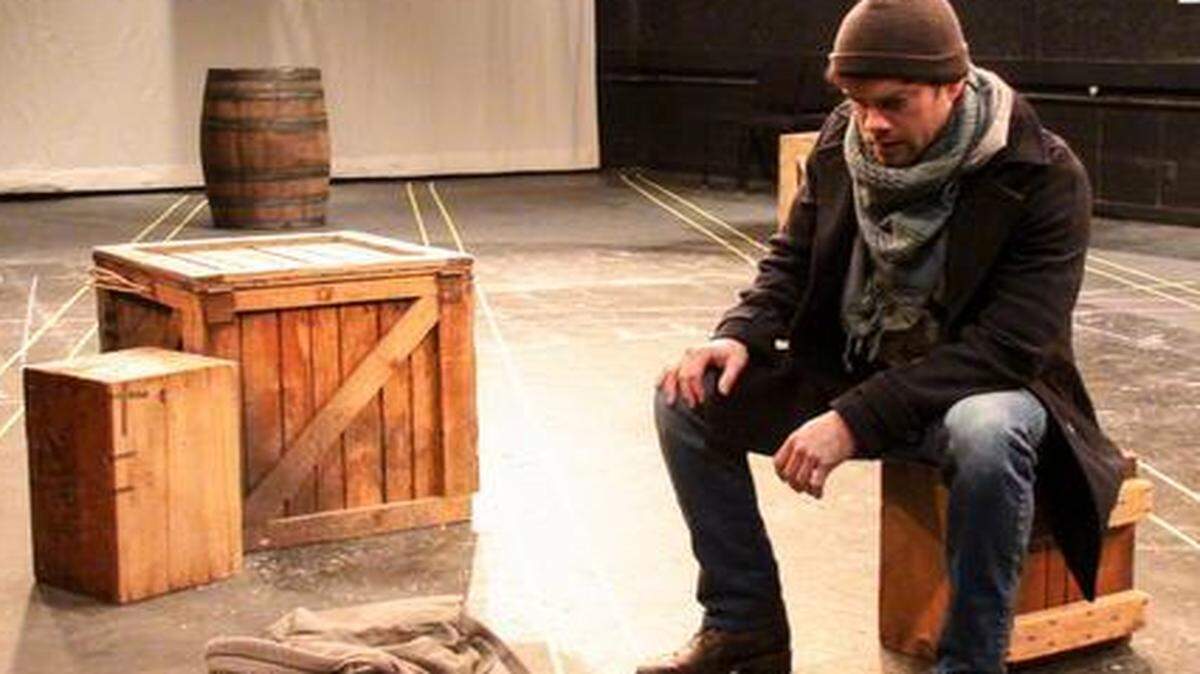
“An Iliad,” as it’s called, will feature Kyle Hatley, resident director at the Kansas City Repertory Theatre, as the Poet — a narrator, bard and chorus who guides us through the feud between Achilles and Agamemnon and the resulting fallout.
“An Iliad” was written by Denis O’Hare and Lisa Peterson over a period of years. Ultimately O’Hare performed the piece in repertory with actor Stephen Spinella in 2011 at the New York Theatre Workshop. O’Hare continues to perform the piece, but never as an extended run.
“Part of my reason for doing it that way is a vocal issue,” O’Hare said in a recent telephone interview. “I don’t trust my voice to do this eight times a week.”
O’Hare won a Tony Award for his performance in the 2003 Broadway production of “Take Me Out” and is familiar to TV viewers for his recurring roles in “True Blood” and “American Horror Story.” The “Iliad” project began in 2005, when director Lisa Peterson asked if he’d read the poem.
“And I said, ‘Actually, no.’”
O’Hare had read “The Odyssey,” Homer’s second epic poem. Peterson asked him if he’d like to work with her and figure out a way to perform a stage version of “The Iliad.”
“At that point we were two years into the wars in Iraq and Afghanistan, and Lisa felt like, ‘Why aren’t we talking about this? Where are the theatrical reflections of what we’re doing?’” he said. “She was thinking ‘The Iliad’ is a book that talks about war. And she knew I had very strong opinions on war.
“So we just kind of started and met when we could, with no official sponsor. We begged, borrowed and stole space to work … and we kind of groped our way forward for the next seven years.”
In the summer of 2009, O’Hare and Peterson traveled to the Sundance Institute in Utah to continue developing the work. Also in attendance was Eric Rosen, the Rep’s artistic director. Rosen said he vividly recalls sitting in a room and being riveted as O’Hare read an early version of the work.
“It was astonishing,” Rosen said. “Incredibly powerful. I remember my blood was racing and my heart was beating just like they would in an action movie. It was most horrifying. Most uplifting.”
A few years later Rosen was approached by two artists on his staff: Jerry Genochio, the Rep’s producing director, and Hatley. They wanted to do the show. Genochio would direct and Hatley would perform.
Hatley, a gifted actor who also directs and writes plays, seems a natural fit for “An Iliad.” His own plays, including “The Death of Cupid,” have explored the world of Greek and Roman mythology. To Rosen, it seemed like a no-brainer, and he green-lighted the show.
Rosen sees the show as one of the most primal forms of theater.
“It’s the simplest form we have, that of people huddled around a fire listening to a story,” he said.
O’Hare said he and Peterson considered several translations before settling on the version published by Robert Fagles in 1990. The language, O’Hare said, was very clear, and Fagles sometimes mixes in casual figures of speech, which they liked.
Those who have never read “The Iliad” or have read only an abridged version may be unprepared for the poem’s explicit descriptions of battlefield violence. O’Hare said he and Peterson were inspired in part by British poet Christopher Logue’s book “All Day Permanent Red: The First Battle Scenes of Homer’s Iliad Rewritten.” The idea, he said, was to make the combat as vivid as possible.
Homer’s descriptions — of spearheads splitting skulls, eyes popping from their sockets, blood streaming from nostrils — have proven to be a bit much for some audience members. When O’Hare performed it in New Orleans, a group of five 10-year-olds reacted to a particularly grisly line.
“All of them in unison went, ‘Eeww,’” he recalled. At another performance a woman told him the fighting was so graphic that she had to close her eyes, even though there was nothing to see except an actor at center stage.
O’Hare was born in Kansas City and spent the first two years of his life in the Red Bridge area. His parents moved to Detroit, but he frequently returned on family vacations. He plans to be here Friday — the show’s official opening — and will also attend a couple of enormous family get-togethers.
O’Hare and Peterson have other works planned, plays that tackle other major pieces of literature. Their next project, he said, will be a piece on the fall of Rome, using Virgil’s “The Aeneid” as a point of departure. That piece will have a woman narrator.
“We can imagine an evening where we would do ‘An Iliad’ first and then do what we call ‘The Song of Rome,’” he said.
They also want to do a piece called “The Good Book” that looks at how the Bible was written, edited and translated and came to be what it is.
“It’s the story of the evolution of the document we call the Bible,” he said. “We chart the rise of the ideas of the Bible, the beginning of writing, the process of writing, the phenomenon of Jesus.”
If you think you see a pattern there, you’re right. Don’t be surprised if in the coming years you see plays by O’Hare and Peterson based on “Paradise Lost,” “Dante’s Inferno” or “The Epic of Gilgamesh.”
“We joke about it,” he said. “We have a little theater group we formed called Homer’s Coat. We deal with foundational literature. And these are foundational literature.”
To reach Robert Trussell, call 816-234-4765 or send email to rtrussell@kcstar.com.
Onstage
“An Iliad” runs through Feb. 15 at the Spencer Theatre at the James C. Olson Performing Arts Center, 4949 Cherry St. For more information, call 816-235-2700 or go to KCRep.org.
This story was originally published January 24, 2015 at 6:00 AM.