
Guest conductor Bramwell Tovey joins the Kansas City Symphony for an otherworldly program
The weather has been a little too frosty to go outside and enjoy the Leonid meteor shower that lights up the night sky every November.
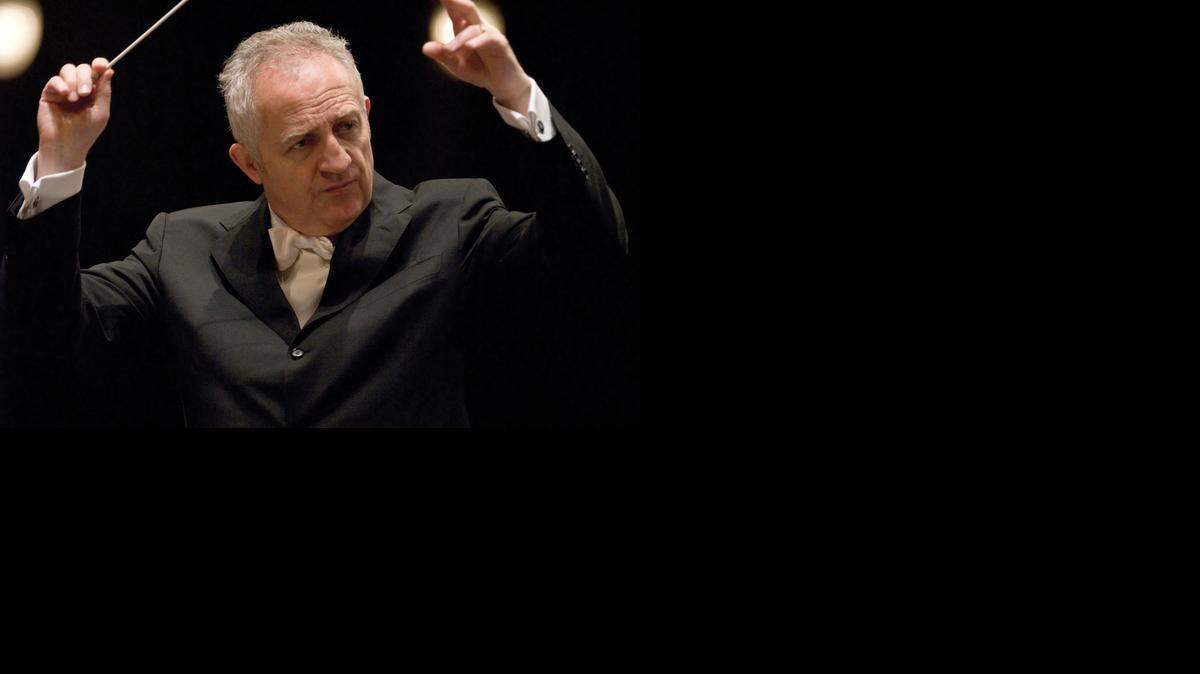
But the Kansas City Symphony under guest conductor Bramwell Tovey will take you on a tour of the solar system in the warmth of Helzberg Hall with a program titled “The Planets and the Moon,” beginning Friday.
Tovey, the music director of the Vancouver Symphony Orchestra, will begin the concert with “Clair de Lune” by Claude Debussy, arguably the French impressionist’s most popular work. Inspired by a poem by Paul Verlaine, Debussy’s moonlit miniature masterpiece was originally written for piano, but lends itself well to the full orchestral treatment.
Pianist Orion Weiss, blessed with a starry first name, will then join the orchestra for Wolfgang Amadeus Mozart’s Piano Concerto No. 23, which Weiss describes as “celestial.”
“It sounds not of this Earth, this concerto,” Weiss said. “Every Mozart concerto I play, I keep thinking, ‘Oh this is the best one, this is the greatest one,’ but there’s something very special about this piece. It’s heartbreakingly beautiful all the way through. You can’t imagine it was conceived on Earth by a human. It’s pretty magical.”
The 33-year-old Weiss has a remarkable resume. Born in Iowa, he grew up in Cleveland, Ohio. While only a teenager, he studied piano at the Cleveland Institute of Music and eventually made his way to the Juilliard School, where his mentor was Emanuel Ax.
When he was 18, he made his debut with the Cleveland Orchestra. Since then, he’s performed with great orchestras around the world and has captivated the critics.
Throughout his career, Weiss has performed music by all of the great composers, but he still holds special affection for Mozart.
“You can’t say who is the greatest composer who ever lived, but no one would argue if you said Mozart was,” Weiss said. “I do play a lot of Mozart, and it’s so rewarding. It’s so fun to play his piano concertos because they’re just some of the greatest pieces ever written. They show his pure genius. They have wonderful surprises and beautiful writing for all the instruments, not just the piano.”
It’s often said that if you want to understand the essence of Mozart, you need to listen to his operas and to his piano concertos. Weiss believes that Mozart’s piano concertos have many of the same qualities that make his operas so great.
“The concertos have this constant narrative,” Weiss said. “You can definitely hear the concertos as tellings of stories with the same kind of high passion as the operas. I try to make the piano sound as much like a voice as possible. And the voices of the other instruments make the concerto like a full operatic cast. Like his operas, Mozart’s piano concertos are little slices of perfection.”
The second half of the concert will be devoted to “The Planets” by English composer Gustav Holst. Written between 1914 and 1916, it fits perfectly into the Kansas City Symphony’s World War I theme this year. “The Planets” is definitely part of the romantic tradition, but the influence of modernist composers like Igor Stravinsky and Arnold Schoenberg also can be heard.
Contrary to popular belief, “The Planets” was not inspired by astronomy but rather astrology. Holst had a strong mystical streak, studying Sanskrit and Hindu philosophy, as well as Christian gnosticism. He was also drawn to astrology, and based each movement of his tone poem on the astrological attributes of the planets.
Holst’s mysticism can especially be heard in the final movement, “Neptune,” when a wordless chorus sung by women’s voices fades into the ether. One can expect the women of the Kansas City Symphony Chorus directed by Charles Bruffy to add the perfect finishing touch to Holst’s magical mystery tour.
This should be a perfect concert to start the festive holiday season, with glorious orchestral showpieces beloved by all and a piano concerto performed by a person deeply connected to the music. Weiss says there’s no place he’d rather be Thanksgiving weekend than in Helzberg Hall, playing the music he loves so much.
“We can come together and give thanks for friends and family, and give thanks for some of the world’s greatest music, these miracles from the past.”
8 p.m. Friday, Nov. 28, and Saturday, Nov. 29, and 2 p.m. Sunday, Nov. 30. Helzberg Hall, Kauffman Center for the Performing Arts. $26-$74. 816-471-0400 or www.kcsymphony.org.
Patrick Neas is program director for RadioBach.com. You can reach him at pneas@jccc.edu.
Musica Vocale
In some Christian traditions, November is the month of remembrance. It’s a time to reflect on loved ones who have passed and, on a more cosmic scale, the end of time. It’s a time for reflection before a new liturgical year begins on the first Sunday of Advent.
Arnold Epley’s outstanding choral ensemble, Musica Vocale, will perform a concert Sunday afternoon that contemplates the tragedy of human loss and celebrates beginnings. “Tribulation and Joy” will feature music from the 14th to the 21st centuries that explores these themes as, for example, in the biblical tale of Jonathan and David.
The final part of the concert, however, will look forward to the Christmas season with the Advent motet “O Heiland reiss die Himmel auf” by Johannes Brahms and a Christmas carol by John Rutter.
3 p.m. Sunday. Cathedral of the Immaculate Conception, 416 W. 12th St. $10-$15. Tickets available at the door or www.musicavocale.org.
This story was originally published November 23, 2014 at 2:00 AM.