
The Classical Beat: Lyric Opera’s ‘Tosca’ and Harriman-Jewell concert provide full dose of Puccini
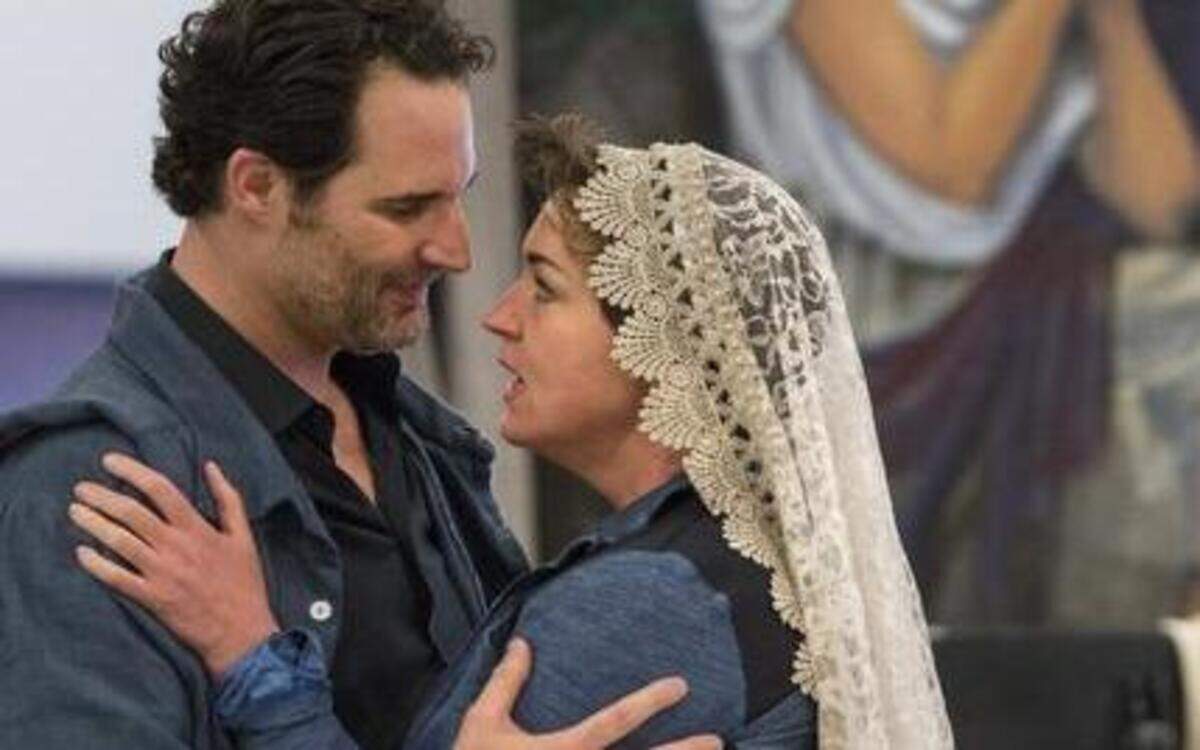
Certain musical snobs look down their noses at the opera “Tosca.”
It’s melodramatic for sure, but “Tosca” is a vital opera, bursting with human passions and emotions and Giacomo Puccini’s sweeping, heart-rending music.
This “shabby little shocker,” as the American music critic Joseph Kerman once called it, may have a story straight out of pulp fiction, but the opera has held audiences in its grip since it was first performed in 1900.
The Lyric Opera of Kansas City will present “Tosca” for four performances beginning Saturday at the Kauffman Center for the Performing Arts.
The story is a barn-burner.
Floria Tosca is a sought-after opera singer who finds herself caught up in Italian political intrigue in 1800. Royalists and reactionary Catholic clergy are running the show in Rome, but they’re getting antsy. Napoleon is about to gain control of Italy and drive the reactionaries out of the country once and for all. Tosca’s boyfriend, Mario Cavaradossi, is a painter and supporter of the anti-royalists.
“He is the hero, he’s part of the rebellion,” said James Valenti, who sings the role of Cavaradossi in the Lyric’s production. “Cavaradossi supports Napoleon and his political movement to unite Italy and overthrow the royalists and the tyranny. He really has a hatred for the people in charge and the church and everything that they’re doing. He’s willing to sacrifice his life for this cause because he believes in the bigger picture.”
Tosca, on the other hand, is not so politically motivated. She is, however, passionate in her love for Cavaradossi and chafes at the patriarchal authority which currently rules Rome. The sinister chief of police, Baron Scarpia, is Tosca’s most dangerous oppressor.
“I’ve always seen Tosca as being a slight bit jealous of the power that Scarpia has,” said Melody Moore, who sings the role of Tosca. “She wants her boyfriend and herself to live the life that they enjoy, and she wants this guy out of the picture. She wants Scarpia to quit messing with their affairs. She feels overpowered and it creates some violence in her. Tosca is, overall, a good woman, but I think we can all be pushed to violence, if it is for the greater good, or for someone we love or for family.”
This will be the third time Moore has sung the role of Tosca. She says that she is continually discovering new facets to the character.
“When I first did it, I really tried to make sure that I was accurate as to what her character would be doing at the time as a woman, what would she be allowed to say and what would she not be allowed to say,” Moore said. “The second time I did it, I felt like I got a little bit more into her violence in Act II, and allowed myself to sink into that more. This time, what I find in our production is that there is a lot more playfulness between myself and Mario.”
Valenti will be singing Cavaradossi for the first time, although he has extensive experience singing other Puccini roles and performing arias from “Tosca” in concert. He says that it’s a role he’s been wanting to add to his repertoire for quite some time.
“It made sense,” he said “I do ‘La Boheme’ a lot, I do ‘Madame Butterfly’ a lot, and this is the next step as I’m getting older and maturing. This is the next progression for the voice. It suits me very well. It’s also a chance to work again with Ward Holmquist (artistic director of the Lyric Opera). When I was 18 or 19, I really started getting into opera that I was singing in an opera chorus in Princeton, New Jersey, and Ward was conducting. Now it’s full circle with Ward again, this time as soloist.”
Moore and Valenti share a love for Puccini’s music, which they say is well-suited for singers. They also love “Tosca” and believe that audiences, even those unfamiliar with opera, will love it, too.
“I think the drama is still relatable today because there will always be the haves and the have-nots,” Moore said. “There will always be people in power and those that are trying to fight for fairness and justice. I think that this opera highlights that. That struggle is what is so interesting about this opera. And the music is stunning. You cannot go wrong.”
Valenti says that Puccini’s score, filled with “movie score melodies and soaring vocal lines” combined with a dramatic story are what make “Tosca” a perennial opera house favorite.
“The characters are real and visceral, but there are grand moments, too, which makes opera what it is,” he said. “But in this particular piece, you have betrayal, jealousy, torture, rape, political rebellion, a love story. You have all these elements coming together and it makes for some exciting drama. It’s an exciting three hours.”
7:30 p.m. Saturday, April 22 and April 24 and 2 p.m. April 26. Muriel Kauffman Theatre, Kauffman Center for the Performing Arts. $35-$170. 816-471-7344 or www.kcopera.org.
Harriman-Jewell: Joseph Calleja
Tenor Joseph Calleja knows a thing or two about Puccini.
The opera star has sung many of the great Puccini roles, and the composer’s arias often are featured in Calleja’s recitals. For example, when he gives his recital on the Harriman-Jewell Series Tuesday, he’ll be singing “E lucevan le stelle” from none other than “Tosca.”
This will be the Kansas City debut of Calleja, a singer the New Yorker magazine has praised for his “honeyed tone” and “ingratiating style” and has compared to Luciano Pavarotti and Beniamino Gigli.
“I’m really excited to come to Kansas City, Joyce’s country,” Calleja said, making reference to our hometown diva, Joyce DiDonato. “I’m looking forward to discovering Kansas City because I know you’ve been having all the greatest voices there, Juan Diego Florez and Joyce, of course, so I’m curious to discover what Kansas City is all about.”
Calleja was born in the island country of Malta, one of the smallest countries in Europe. Malta is culturally rich, with a strong choral and musical tradition.
“Malta is a very special island,” he said. “Music is very important to Malta. We’re like the Welsh. I was in a church choir and a school choir, and then when I was around 13 years old, I heard Mario Lanza and was completely enthralled and completely enamored with his beautiful voice and charisma, and I started imitating him. It turned out I could produce an operatic sound.”
And the rest, as they say, is history.
Calleja will be singing a very Mario Lanza-like program in Kansas City, full-bodied arias overflowing with passion, like “E lucevan le stelle.”
“It’s an incredible enunciation of desperation,” Calleja said. “I like to sing it a lot because when people say opera is boring, it’s impossible if you listen to that aria. Cavaradossi is talking about romantic, physical love, his sexual love for Tosca. He’s recounting in the aria how she felt, how he touched her, how she smelled. He ends the aria with the phrase, ‘I have never loved life so much.’ It’s such a powerful phrase because, of course, he’s going to be executed.”
Other composers on the program include Peter Ilyich Tchaikovsky, Jacques Offenbach, Giuseppe Verdi and Paolo Tosti. The composers might be diverse, but Calleja says there’s one theme: love.
“Everybody at the moment is reading ‘50 Shades of Grey,’” he said, “but this is ‘50 Shades of Love.’ Betrayed love, romantic love, patriotic love. It’s really about what is the most important thing out there. It will be a nice ride around the emotions that love can conjure in a person.”
7:30 p.m. Tuesday. Folly Theater, 300 W. 12th. $25-$70. 816-415-5025 or www.hjseries.org.
Kansas City Chamber Orchestra
The elegant, classical music of Wolfgang Amadeus Mozart and Franz Joseph Haydn somehow seems to capture the spirit of spring. Perhaps it’s the breeziness and smiling melodies that call to mind a beautiful, gusty April day.
The Kansas City Chamber Orchestra will perform a program of Mozart and Haydn to celebrate “April on the Plaza” Friday night at Unity Temple on the Plaza.
Bruce Sorrell will conduct a program that includes Mozart’s Symphony No. 33 and Haydn’s Symphony No. 83, “La Poule” (“The Hen”). Violinist Anne-Marie Brown and violist Duke Lee will join the orchestra for Mozart’s Sinfonia Concertante. When the violinist and violist have the right chemistry, the Sinfonia Concertante is some of the sexiest music you’ll ever hear.
8 p.m. Friday. Unity Temple on the Plaza. $25-$35. 816-235-6222 or www.kcchamberorchestra.org.
Friends of Chamber Music: Artemis Quartet
The Friends of Chamber Music will present the acclaimed Artemis Quartet in a program called “Slavic Voices” on Saturday night at the Folly Theater. The ensemble will perform Antonin Dvorak’s beloved “American” Quartet, Tchaikovsky’s richly melodic String Quartet No. 1 and the Quartet No. 5 by the Latvian composer Peteris Vasks. Vasks’ music is often influenced by Latvian folk music and is informed by a strong sensitivity to natural beauty.
8 p.m. Saturday. Folly Theater, 300 W. 12th St. $20-$30. 816-561-9999 or www.chambermusic.org.
Patrick Neas is program director for RadioBach.com. To reach him, send email to pneas@jccc.edu.
This story was originally published April 11, 2015 at 6:00 PM.