
Roots music: ‘Black Pearl Sings’ explores the power of folklore
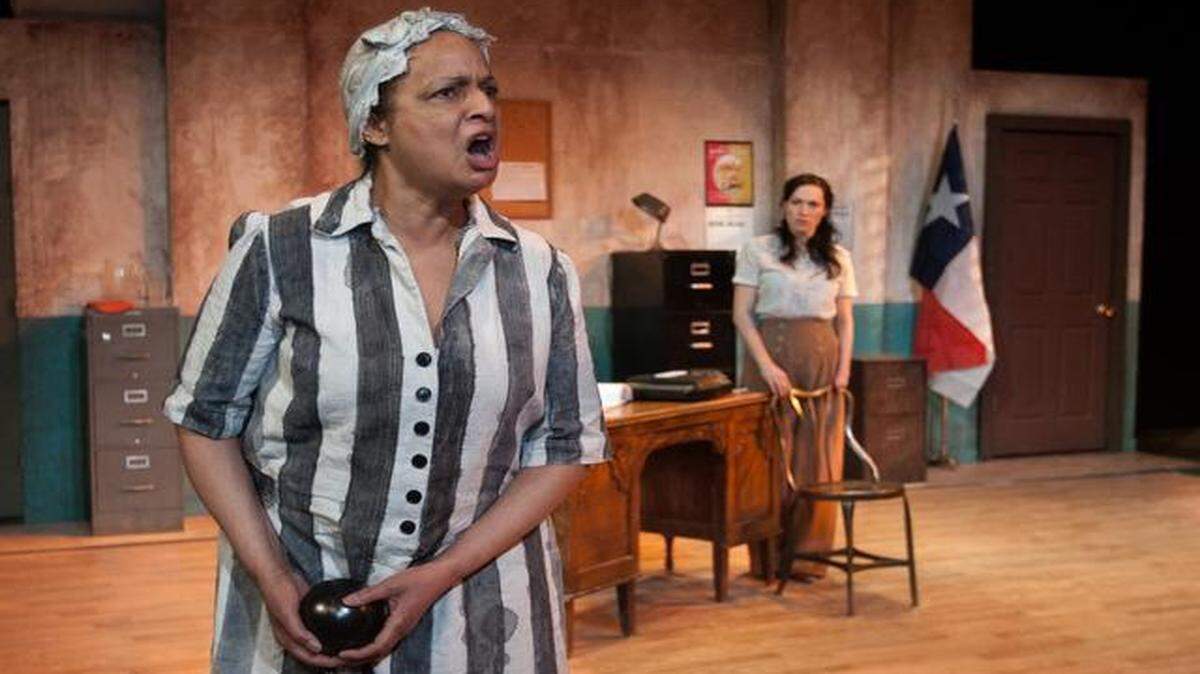
Nice music. Good actors. Forced drama. Some good lines.
This quick check-list of impressions occupied my mind after watching “Black Pearl Sings,” a widely produced play by Frank Higgins receiving its first local production from the folks at Spinning Tree Theatre.
This handsomely mounted show features two charismatic performers, Nedra Dixon and Vanessa Severo, and marks respected actor Walter Coppage’s directing debut. It benefits from impressive work by a design team that includes Victor En Yu Tan (lights), Shannon Smith-Regnier (costumes) and Matthew Mott (sets).
Higgins attempts a complex thematic brew that touches on race, feminism, cultural legacies and the power of music. His plot, although clearly inspired by historical facts, fails to convince at crucial moments and he can’t resist inserting cheap anachronistic jokes. His eagerness to entertain too often elbows aside the play’s serious intent.
But his exploration of the importance of real folk music and what it means to the people who keep it alive becomes an absorbing journey for the viewer. Coppage leads us with a firm hand to the final moment of the show, which can only be described as an electric moment of pure theater.
Higgins’ fictional tale, set in the 1930s, is about two women -- a white researcher seeking to make a name for herself as a folk-song collector for the Library of Congress, and an African-American convict serving time in a Texas prison for using a knife on a guy who apparently deserved what he got.
The inspiration for this relationship was folk music collector John Lomax and singer/songwriter Huddie Ledbetter, who became a celebrity in New York after Lomax “discovered” him in a Louisiana prison. By creating fictional female alter egos for Lomax and Ledbetter, Higgins allows himself to make billboard-sized statements about women struggling for independence in a male-dominated world.
The first act is set in the office a Texas prison warden, where Susannah Mullally (Severo) is interviewing female convicts in the hopes of finding a folk song or two that nobody else knows about — songs that can be traced to their African origins.
She finds the ideal choice in Alberta “Pearl” Johnson (Dixon), who enters the room literally wearing prison stripes and a ball and chain. Susannah’s agenda is to exploit Pearl’s musical memory and make field recordings to establish herself in a male-dominated field. But Pearl has her own goal — to locate her daughter, who was only 12 when Pearl was sent to prison.
Early on, the relationship is all about bargaining and maneuvering for position. Eventually it morphs into mutual respect, affection and friendship. Dixon holds the stage with Shakespearean authority and usually finds a way to finesse Higgins’ obvious laugh lines. The emotional depth of her performance is consistently impressive.
Severo is, as always, a magnetic presence on stage but rarely seems like someone who could have stepped out of 1933. She projects an up-to-the-minute sensibility that seems at odds with the play’s historical backdrop. A brief comic sequence in which Pearl shows the supposedly stiff Susannah how to dance “nasty” is amusing but utterly unconvincing; Severo, who moves with the natural grace of a dancer, hardly seems like someone who needs to loosen up.
Act 2 catapults us to New York. Susannah has used her influence to win Pearl’s parole with the understanding that they would share the freed convict’s music with the public. This section of the play is by turns weightier and funnier as Pearl’s search for her daughter reaches an unhappy resolution, even as she basks in the admiration of upper-crust New Yorkers. A depiction of one of Pearl’s performances, accompanied by Susannah on autoharp, allows Dixon to involve the audience in the show’s most vivid sequence.
The second act is more satisfying thanks largely to the chemistry between Dixon and Severo. The conflict between the characters’ competing agendas is more credible and their mutual affection feels more authentic. They project a deep emotional connection so pronounced that you can’t really judge how much of it is “acting” or to what degree it reflects a genuine bond between the performers.
In the final moments, Pearl is alone onstage and in an expression of grief sings a rare old song that recalls the journey of slaves bound for a life of captivity in America. Dixon’s heartfelt performance, along with subtle but dramatic lighting effects and striking visual images projected onto the set, concludes the production with something like a spiritual epiphany. Call it what you will, it packs a punch.
To reach Robert Trussell, call 816-234-4765 or send email to rtrussell@kcstar.com.
This story was originally published March 8, 2015 at 1:16 PM.