
Kansas City Repertory Theatre opens ‘Angels in America,’ a sprawling, timeless tale of the 1980s
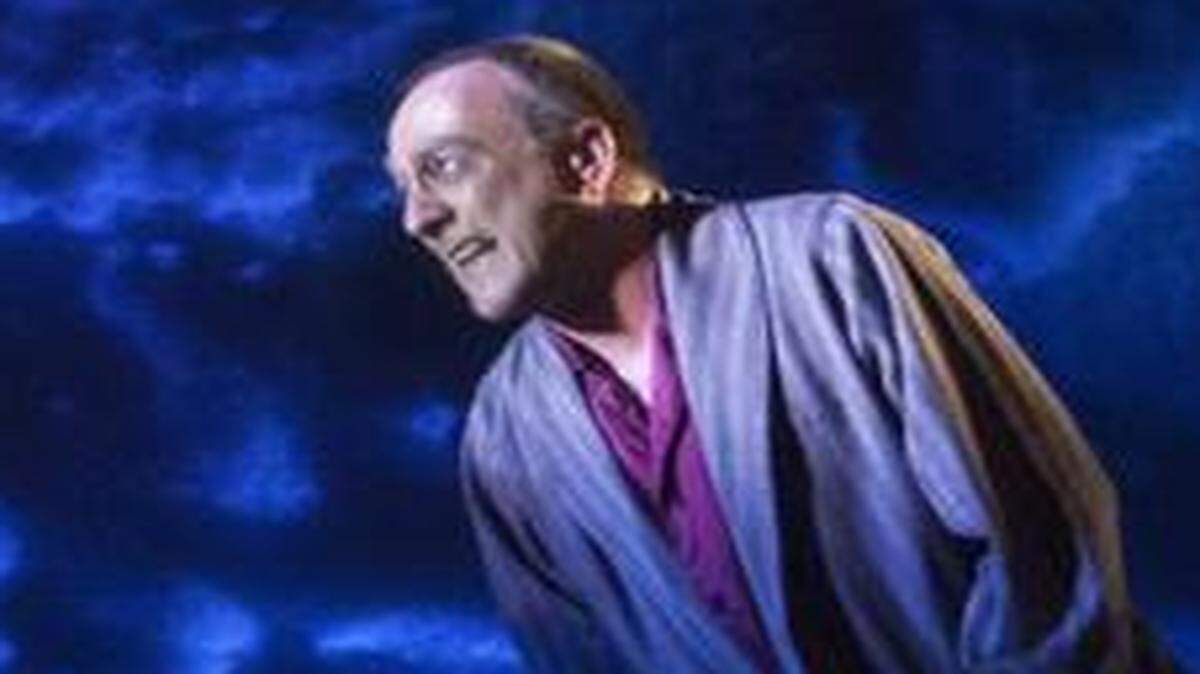
At last “Angels in America” comes to the Kansas City Repertory Theatre stage.
Tony Kushner’s epic, comprising two full-length plays, was staged by the Unicorn Theatre in 1996, and a national tour performed it in Lawrence.
But programming at the Rep in the 1990s, when it was called Missouri Repertory Theatre, was pretty conservative. So several Pulitzer Prize-winning plays, including “Angels,” found a home at the little Unicorn instead of the city’s leading nonprofit theater company.
Well, that was then.
The Rep under artistic director Eric Rosen will likely be remembered for taking risks, and he has invested the Rep’s resources in a full-blown new production of Kushner’s audacious work at Copaken Stage, the Rep’s downtown venue.
He has brought back director David Cromer (“The Glass Menagerie,” “Our Town”) to stage it, and Cromer has assembled a cast from New York, Chicago and Kansas City.
Rep audiences won’t see the exact version that was staged on Broadway or at the Unicorn. Before a 2010 revival at the Signature Theatre in New York, Kushner revised parts of “Perestroika,” the second play, which he had finished under deadline pressure before the first production.
Cromer has directed “Angels” before. In 1998 he claimed a Joseph Jefferson Award — Chicago’s most prestigious theater honor — for his direction of the two-part epic.
“There are plays like this that can’t ever be conquered (“Hamlet,” “The Cherry Orchard”) because they are about so much,” Cromer said in a statement. “They are so much more than any single production can capture; but, if you can find the energy, you have to keep trying whenever the opportunity presents itself.”
“Angels,” set in 1985-86, captured something of the 1990s zeitgeist with its sprawling, surrealistic narrative. The work linked Mormon and Jewish characters; explicitly criticized the political establishment in the Reagan era; depicted the AIDS crisis in uncompromising terms; showed an attitudinal angel crashing through the ceiling; mixed tragedy and acerbic humor; and included a charismatic character from our post-World War II history: Roy Cohn, the conservative lawyer whose resume included aiding Sen. Joe McCarthy during the Commie witch hunts of the 1950s and earlier helping to prosecute Julius and Ethel Rosenberg for espionage.
The plays trade in big themes — personal and political hypocrisy, courage and cowardice, homophobia, religious and ethnic identity, and a spiritual longing that seems to transcend political and religious differences and history itself. Kushner claimed a 1993 Pulitzer Prize and Tony Award for the first part, “Millennium Approaches,” and won a second Tony the following year for “Perestroika.”
Subtitled “A Gay Fantasia on National Themes,” the plays had a major impact on theater and American culture. Everything about the work felt new, radical and unprecedented.
Staging it in 2015 may effectively transform it into a period piece, but it still reflects Kushner’s overactive theatrical imagination. The man who wrote the screenplay for Steven Spielberg’s “Lincoln” thinks big.
“The geopolitical climate has changed, but other than that, what’s different really?” said Mark Robbins, who plays Roy Cohn. “Certain things don’t change. AIDS still exists and in some parts of the world is just as rampant. The polarization of political attitudes is as bad now as it’s ever been. … Homosexual communities are still fighting even harder for civil rights. I think the play has yet to even come within spitting distance of a time when it loses relevancy. If nothing else, it’s beautifully written.”
“Angels” fits into no established genre. It could be called a “gay play.” Or a “Jewish play.” Or a “Mormon play.” But it defies labels. And it captured the collective imagination of young theater artists. For many, it was the play of the era.
Rosen said last year that if you consider the play’s content — the “intellectual legitimacy of Jews and Mormons and gay people and anyone struggling against God to make sense of the world” — its popularity, cultural impact and commercial success are utterly improbable.
“I do not know of a better example of how a play changed the way we think about things,” Rosen said. “By humanizing and elevating that soap opera of characters — lovers betrayed, families disrupted, drug addiction — it’s a fantastic story, but it put gay identity at the center of American life.”
The play was originally commissioned by the Eureka Theatre in San Francisco. Kushner has said in interviews that he signed a contract to write a two-act play. But as he worked on it, the length and thematic complexity grew and grew.
“I had a dream, in 1985 I believe, when a friend I’d gone to school with was sick — one of the first people I knew who’d gotten the AIDS virus,” Kushner told New York Magazine about the origins of the play. “I had a dream of him in his bedroom with an angel crashing through the ceiling. I wrote a poem called ‘Angels in America.’ I’ve never looked at the poem since the day I wrote it.”
A sense of history runs through Kushner’s work, and “Angels” is no exception. His themes include the saga of Jewish immigrants coming to America and the Mormons’ 19th-century trek west to flee persecution. And there, among the gallery of Kushner’s fictional characters, is Roy Cohn — a symbol of the Cold War.
Robbins said Cohn reminds him a lot of Richard III, Shakespeare’s spectacular villain who murders his way to the English throne — a role that Robbins has played. Richard and Cohn have in common a sort of “vitality of malice,” Robbins said.
The original published version of the play includes a disclaimer from Kushner, who explains that though the play’s version of Cohn corresponds to certain facts of history, he is essentially a fictional character and that “liberties have been taken.” Robbins said he did watch archival footage of the Army-McCarthy hearings, in which Cohn took part, and found a filmed interview with Cohn from 1951.
“He really sounded like a gangster,” Robbins said. “He sounds like someone on ‘Boardwalk Empire.’”
But he limited his research, because his job is to play Kushner’s version of Cohn. And that, he said, has been a unique moment in his career.
“It’s always rewarding to feel like you’re in an ensemble of people whose work you admire and trust,” Robbins said. “But also, just to be able to take on this role has been hugely rewarding and fun. Challenging and joyous.”
Kushner conceived of the play as highly theatrical — flying angels, dreams intersecting with reality, hallucinations, ghosts, actors playing multiple roles. Mounting it is a huge challenge, no matter how many resources a theater has at its disposal.
Peggy Friesen, one of the city’s most respected actors, plays the key role of Hannah Pitt, a Mormon who travels from Salt Lake City to New York after her son there tells her he’s gay. And she plays Rabbi Chemelwitz, the World’s Oldest Bolshevik and the ghost of Ethel Rosenberg.
“I play five characters, and three are male,” she said. “It’s a lot of fun. Lots of wigs and facial hair.”
But it’s also a massive amount of work. Cromer is basically directing two plays that together represent about seven hours of theater. In the second play, Friesen said, she flies through a series of quick costume changes.
“I have 16 scenes, and a lot of times I’m changing,” she said. “I’m ending one scene, walking off stage and turning around at the top of the next scene as a completely different character. Every character I have has a wig.”
Friesen worked for Cromer in “Our Town,” in which she offered a brief but memorable performance as Mrs. Soames. She said working with him a second time — in one major role and multiple supporting parts — is a rare pleasure.
“He’s an actor’s director,” she said. “He really is. He understands our process. He’s also been an acting teacher and a director after being an actor. He’s got a vocabulary down, and he knows what he’s talking about.”
Friesen, like Robbins, saw the Unicorn production, but her memories of it have faded. (Robbins also saw the Broadway production from the “nosebleed section.”) Since she and the rest of the Rep cast are using a revised version that Kushner published in 2013, she said it’s like coming to the material fresh.
“Every time I read this play or hear myself say something from it, something else jumps out of me,” she said.
Another added challenge is the venue: Copaken Stage has virtually no fly space above the stage, and its steeply raked seating sections make telegraphing to the back row an enormous challenge. But Cromer directed “Glass Menagerie” there and found a way to make the space work.
“It’ll be interesting doing it at the Copaken,” Friesen said. “We aren’t going to have any fly space, so any special effects are going to be totally actor driven. The special effects will be pretty transparent for the audience.”
To reach Robert Trussell, call 816-234-4765 or send email to rtrussell@kcstar.com.
Opening Saturday
“Angels in America” began previews this weekend, and officially opens Saturday and runs through March 29 at Copaken Stage, 13th and Walnut. Parts 1 and 2, “Millennium Approaches” and “Perestroika,” will be performed in repertory. On certain dates viewers will be able to see the entire work in one day. To see the performance schedule, go to KCRep.org. For tickets, call the box office at 816-235-2700.
The cast
“Angels in America” calls for an ensemble cast to play central and multiple roles. The characters include:
▪ Roy Cohn (Mark Robbins), a Machiavellian wheeler-dealer who is in denial about his sexuality and the fact that he is dying of AIDS.
▪ Joe Pitt (Claybourne Elder), Cohn’s young Republican aide, a Mormon who is a closeted gay man.
▪ Joe’s wife, Harper Pitt (Jessiee Datino), an agoraphobic Valium addict whose closest companion is Mr. Lies, a “travel agent” who exists only in her hallucinations.
▪ Joe’s mother, Hannah Pitt (Peggy Friesen), who travels to New York to “save” her son after he tells her he’s gay in a late-night phone call; she undergoes a remarkable transformation.
▪ Prior Walter (Seamus Mulcahy), a young man with AIDS who is deserted by his lover but by happenstance becomes a close friend of Hannah Pitt.
▪ Louis Ironson (Nik Kourtis), Prior’s lover, a guilt-ridden word processor who works for the federal appeals court and is ultimately redeemed by his idealism.
▪ Belize (Paul Oakley Stovall), a registered nurse and ex-drag queen who reluctantly cares for Cohn as he is dying.
▪ The Angel (Jennifer Engstrom), an airborne heavenly messenger who appears to Prior in a vision and declares him a prophet.
Among the smaller roles are the World’s Oldest Living Bolshevik, the garrulous Rabbi Chemelwitz , Ethel Rosenberg, a second nurse, a real estate agent, Cohn’s doctor and a Justice Department official.
This story was originally published February 21, 2015 at 6:00 PM with the headline "Kansas City Repertory Theatre opens ‘Angels in America,’ a sprawling, timeless tale of the 1980s."