
Opus 76 quartet’s series turns focus to a composer who is ‘the perfect modern hero’
One doesn’t just talk about Beethoven with violinist Keith Stanfield, founder of the Opus 76 Quartet. Any discussion of classical music with Stanfield involves the bigger picture, from poverty to racial tension to the pandemic to misguided notions about classical music’s “irrelevance.”
Stanfield is a big picture thinker with big plans and big ambitions. Right now, he and the Kansas City-based Opus 76 are planning to launch one of their biggest projects, a multi-week series of performances of the complete Beethoven string quartets. The first concert will take place Aug. 15 at the Cathedral of the Immaculate Conception.
Stanfield is the embodiment of multiculturalism. He was born in England, but his mother is from the small island of Western Samoa in the South Pacific. His father, a painter from Australia, moved his family to England so he could study painting there.
It was in England, when Stanfield was 3 1/2, that he saw Itzhak Perlman playing the violin on TV. When everyone started clapping at the end, Stanfield knew he wanted to play the violin.
“It was basically the clapping that made me want to walk down this vale of tears for the next 28 years,” Stanfield said.
Stanfield showed an immediate affinity for the instrument. Although his parents were certainly proud of their violin-playing son, Stanfield says they would have preferred him to be a soccer player. He didn’t let them down in that department, either. Stanfield played in the 2010 World Cup for Western Samoa. But violin won out. Stanfield says he left soccer to learn the Brahms Violin Concerto.
He studied at the Royal Academy of Music where he met his wife, Ashley, a violist and Kansas City native. He eventually moved with his wife back to her hometown, and he hasn’t regretted it one bit.
“The United States has exceeded my expectations in many, many ways,” Stanfield said. “From abroad, the picture that’s painted of the United States is one of relentless optimism and industry and the American Dream. If you want it hard enough, you can get it. I have to say, that isn’t total propaganda.”
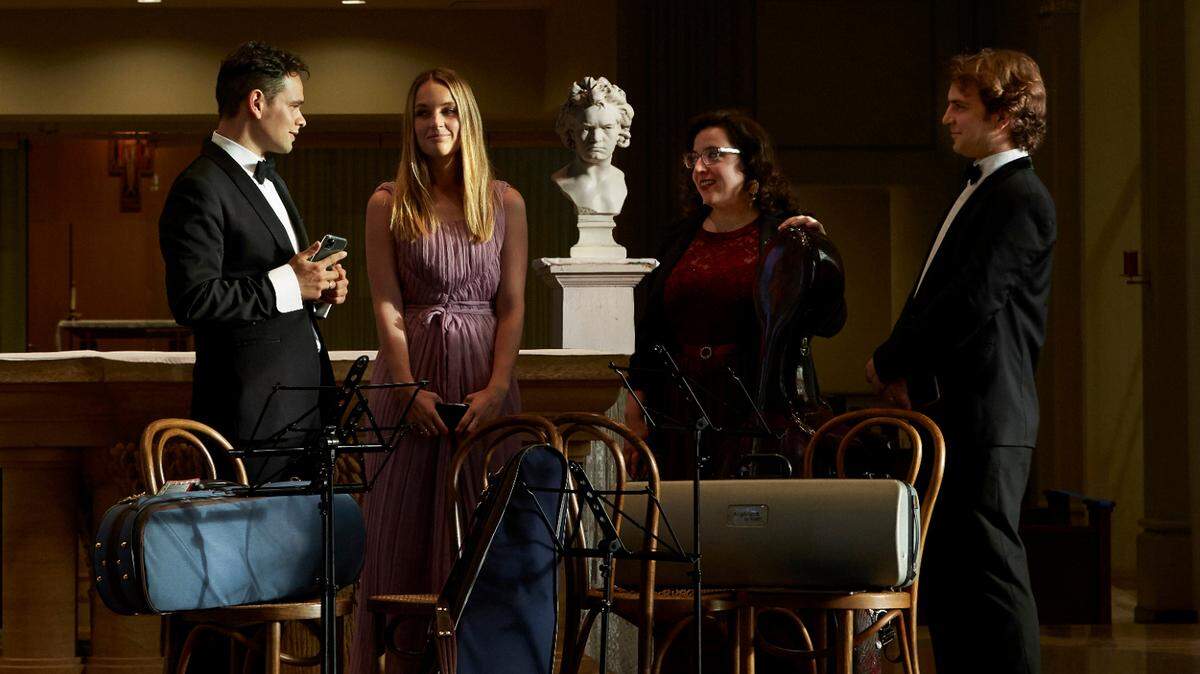
Stanfield, an enterprising and energetic musician, has been making things happen since he moved to Kansas City. In 2017, he founded Opus 76, which has already established itself as an important and unique part of Kansas City’s classical music scene. In addition to himself and his wife, the quartet includes violinist Zsolt Eder and cellist Sascha Groschang.
From the beginning, Stanfield wanted Opus 76 to make a difference in the community. The ensemble has engaged in various charitable efforts, as well as lending a helping hand to other musicians in the area. The quartet has worked with Morning Glory Ministries, a group devoted to providing meals and emergency assistance to the homeless.
“We’ve been doing a few things to help treat people who are down on their luck with a bit of dignity,” Stanfield said.
One of those things is playing music for the homeless while they eat their meals.
“Many of the quartets we play, especially the earlier works, were the light entertainment of the aristocracy as they were having their meals,” Stanfield said. “Fast forward to Kansas City in 2020 and these people are getting the same treatment as Emperor Franz Joseph. That gives me great pleasure. It can actually help turn their life around in many ways, just by showing them a bit of kindness and respect.”
The Opus 76 “Beethoven Cycle” is being presented to celebrate the 250th anniversary of the birth of Beethoven, a composer Stanfield calls “the perfect modern hero.” To hear Stanfield tell it, Beethoven was probably the most woke composer in classical music history.
“First of all, we have a documented example where a 10-year-old girl wrote him a fan letter and asked how she could become a great composer,” Stanfield said. “Beethoven replied with a four-page letter thanking her and with full instructions on how to develop her talent. Then he finished up by telling her that any time she’s in Vienna she should come and take lessons with him. That’s wasn’t a piece of PR. It was a letter that no one else was supposed to see.”
Stanfield also cites the Afro-European violinist John Frederick Bridgetower, who claimed to be an African prince and to whom Beethoven originally dedicated his Kreutzer Sonata. After playing through the sonata with Bridgetower, Beethoven embraced him with joy and lavished him with praise.
Finally, Stanfield notes that Beethoven struggled with ever-worsening deafness throughout his life, a disability that almost drove the composer to suicide.
“He’s a person who triumphed over significant physical adversity and who championed female composers and mixed race performers,” Stanfield said. “The only reason you would dog Beethoven is because you look at his gender, you think he’s part of the establishment and you don’t know anything about his music or his history.”
A recorded set of the Opus 76 Beethoven Cycle will be made available to the public free of charge in November, thanks to a generous gift from Marny and John Sherman. John Sherman, of course, is the owner of the Kansas City Royals.
“Isn’t it incredible that the owner of a major league baseball team is also interested in a classical music festival celebrating the 250th anniversary of a famous composer?” Stanfield said. “Quartet music might sound incredibly niche to some people, but the Shermans want everyone to enjoy it free of charge.”
Aug. 15, 22, 29 and Sept. 12 at 8 p.m. at the Cathedral of the Immaculate Conception, 416 W 12th St. and Sept. 5 at 8 p.m. at Visitation Catholic Church, 5141 Main St. $30-$60. https://tinyurl.com/yxhjroxp. For more information about Opus 76, www.opus76.org.
You can reach Patrick Neas at patrickneas@kcartsbeat.com and follow his Facebook page, KC Arts Beat, at www.facebook.com/kcartsbeat.
This story was originally published July 31, 2020 at 5:00 AM.