
‘Beauty in dark places.’ Local researcher documents work of ‘weird fiction’ author
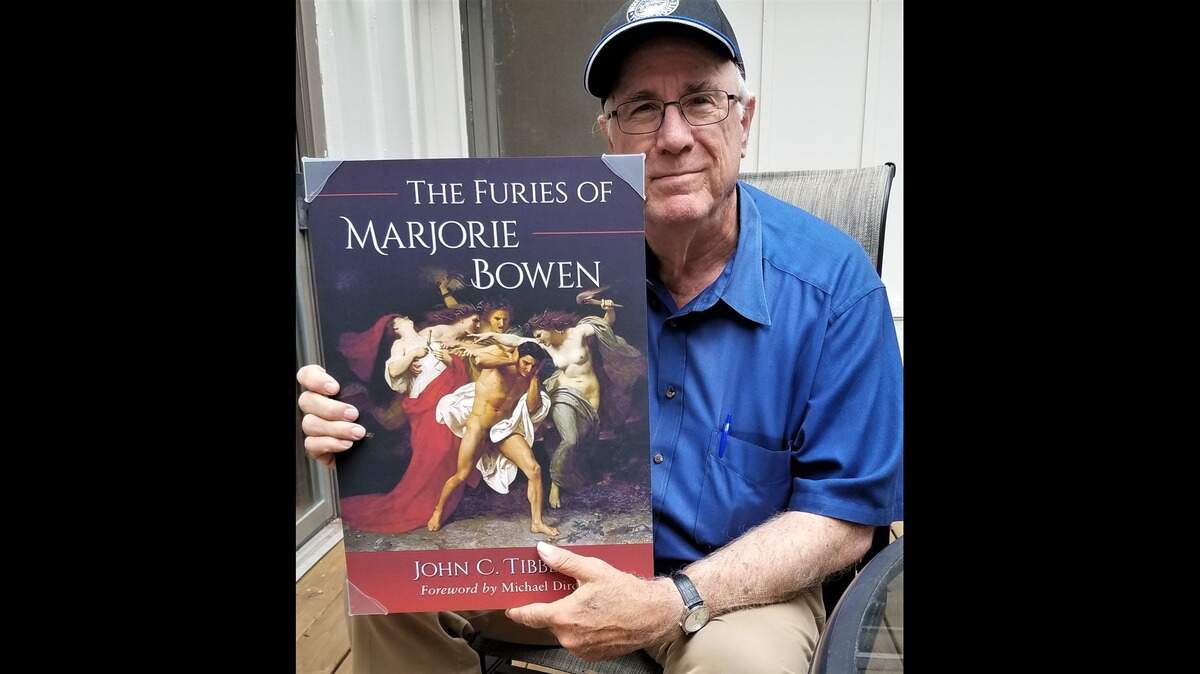
Marjorie Bowen may not be as well known as H.P. Lovecraft or Ray Bradbury or other writers of horror and fantasy from the last century, but John Tibbetts says she should be.
Tibbetts, a local cultural historian and critic who is well known for his books on composers like Liszt and Schumann, has recently written “The Furies of Marjorie Bowen.” He reveals her to be a masterful writer seeking “to find beauty in dark places.”
Bowen had the sort of life that would definitely give one a dark turn of mind. After suffering a wretched childhood in an emotionally abusive home, Bowen was thrown upon her own resources with little formal education. She went through two marriages.
She moved with her first husband, who was Sicilian, to Italy during World War I not knowing that he would shortly succumb to tuberculosis. It was a loveless marriage that Bowen suffered out of a sense of duty. She was only able to write in the evening hours when her bedridden husband wasn’t ringing for her. She lost a child before her husband died around 1917.
During World War II, she was living in London in the middle of the Blitz. Her boys were in prisoner of war camps and her second husband was away most of the time while she was cranking out novels and short stories, making appearances and giving lectures. Bowen was indomitable.
“Through sheer grit and industry, she made a living as a writer, becoming a respected historian,” said Tibbetts, a retired professor of film at the University of Kansas.
Tibbetts became acquainted with Bowen’s work when he was a boy rummaging through his father’s extensive library of the genre known by the catch-all title of “weird fiction.”
“I was looking through my dad’s books on fantasy, science fiction and horror, and there was a little book called ‘Bishop of Hell’ by someone named Marjorie Bowen. What small person wouldn’t be intrigued by a title like that? So I plucked it off the shelf, opened it up and read the title story, and thought, wow. I didn’t forget it, but sort of filed it away.”
Years later, Tibbetts began writing articles for Weird Fiction Review, a serious journal devoted to this curious literary genre. After writing a series of articles on authors like J.M. Barrie and Edith Wharton, Tibbetts remembered “Bishop of Hell” and decided Bowen would make an intriguing subject for an article.
“From that little acorn has grown one published book, ‘The Furies of Marjorie Bowen,’ and now a second book, which is at the publisher, called ‘The Marjorie Bowen Reader,’” Tibbetts said. “From that acorn also grew a wonderful relationship with the Bowen estate in Dorset, England.”
In Bowen, Tibbetts has discovered an author whose genius encompasses more than just the weird tale. With her superb skill as a historian, Bowen wrote incredibly detailed and popular historical fiction. Tibbetts says that one of Bowen’s historical tales is especially pertinent today.
“It’s a novel called ‘God and the Wedding Dress,’” he said. “It’s based on a true account of a small village outside London that was engulfed by the plague that was also endangering London itself. It was around 1660 when Daniel Defoe wrote his ‘Journal of the Plague Year.’ England at that time was also having a terrible time with the Great Fire that Samuel Pepys writes about.”
Tibbetts says Bowen’s tale is a harrowing story about two religious figures who are engaged in a battle for the hearts and minds of the villagers. Although it’s a historical novel, Tibbetts says it has elements of the weird tale.
“It’s weird in the sense that one of the religious figures in the story is a pagan priest who has his own ideas about what is causing the plague,” Tibbetts said. “So there are sacrificial rituals and observances to gods.”
Although Bowen is a specialty taste, Tibbetts hopes his two books will help broaden the audience for this remarkable author.
“I’m a writer and researcher who has fallen in love with his subject,” he said.
“I’ve fallen in love with a woman who made her way in a world dominated by men, practicing a profession in which she was able to support house and home, maintaining an inward fantasy world while maintaining an outward conventionality. There’s a magnetic quality about her writing that reaches across time to me and makes me wish I could have met her and interviewed her.”
You can reach Patrick Neas at patrickneas@kcartsbeat.com and follow his Facebook page, KC Arts Beat, at www.facebook.com/kcartsbeat.