
‘When Lions Roar’: An interesting melding of tales about the Churchill and Kennedy clans
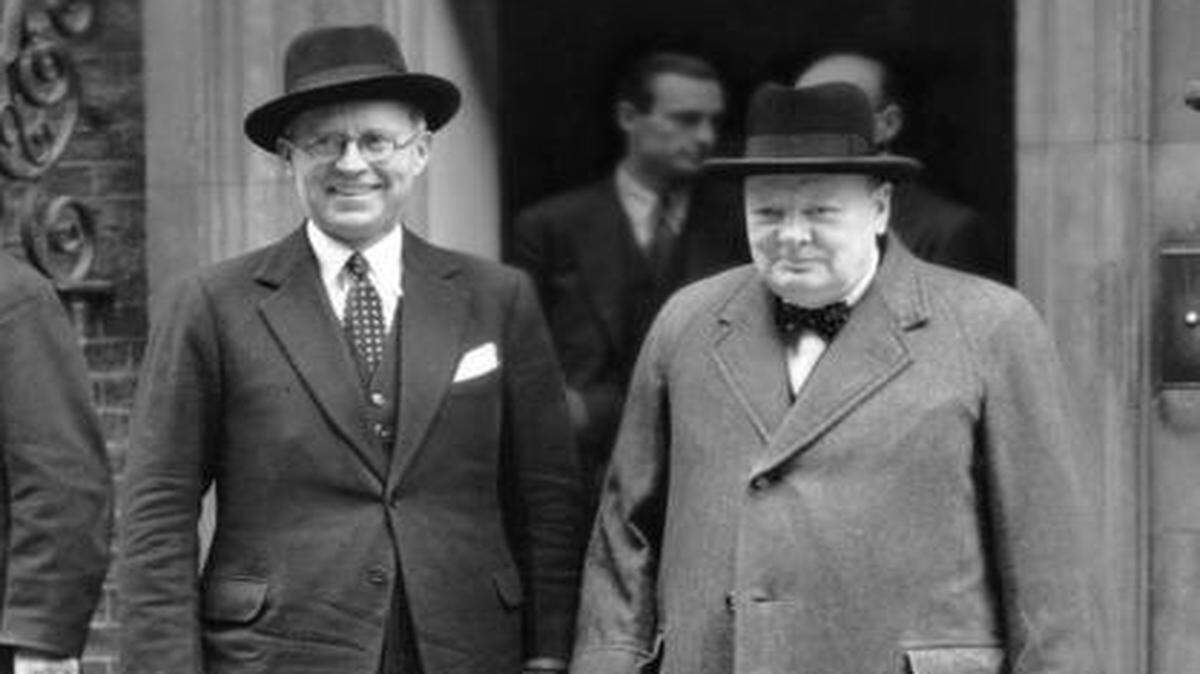
A serious problem for a scholar writing about the Churchills and the Kennedys is the most basic one for any historian: trying to say something fresh. The cottage industry of writing about these two dynastic families is so large that you need a Wal-Mart-size home library to collect every title.
So when the fat galley of “When Lions Roar” arrived, I moaned. The book had the whiff of taking two great stars — say, Lady Gaga and Tony Bennett — and cross-marketing them in a duet CD for the big cash payoff. How much new information could there possibly be about the Churchills and the Kennedys?
My skepticism was misplaced. Longtime Newsday investigative journalist Thomas Maier — author of the acclaimed “Masters of Sex” (2009) and “The Kennedys: America’s Emerald Kings” (2003) — delivers the goods.
Weaving the life stories of nearly 30 Churchills and Kennedys into a seamless narrative, Maier smartly anchors his reportage on the clans’ larger-than-life cornerstones: Winston Churchill and Joseph Kennedy.
The sheer accumulation of colorful anecdotes makes for riveting reading from start to finish. Although Churchill comes off as the far greater man, Kennedy is clearly a more sympathetic father.
“As if by some gravitational pull or providential design,” Maier writes, “these two dynastic families — one American, one British — seemed fated to meet, their fortunes soon intertwined forever.”
The rambunctious Kennedy was a freckled, hard-charging man driven to make a Gatsby-like fortune. At age 25, he was a bank president. Maier profiles his rise as shipbuilder, booze distributor and Democratic Party donor.
He explains Kennedy’s power-driven relationship with the Catholic Church, his bizarre womanizing and his admirable raising of four sons and five daughters.
By contrast, Churchill, a swashbuckling British Tory politician, wildly famous for conspicuous public service as well as for writing headstrong historical narratives such as “The World Crisis” (1923), was perennially cash-strapped. Enter Kennedy and his checkbook.
According to Maier, Churchill obtained a lucrative portion of stock in two U.S. companies associated with Kennedy in what reeks as influence-buying. This coincided with Kennedy’s getting a post-Prohibition franchise to ship scotch and other liquor to the United States. Both Churchill and Kennedy come off as slippery businessmen, playing just within the legal margins.
In 1933, for example, Kennedy brought James Roosevelt, one of President Franklin D. Roosevelt’s sons, along with him to England to help secure liquor contracts for Haig and Haig Whisky and Gordon’s Gin with Churchill’s help. At Churchill’s Chartwell Manor estate, Kennedy used his colleague’s presence to insinuate that he had a direct pipeline to the White House.
According to Maier, when U.S. Securities and Exchange Commission Chairman William O. Douglas visited the White House to complain about these shady business dealings, FDR “cradled his head on his arm and cried like a child for several minutes.”
In 1938, to keep Kennedy in the Democratic tent, Roosevelt appointed him ambassador to the Court of St. James’s — a milestone in American Irish Catholic history — despite the fact that he distrusted the man’s isolationism and blind-eyed tolerance of Adolf Hitler.
Interestingly, Russian Ambassador Ivan Maisky suggested that “Capitalist Kennedy” was too preoccupied with his business interests to bother with the moral implications of the Nazi threat.
But Maier also offers a more admirable rationale for why Kennedy opposed the United States’ entry into World War II: fear of losing a beloved son in battle.
Indeed, on Aug. 12, 1944, his oldest son, Joseph Patrick Kennedy Jr., was killed on a combat mission over Europe. All ambitions then fell on John F. Kennedy, who nearly was lost, too, in Pacific combat.
Maier documents the two patriarchs’ various ups and downs during the war quite well. It rains espionage, skullduggery, adultery and parlor gossip in the World War II chapters.
Portraits of Churchill’s wife, Clementine, and Kennedy’s wife, Rose, are well rendered, but the scene-stealer is Kay Halle, a vivacious Cleveland journalist, socialite and Office of Strategic Services intelligence operative. Her torrid affairs with Joseph Kennedy and Churchill’s son Randolph make for juicy, tabloid-like reading.
But it’s Maier’s ability to substantiate various bold claims with original Cold War-era research that is most impressive.
His most startling revelation has to do with Churchill’s clamor to drop atomic weapons on the Soviet Union in the early Truman years. Sen. Styles Bridges of New Hampshire, a conservative Republican, told the FBI how Churchill “pointed out that if an atomic bomb could be dropped on the Kremlin wiping it out,” it would thus leave “a very easy problem to handle the balance of Russia, which would be without direction.”
By the 1960s, the drama shifts to Churchill’s son Randolph, as well as Kennedy’s son Jack. Maier does an admirable job of documenting JFK’s lifelong obsession with all things Churchill.
Churchill heard that the Democratic senator from Massachusetts was going to make a White House run in 1960. “They tell me he is presidential timber,” Churchill explained to Greek tycoon Aristotle Onassis, on whose yacht the 1958 meeting would take place. “I’d like to meet this presidential timber.”
It was a bust. Churchill wasn’t at his sharpest, and Kennedy seemed tongue-tied, while Onassis flirted with Jackie Kennedy.
“I felt sorry for Jack that evening because he was meeting his hero, only he met him too late,” Jackie recalled. Trying to ease her husband’s pain, she teased, “Maybe he thought you were the waiter, Jack.”
Douglas Brinkley is a professor of history at Rice University and author of “The Wilderness Warrior: Theodore Roosevelt and the Crusade for America.”
When Lions Roar: The Churchills and The Kennedys, by Thomas Maier (767 pages; Crown: $30)
This story was originally published December 5, 2014 at 6:00 AM.