
Book club: Award-winning poet confronts us while drawing us into Middle Eastern world
%20PUBLICITY%20FULL%20COLOR.jpeg "“Provocation can be that kindle of inspiration for someone who needed one more push to make a big change,” says poet Threa Almontaser.")
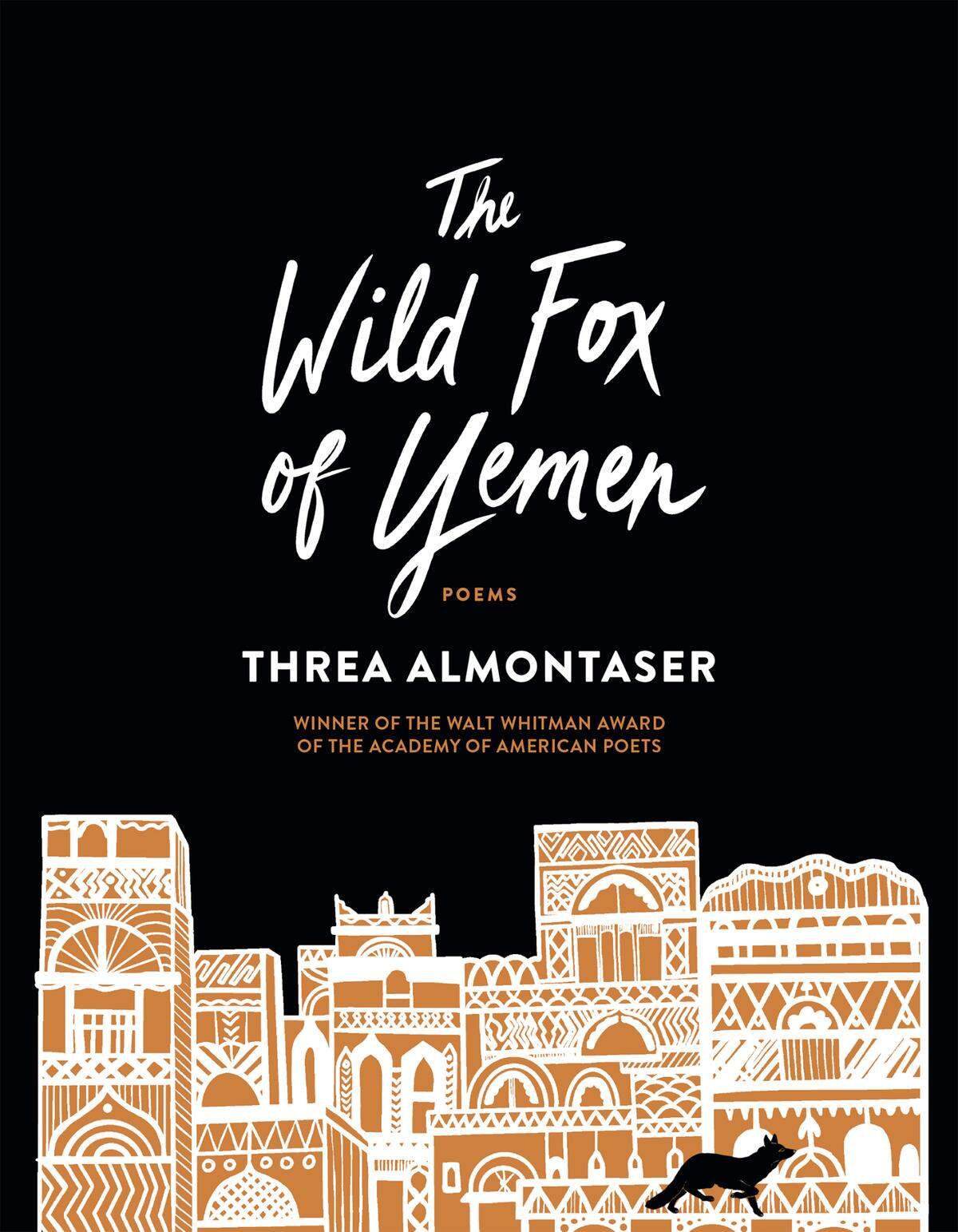
Threa Almontaser says she wants to leave her titular fox open to interpretation.
In October, her debut poetry collection, “The Wild Fox of Yemen,” was the inaugural winner of the Maya Angelou Book Award, presented by the Kansas City Public Library and the University of Missouri-Kansas City.
The fox doesn’t show his bushy tail many times in the collection, but his crafty presence is woven throughout. And as might be expected, he’s hard to pin down.
Via email from her home in North Carolina, Almontaser writes, “I am drawn to the idea that the trickster troubles things out of a kind of hunger.”
Which is exactly what the voice of the book does. Seemingly starved for a place in the world, the speaker “troubles” what it means to be American-born yet still alien, what it means for a family to transplant to U.S. soil with hopes of cultivating new growth yet feeling its roots rot.
These are difficult, almost abstract concepts to impart to a general audience, and Almontaser knows it. The language is attention-grabbing, even inflammatory in places, and seemingly chosen to discomfit a reader — some of it inappropriate for print in a daily newspaper.
“Provocation can be that kindle of inspiration for someone who needed one more push to make a big change,” Almontaser says. “It’s an evoking, a calling forth, a radical presence. Reading poetry slows us down enough to imagine, if only for a few moments, these other people’s lives.”
In the poem “I Thicken the Room w/Dim mirrors & an Altar of Aliens, Waiting for a Sign,” Almontaser writes about the speaker’s mother’s interaction with Avon customers, none of whom asks, she writes, “Where are you really alien?”
“We forget Lady Liberty is flammable & foreign, corroding a petrified green. Her mirror, our mirror. In it, the alien grimes. She alienates all other tongues. The carbon moon path leads to a necklace of joy-armored aliens. it follow I.”
A strength of this collection, which is the latest FYI Book Club selection at the Kansas City Public Library, is Almontaser’s ability to draw the reader into the predicament caused by the hunger to not be “other,” and the hunger for belonging.
Throughout the collection, she inverts sentences like the one above (.it follow I), forcing even a native English speaker to stop and interpret the text — in this case that means reading from right to left as in the Arabic language.
Similarly, Almontaser peppers the pages with Arabic words and transliterated Arabic words with little or no explanation. Those who don’t know the language must pause and puzzle out the meaning of the words through context — that’s only sometimes possible.
“I would hope it empowers and fuels the poems in a special way,” she says, “and that (readers) have fun Googling or asking Arabic-speaking friends for answers.”
But the effect goes well beyond special and fun; the unexpected foreignness of the words and syntax railroads the reader into the role of immigrant.
Almontaser won the Maya Angelou Book Award specifically for demonstrating a commitment to social justice through her poetry. This is the first year for the prize, but each year the goal will be to draw attention to work that enriches the diversity of American literature — the type of work Missouri-born writer and poet Maya Angelou contributed.
Angelou’s son, Guy Johnson, says that his mother’s “attitude was ‘I write from the Black experience, but I aim for the human heart.’”
And so it is with Almontaser’s work; it’s specific to her experience as an American-born Yemeni, but she crafts the alienation of the poems’ voice into a universally relatable shape.
The poet, who’s also a translator and multimedia artist, grew up in New York City and moved to North Carolina for her graduate studies. She now teaches English to immigrants and refugees in Raleigh. In March, she’ll begin a residency at Duke University.
While it’s easy to assume that her poetry is autobiographical, Almontaser keeps the details of her private life close enough to her chest that it’s hard to say what’s factual. Are these her actual aunts adorning their skin with intricate henna tattoos? Are these her uncles and cousins arbitrarily falling prey to immigration raids and attacks on the street? Is this man from Yemen and woman who has sewn her “citizenship into her hijab” her real parents falling in love on a balcony?
The poem “Heritage Emissary” draws the reader into the discomfort of living between two languages, two cultures, through the common experience of a teenager tricking a parent about what’s going on at school.
At the outset of the poem, the speaker grapples with classmates’ treatment of her that suggests they think she may be a terrorist or a witch. She’s just returned from Yemen, and her English is tainted by time with another tongue.
The voice of the poem is “out of breath” from code-switching, that is, switching between English at school and Arabic at home, “crunching the sand it leaves in my teeth.”
She’s gotten a D in algebra; she’s been suspended for fighting.
The school threatens to call her parents, and she shrugs and says, “Taib. Go ahead. They’ll say, yes yes, but won’t yafhumun, will ask me about it later so I can twist it.”
But that same night at dinner, her father tells a childhood story in Arabic about catching a wild fox — here’s that trickster — in Yemen with his brother.
She drowns him out but apologizes for doing so. “It’s only that my languages get mukhtalita, and when he talks it sounds mithl poetry. So when I hear a line about a lost, sly animal, I am struck mute. Think he means me.”
But is that fox her? Or something more like the elusive in-between place she occupies? A good reader is called upon to consider all possibilities.
Almontaser says that the duality of identities is a part of so many lives and, in her case, that’s what mobilizes the use of multimodal language in her poems. However, many readers never experienced that duality of identity.
So she “troubles things out of hunger.” She provokes her readers not only with words they don’t know, but also with the gift of a vantage point they’ve never had.
Join the discussion
▪ The Kansas City Star partners with the Kansas City Public Library to present a book-of-the-moment selection every six to eight weeks. We invite the community to read along. Kaite Mediatore Stover, the library’s director of readers’ services, will lead an online discussion of Threa Almontaser’s “The Wild Fox of Yemen” at 6:30 p.m. Tuesday, Jan. 11, via Zoom. Email kaitestover@kclibrary.org for details on joining in.
▪ Almontaser will give a reading at the library on Wednesday, April 27. Watch the library website, kclibrary.org, for details.
An excerpt
The poem “Dream Interpretation (Fox)” is part of Threa Almontaser’s poetry collection “The Wild Fox of Yemen” (Graywolf Press).
Found napping in your purse means you will bump into your younger self trekking
through a botanical garden, searching for an apology.
A tail plucked and pinned to your hijab means an uncle will beg you to marry his son,
bring him across the ocean where he won’t know hunger.
I can’t stop eating, even the spines — they shred my throat, tongue a raw copper. I have
stopped apologizing with intention. Get myself a triple cheeseburger, bacon this time.
Very American. Because that’s what I am now, right? Tripping over familiar shapes on an
empty road, dizzy from the shisha and pork, thinking headlights look holy from afar.
How easy to make a thing all wrong. Most of my cousins are dying. The littlest leads me
by the hand into a cave streaked with limestone, handprints, a swollen matriarchy. I find
our famished ancestors cooking beside orange tatters. In their circle, a fox, her body ready
for the fire.