
Our book club readers toast ‘Girly Drinks’ and author Mallory O’Meara

It was a BYOB kind of evening at the most recent gathering of the FYI Book Club. Attendees not only brought their own books, they brought all manner of beverages to toast reading “Girly Drinks: A World History of Women and Alcohol” and talking with the author, Mallory O’Meara.
Before diving into deeper conversation about women’s varying roles in the development of one of the world’s most lucrative industries, readers felt the need to address a crucial question. Exactly what “is” a “girly drink”?
Judith Reagan, Kansas City, was surprised. “I have never heard that term before,” she said laughing. “But I think it’s pink drinks. Isn’t a Cosmo pink?”
Ellen Schwartze, Kansas City, said, “If you’re going to be stereotypical, it’s got to have a lot of sugar, and serve it in a cute glass.”
“Anything with an umbrella,” said Debbie Gamm, Kansas City.
“I’ve only heard it as a pejorative term,” said Evelyn Summers, Kansas City. “It’s nice for Mallory to work it so we can take the term back.”
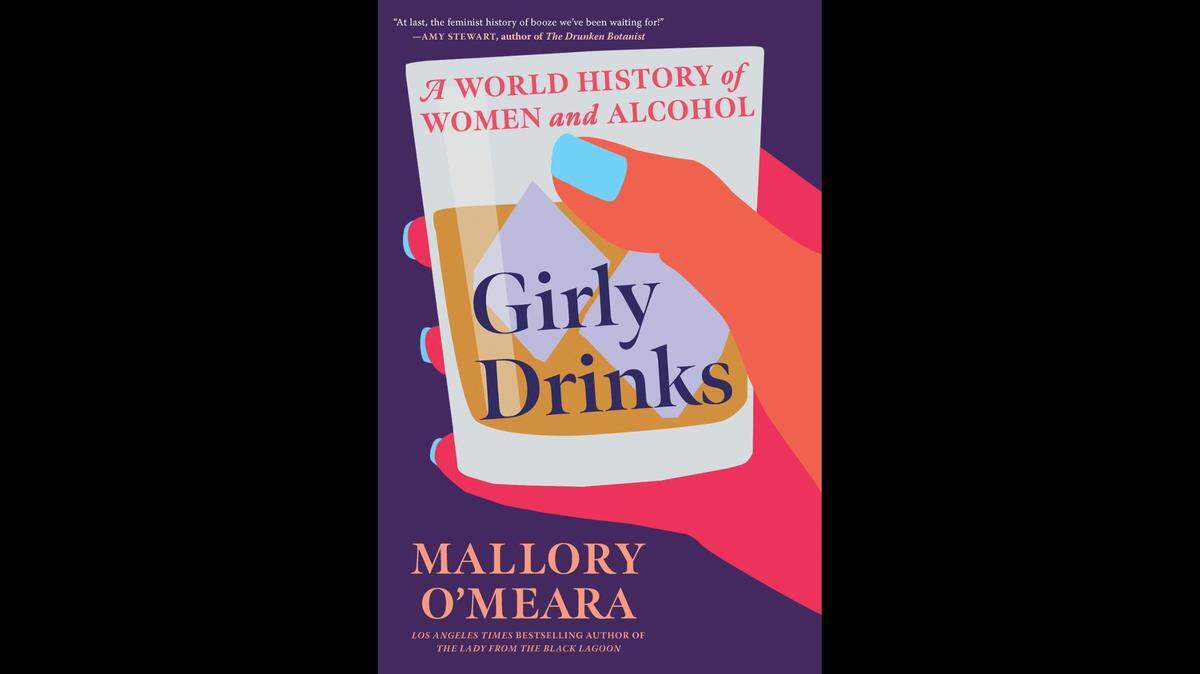
Louisa Whitfield-Smith, of Jackson, Mississippi, pointed out the cover of the book was decidedly not pink. “I love how the designer used a high ball glass. It could be a whiskey sour or an Old-Fashioned or bourbon. You know right away this is not going to be a book about what culture has told you is a ‘girly drink.’ It’s going to be about real women.”
Schwartze described a “Cyanide and Happiness” cartoon strip. “This cartoon dude walks up to the bar and asks the bartender for the girliest drink you have. She hands him a straight shot of whiskey, and when the guy asks, what is this? The bartender says, Yeah, you better woman up.”
That comic is a humorous picture of a serious subject as presented by O’Meara in her book. Thousands of women contributed to the history of distillation, creation, consumption and business of alcohol, but O’Meara only had 15 chapters in her book to tell their stories.
Since the discussion took place online, Whitfield-Smith, demonstrated how to make a Silver Fizz, a classic cocktail recipe from a vintage book on “household management” by Isabella Beeton. O’Meara references this manual in “Girly Drinks” and points out that Beeton’s book reached “a Kardashian level of influence” upon publication, yet the book is all but forgotten today.
Readers laughed over the measurement of gin, a “wineglassful.” No one knew exactly how much gin that might be. “But I’m not surprised that it’s the measurement a woman would use,” said Gamm. “That glassware is going to be easy to find in a kitchen.”
This issue led to a conversation about stereotypes involving women and alcohol. Schwartze mentioned one of the most prevalent, “Women and wine. The stereotype of a woman who LOVES wine and can always be found with a wineglass in her hand.”
Lisa Timmons, Kansas City, said, “The notion that women can’t handle their alcohol like a man can.” Schwartze agreed: “That’s a silly stereotype, the instant drunk, ‘ooh I’m so tipsy, I’ve had one glass of wine!’”
Gamm elaborated further and said, “The idea that a woman who drinks is free-spirited or looser in her behavior. Maybe more reckless. A wild woman.”
“This book opened my eyes,” said Gamm. “I had no idea there were so many women involved in the development of alcohol. Hildegard the nun, the widow Barbe-Nicole Clicquot, Li Qingzhao and her sake empire.”
Reagan agreed. “Women have been on the scene and behind the scenes wherever alcohol has existed,” she said. “From making it in the kitchen to running massive business empires. But we’ve lost so many of their names.”
Gamm expressed dismay when she pointed out, “No one remembers Tatsu’uma Kiyo, the Japanese sake business woman. She was not honored as a successful woman; it just wasn’t something her community could be proud of.”
O’Meara, joined the discussion, and the group wanted to talk about women, brewing, economics, and politics.
“By the end of the book you can see a pattern: Women start an industry, they’re doing well, doing it for their families or community, and then men take it over and monetize it,” said O’Meara. “When a country is colonized, the first thing done is take over the alcohol. It’s an easy way to control the people. Telling a woman she couldn’t brew was telling her she couldn’t provide for her family. She couldn’t feed her family. Beer was a valuable food staple during the Middle Ages.”
Several readers cited the Prohibition chapter as their favorite. O’Meara laughed and said, “It’s my favorite, too. It’s the longest and it could have been longer! I had to trim so much. It could almost be its own book!”
O’Meara went into more detail about women, voting and Prohibition. “There’s this belief that once women got the vote, they voted out alcohol. The two became entwined.” O’Meara said.
“It became a rallying point for the Women’s Christian Temperance Union. The popular thought was if we get rid of the alcohol, we’ll get rid of the social problems. If people don’t drink, they won’t hurt their wives or children and they’ll work more. It became a political movement and they weren’t wrong. They really did think it would be easier to ban alcohol than ban violence against women.”
O’Meara pointed out that it was women who played a prominent role in the repeal of Prohibition, and she spoke specifically about Pauline Sabin. “It’s frustrating when you read these cocktail histories, these incidents aren’t mentioned. It was all women who did all these brave political moves and making things happen.
“Women are the ones who gave us back alcohol. Pauline Sabin saw how hypocritical it was. She saw that people were dying from terrible alcohol. They didn’t stop drinking, they stopped drinking safely. They were drinking bad liquor. The crime rate was up. Pauline rallied all these women to vote to repeal Prohibition. It was a massive campaign Pauline organized.”
“I wanted readers to see that cocktail history is a history of women,” O’Meara said.
Whitfield-Smith had an idea for keeping the names of these women in the public consciousness. “There are so many festivals involving women and alcohol that need to be revived,” she said. “The Mesopotamian festival of Hathor, the Japanese women’s moon viewing parties, the beer parties of rural South African women.”
In unison, the group nodded and raised a glass in tribute.
Join the club
The Kansas City Star and the Kansas City Public Library present a book-of-the-moment selection every few weeks and invite the community to read along. The next book will be “The Wild Fox of Yemen” by Threa Almontaser. Look for an interview and book introduction Dec. 19. To participate in the book discussion led by the library’s Kaite Stover, email kaitestover@kclibrary.org.