
Kansas vet found fame in Ken Burns series. Now his book delves deeper into hell of war
John Musgrave has a story to tell.
In 1966, he started the paperwork to enlist in the Marine Corps when he was just 17 years old. His parents met his intent to join up with the same reluctance of those whose child wants to fight bulls for a living. Over the previous year, thousands of U.S. servicemen had been killed in combat in Vietnam, including Bill Peck, a classmate of Musgrave’s from Van Horn High School in Independence.
But service to the country ran deep in his family; his father had served as a teenage pilot in the Army Air Forces, and throughout his childhood, Musgrave would often eavesdrop on his father and his father’s friends discussing World War II.
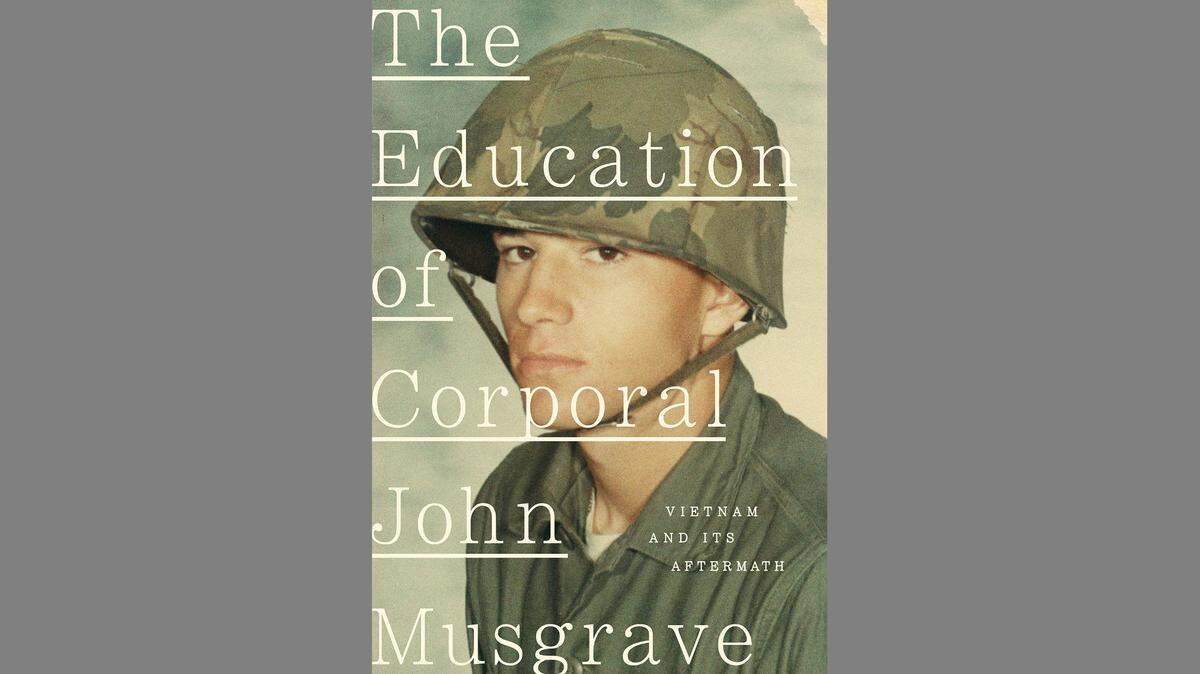
“They were just regular guys from the neighborhood,” he writes in his new book, “The Education of Corporal John Musgrave.” “But they had done extraordinary things in service of their country.”
Those who tuned into the 2017 Ken Burns and Lynn Novick documentary “The Vietnam War” know how his childhood dream of serving his country turned into an 11-month nightmare.
On a Saturday afternoon in October, I drove to Musgrave’s home in Baldwin City, a few blocks from where he attended Baker University on the GI Bill. A pair of barking chihuahuas greeted me at the door. Light slanted weakly through the shutters near where Musgrave sat stoically and slightly shivering in a leather recliner. Across from him, DVDs documenting various wars lined the built-ins around his TV.
I’d seen Musgrave speak in 2018 when he was inducted into the Van Horn Hall of Honor alongside my father, Joseph Gall. Wrapped in a fleece blanket emblazoned with fighter jets, he resembled Colonel Kurtz from “Apocalypse Now” more than the robust former Marine from my memory.
“Combat is a lunatic asylum,” he told me, his voice a gravelly whisper. “You’re just so terrified and so filled with hatred because the hatred gives strength to your terror. You can use your terror if you hate enough. So none of us were in our right minds.”
Musgrave’s frankness about his experience in the “Vietnam” documentary, including the confession of the extrajudicial killing of soldiers and civilians, gained national attention. Among the ensuing correspondence he received, an Air Force veteran accused him of war crimes and suggested he ought to be in prison for his violation of the Geneva Convention.
“I can’t tell you how many times I heard this in the bush: ‘This ain’t Geneva, man,’” said Musgrave. “‘We get to Geneva, you tell me all about that place. But get the (expletive) out of my face now.’”
The creators of the documentary view Musgrave’s contributions like most of the others who’ve reached out to him: as an honest and necessary voice speaking out against the horrors of combat. At the time of its airing, Burns drew parallels between Musgrave and another Kansas City icon who had spoken for a generation of players in Burns’ documentary “Baseball.”
“You can think of Buck O’Neil in the same breath,” he said during an appearance in Kansas City to promote the documentary.
Of all the veterans they’d found, and all those that Musgrave had contacted thinking they’d be more helpful to their purpose than he, they pegged him as a prominent voice to speak for the generation of soldiers who’d carried the weight of the war upon their shoulders.
It was a voice, they must have believed, that could end up saving lives.
War is not glorious
In the opening chapter of “Slaughterhouse-Five,” which Kurt Vonnegut wrote at the height of U.S. involvement in Vietnam (the son of the main character is a Green Beret), the author visits an old war buddy to rekindle some memories from their time in Dresden that he might then use in a novel he plans to write about the war. Stewing about Vonnegut’s presence since his arrival, his friend’s wife, Mary, finally confronts him about her anger toward his project.
“You’ll pretend you were men instead of babies,” she says, “and you’ll be played in the movies by Frank Sinatra and John Wayne or some of those other glamorous, war-loving, dirty old men. And war will look just wonderful, so we’ll have a lot more of them. And they’ll be fought by babies.”
“A great book,” says Musgrave, who after the war helped operate Adventure Books in Lawrence. “We need to discourage portraying it as glorious, because it’s not. It’s damned hard work, it’s terrifying, and it’s mostly done by kids.”
Vonnegut gave his novel the subtitle “The Children’s Crusade.”
When he was a child, Musgrave spent a lot of time in movie theaters consuming the kind of stories Mary was trying to prevent. Movies like “Porkchop Hill,” starring Gregory Peck, were full of exciting sequences that were more titillating than terrifying.
“To my young eyes, it was just cooler than (heck),” he says. “They weren’t conveying the terror to me, just the excitement of firing on full automatic and throwing hand grenades.”
To avoid falling into the same trap, “The Education of Corporal John Musgrave” eschews glorifying imagery or language for the same plainspoken, stripped-down manner of the 17-year-old grunt that was fighting at Con Thien.
When a 19-year-old kid steps on Bouncing Betty — a pressure-released mine that exploded waist-high after someone stepped off of it (“it didn’t just blow your legs off; it ripped them off, tearing through flesh and bones”) — Musgrave arrives on the scene with battle dressings that would prove useless.
“His eyes were completely red — no whites at all,” he writes, “I guess from the concussive force of the explosion, which had burst all the blood vessels in his face. He was in shock and kept saying over and over, ‘What’s going to happen to my little girl? Oh, God! What’s going to happen to my family?’ They gave him a blood transfusion and loaded him onto a helicopter, but he died on the bird.”
After his first kill, which he describes in terse, unromantic detail, he doesn’t feel like Peck or “John Wayne or Steve McQueen — my cowboy heroes. I thought it was going to be cool. I thought I was going to feel great.”
Instead, Musgrave gives a naked, raw account of not only death but his often paralyzing fear. When another Bouncing Betty exploded near his foxhole, maiming two fellow Marines, “I had to listen to their moans, and it was unbearable. Sloan, a young black Marine from the Deep South … crawled out into that minefield to get the bodies of the two who were already dead. … I was too scared of the mines. I stayed right where I was.”
Sloan would receive the Silver Star, one of the highest decorations for valor in combat.
“It’s tempting when you get a forum,” Musgrave told me, “to want to paint yourself as a hero, for your kids. But that’s just not the way I saw it, and … people need to know it’s the greatest violation of civil rights on the earth — to terrify people like that. If we don’t know the truth about what our children go through in the service to our country, then how can we appreciate our freedom? We need to know.”
Speaking truths
Upon his return to the United States, Musgrave made it his mission to tell the truth of what he’d experienced while simultaneously defending the position of those who’d been tasked with duties many at home had shirked — the same population who was unequipped to grasp the immensity of trauma U.S. soldiers suffered in service of their country.
“When I left for Vietnam, the peace movement hadn’t really taken off,” he writes in “The Education of Corporal John Musgrave.” “They weren’t holding giant marches yet. That all started in 1967. On the deceptively short voyage home, all I could think about was how lucky I was to be returning to the safety and comfort … of my family and friends, and the support of neighbors and teachers and citizens who had beamed with pride when I deployed. But as I mulled over the word ‘protection,’ it slowly dawned on me that the America I had left behind when I shipped out for Vietnam was not the America to which I had returned.”
In the book, some of the more fascinating scenes involve clashes between the countercultural forces at work in nearby Lawrence — a relative hippie mecca — versus the more tepid reception Musgrave had received in Baldwin City.
“I was struggling like hell, completely conflicted,” he writes concerning the draft lotteries while he was harboring his own fantasies about returning to the bush. “I’d sit in the back of the room, while all of these guys sat on the edges of their seats worried that they’d pull a bad number. And when one of them did, I’d start laughing at the top of my lungs. My heart was cold.”
In the absence of a comforting public, Musgrave found solace in an unexpected place: World War I literature. He credits poets like Wilfred Owen, who died in combat, and Sigfried Sassoon with providing an alternative to depression and the suicidal thoughts he’d encountered after the war.
“The disillusionment of the British infantrymen just came through so honest to me. Those guys, they kept me alive,” he said. “In the darkest days, I remembered them from high school and thought, ‘Wait a minute. There is another way I can approach this.’ The paths that they blazed saved probably hundreds of thousands of lives over the years.”
It was as if they were speaking directly to him, combat veteran to combat veteran, across the vastness of time. And something must have clicked for Musgrave, because he began a personal crusade to not only speak out against the war, but to ensure that those who are traumatized are welcomed back and provided with the support they deserve.
Most recently, Musgrave has worked with soldiers returning from Iraq and Afghanistan at Fort Riley, Kansas.
“There are countless paths to loneliness, anger, and isolation,” he writes, evoking his own emotional registers following the war, “and we wanted these kids to know that they were not alone.”
In the book, Musgrave describes how the community rallied around his efforts. Other Vietnam veterans joined him and the Fort Riley soldiers, and they ate barbecue together at a local establishment, a private space for them to gather.
Slowly, they began to share their stories. For the younger men, these were the beginning stages of healing. But it was healing for the Vietnam veterans as well, who “asked as many questions as we answered,” writes Musgrave. “Sometimes they’d even offer ideas that they thought might help us, and we’d listen to them with open minds.”
Of all the programs soldiers at Fort Riley had participated in, an Army captain told Musgrave that his was the most effective. He had begun to do the work those who’d come before had done for him. Musgrave had begun to save lives.
Disillusioned warriors
As a country, we have continually failed in fulfilling our promises to veterans, in part because the general public is out of touch with the military, an all-volunteer force representing a mere 1% of the population.
“Because of this,” writes Musgrave, “we have a whole new generation of disillusioned warriors coming home, and we can’t afford another generation of disillusioned warriors.”
Look no further than fiction for proof that, over the course of 100 years, we continue returning to the same themes. In Ernest Hemingway’s short story “A Soldier’s Home,” published in 1925, the protagonist grows tired of telling his war stories to men who didn’t fight and who enjoy only the most obscene details. He finds comfort only in the company of other soldiers, and only there does he tell the truth, that “he had been badly, sickeningly frightened all the time. In this way he lost everything.”
In “Slaughterhouse-Five” (1969), Billy Pilgrim’s wife is so enamored with the antebellum notion of nobility and honor, that despite the fact that he was ineffectual and terrified as a soldier, it’s nevertheless become for her his distinguishing characteristic.
“I look at you sometimes,” she says, “and I get a funny feeling that you’re just full of secrets.”
But she isn’t interested in the truth, especially the fact that Billy, likely suffering from PTSD, believes he’s been abducted by aliens and imprisoned on a planet called Tralfamadore, not unlike the German camp where he was imprisoned during World War II.
In “Home,” by George Saunders (2013), a veteran of Operation Enduring Freedom struggles to adjust to civilian life following unspoken horrors he’s experienced in Iraq, alienating the family who doesn’t — or won’t attempt to — understand what he was asked to do. His life is like Musgrave’s waking nightmare, his own family’s home becoming the home of those he’s destroyed. In this way, Saunders places the burden upon us all, not on the shoulders of the 1% who elected to serve:
“Okay, okay, you sent me (to war),” the narrator says, as if to the audience, “now bring me back. Find some way to bring me back … or you are the sorriest bunch of bastards the world has ever known.”
John Musgrave continues to bring others like himself back home by telling the truth. It’s well past time for the rest of us to listen.
Zac Gall teaches English at Blue Valley West High School. He lives in Overland Park.