
FYI Book Club first: Kansas City author’s poetry in the key of blues. They loved it
Poetry can be intimidating for many readers. But not the FYI Book Club.
Attendees gathered recently to discuss the first volume of poetry ever selected for the FYI Book Club, “Blue Beat Syncopation: Poems 1977-2002” by Stanley E. Banks.
This collection was a signature read for the Kansas City Public Library’s Summer Reading program, Homegrown Stories, recognizing Missouri-related titles, authors, and programs as part of a celebration of Missouri’s bicentennial.
The group was also treated to a visit via Zoom from the poet, who took questions, read two poems and talked about the power of words to make a music all their own.
Many of the poems in the collection resonated with the readers. Dawn Downey of Kansas City said “A Proposition for the Suicidal,” a poem describing a person’s final moments, stayed with her long after reading it.
“This poem smacked me,” Downey said. “It’s a good feeling to have my mind twisted in another direction. I felt Stanley Banks giving honor to the death he writes about in this poem. He gave agency to this person and treated his choice to die with a sense of power and strength and decision making, rather than sink into hopelessness.”
Rita Hertenstein, Kansas City, gravitated toward two related poems about a single person. “Carl” and “Carl at 15” look at different times in a young man’s brief, tragic life.
“Banks took two very different sides of a person and created a whole,” she said. “Just by using words he gave this person flesh and blood and feelings. I thought it was beautiful in these two pieces.”
Instead of reading the title poem, “Blue Beat Syncopation,” Robbin Williams, Kansas City, listened to a special video recording Banks made at the American Jazz Museum. “It gives you the same feeling you get when you hear music and spoken word over it,” said Williams. “It made me think of Langston Hughes talking about the ‘weary blues’ or other poetry that sounds like it could be set to music. Or replicating the rhythm of music with words.”
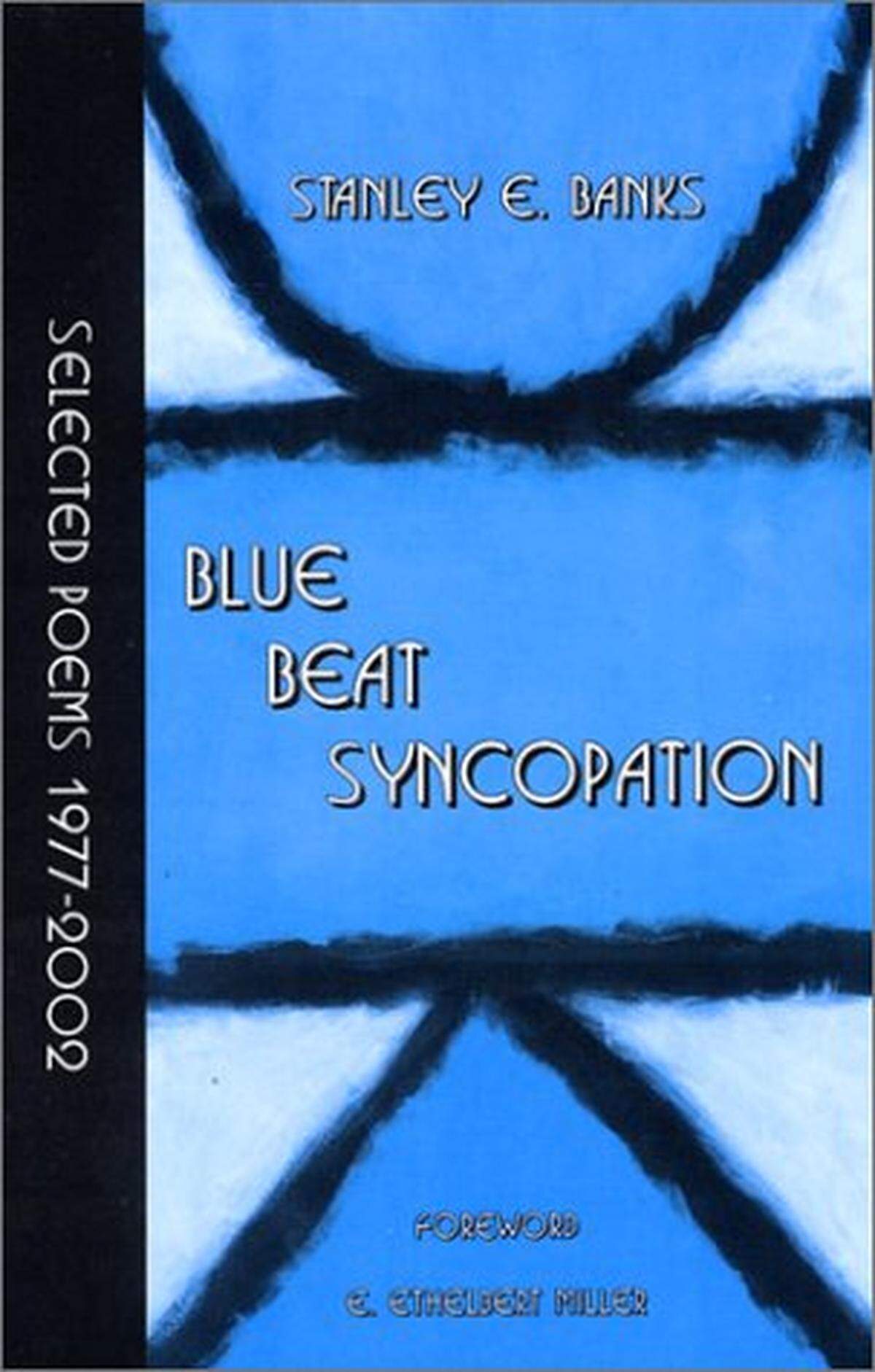
Readers took a moment to ponder the significance of the poem’s title. Williams said, “With syncopation, things are on the upbeat or can move a little differently. Most African American music, like jazz and blues, are in syncopation. They move on the upbeat.”
Downey immediately understood where this definition fit in the poem. “There’s an irony and a twist. Because this poem is definitely about African Americans, but Banks ends it with not Black, not white, it’s blues.”
She pointed out how active the poem is. “A lot of poems you absorb and savor; they’re still. But this poem is movement and rhythm all the way through. It’s not a still poem. The poem itself is music because it’s talking about movement and dance.”
Malcolm Cook noted how celebratory the poem is. “It asks the reader to engage with all these different aspects of culture. And the celebration is tempered with the raw pain of Billie Holiday, Tupac and Biggie. Their stories may be desperation stories, but at the end there’s universality. This poem is asking all readers to say you have a stake in this. The blues are a universal vehicle for telling stories across culture and ethnicity.”
Ben Furnish, Kansas City, said, “This poem’s voice is in the imperative. Commands or requests to engage in one or another cultural element.”
Cook agreed and said, “Banks uses ‘jazz’ as a transitive verb, which caught me. At the end of the poem the demands are abandoned and at the same time saying it’s universal.”
Lynn Snyder, Kansas City, noticed the tone of the poem. “Blues songs are usually about sad experiences, but the experience of listening to the blues is uplifting,” she said. “The poem has a similar structure with the ‘grandeur’ of Nat King Cole’s voice and the sadder and sadder stories of the following artists in the poem. But at the end of the poem, the reader is brought to an emotional high.”
At this point, Banks joined the group. Readers continued chatting about the title poem with him, particularly the title.
Williams said, “There were so many questions about syncopation and emphasizing other beats, particularly in the context of African American music. People can use the same words, but emphasize different words or syllables. It changes the entire way you think about the word or the poem”
“I didn’t want to be too technical,” Banks said. “I came across the word ‘syncopation’ and it jumped out at me. Then it struck me, that’s the way I read my poetry aloud. I put the accent on different words in ways that aren’t typical.
“Think of syncopation as a kind of power,” he said. “Black artists come into the public collective and it’s usually in an off-beat kind of way. Being twisted or stereotyped.
“I’m making people see language in a different, musical, rhythmic way. Hook them with the first line and then punch them in the gut with the last. I want people to feel something. I don’t want the reader to go away saying, that was nice, that was sweet. I’d feel insulted.”
Marcellina John, Kansas City, asked Banks about a poem he wrote 30 years ago, “America Are We Safe, Were We Ever,” about social injustice, racism, climate change and immigration. “Do you read this poem differently today than when you first composed it?” John said.
Banks thought for a moment and said, “No, I don’t read it any differently. It still hits me. I was just listing all the things that were out of whack and driving me mad when I wrote it. That common theme of your government saying, ‘we’re keeping you safe, we’re keeping the children safe, let’s all be safe.’ What is safe? Have we ever been safe? Was there ever a time any human being felt totally safe?”
Downey said, “I want to pay a compliment to you. I see death as a part of life. I’m getting older and I like to talk about death and the body.” Downey laughed, “It’s a science experiment! So thank you for talking about death in your poems.”
Banks chuckled and told a story about a critic who noticed how often Banks wrote about murder and death. The critic “hoped Banks was well.”
Banks said, “There’s a certain kind of death that is so slow and I’ve seen it in my lifetime. People don’t commit suicide but they’ve been dead forever and then finally they’re dead. I think by the time I was 21 I had been the front person for two funerals. I decided I’m going to get better at this living thing and I’m going to make other people’s lives better.”
Banks looked into the camera at each reader and said somberly, “Some people are afraid of life. They worry too much about death. Get busy living.”
On a note of finality that was by no means his final word, Banks said, “I call myself a pessimistic optimist. Because I know all the bad stuff. I’ve seen the blood and the terrible stuff. But I’m trying to have something hopeful towards the end.”
Kaite Stover is the Kansas City Public Library’s director of reader’s services.
Join the club
The Kansas City Star and the Kansas City Public Library present a book-of-the-moment selection every few weeks and invite the community to read along. The next book will be “Girly Drinks: A World History of Women and Alcohol” by Mallory O’Meara. To participate in the book discussion led by the library’s Kaite Stover, email kaitestover@kclibrary.org.