
At 67, she could have retired, but instead she reinvented herself. It wasn’t easy
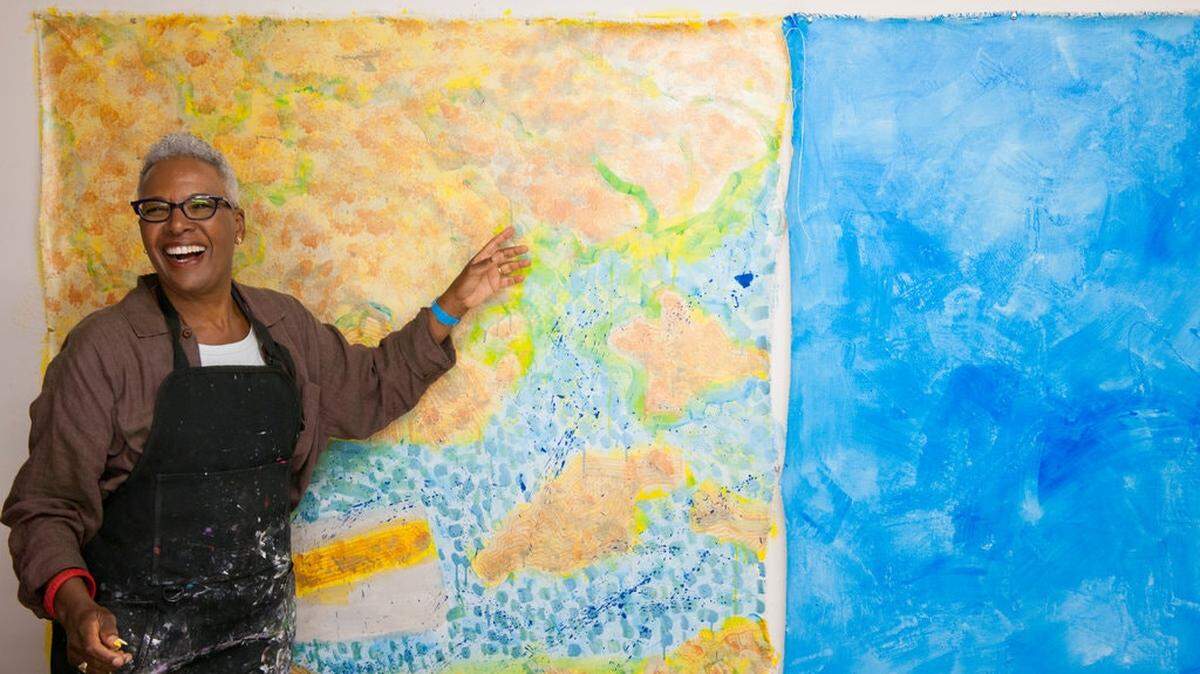
It has been more than 10 years now, and Nell Painter still seethes over the contempt a graduate school instructor showed one day for her potential as an artist.
“You may show your work.
“You may have a gallery.
“You may sell your work.
“You may have collectors.
“But you will never be an artist.”
Was it because of Painter’s age? She was 67 at the time. Was there resentment that someone who’d spent three decades in higher education, writing seven books and gaining national renown as a historian at Princeton University, deigned to think she simply could slide over to the world of art and make a meaningful mark?
Whatever the disadvantages of being a certain age in art school — and they certainly existed — Painter looks back and sees one real benefit. “If somebody had told me that when I was 23, I would have crumpled up,” she says of her printmaking professor’s dismissive remark. “I’ve said that many times and, every time, somebody will tell me that they or somebody they knew was told the same thing and thought, ‘Oh my God, they’re right.’ And they quit.
“I think if you’re over 30, or more certainly if you’re over 40 and definitely if you’re 50, you’ve lived through so many experiences and challenges that if some (jackass) of a teacher tells you that you’ll never be an artist, you know it’s B.S.”
She told the guy so. In those explicit terms. Painter put in five years of art school, earning bachelor’s and master’s degrees at a time in life when many are easing into retirement. She now makes art that she’s proud of, expressive and provocative pieces often incorporating her historian’s appreciation for written text.
Other devotees apparently share her eye. They’re buying.
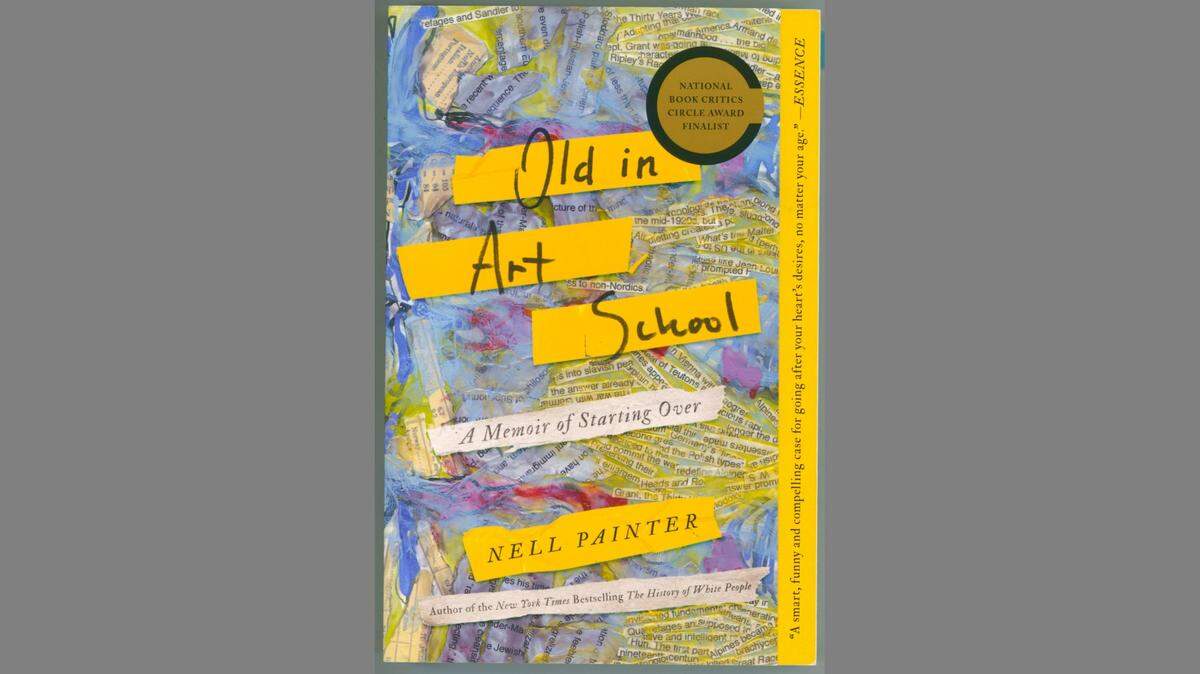
It’s an exceptional shift in her life’s course — challenging, exhausting, ultimately self-affirming — that Painter chronicles in her eighth book, “Old in Art School: A Memoir of Starting Over.” A finalist for the National Book Critics Circle Award for autobiography in 2018, the memoir is the Kansas City Public Library’s latest FYI Book Club selection.
Painter will talk about the book and her experiences in an online Library program Nov. 16.
“Going through art school and launching myself into this different career, I look back on it and … getting a Ph.D. in history at Harvard was a piece of cake in comparison,” she says.
“Who I had been before didn’t count. I don’t consider myself a diva. I don’t insist that people give me props and all that. But when I went to art school and none of that counted and I was nobody, it was a shock.”
Painter had risen rapidly in academia, becoming an important, oft-sought voice on African American history and identity. She gained tenure at the University of Pennsylvania in three years, was a full professor at the University of North Carolina in another three years, and headed Princeton’s Program in African-American Studies for a time during her decorated, 17-year tenure there.
Her 2010 book “The History of White People” was a best-seller, and she earned Guggenheim, National Endowment for the Humanities and Fulbright fellowships. She holds honorary doctorate degrees from seven universities including Yale and Dartmouth.
Which meant … not a whit when Painter enrolled at age 64 in Rutgers University’s Mason Gross School of the Arts. She had originally majored in art in college, and was acting on a lifelong love. She also took inspiration from her mother, who’d reinvented herself late in life as an author.
Mason Gross was tough, and so was grad school at Rhode Island School of Design in Providence. Painter’s long adherence to order and scientific truth as a historian was seen as contradictory to the spontaneity of art. Race wasn’t an apparent issue. The art world has had its awakening there.
But boy, age was.
“I was used to juggling my self-perception and other people’s views of me as a black person and as a woman, from with and without,” Painter writes. “But now what I took as me seemed almost inconsequential as my essence shriveled to my age. That was something new.”
She endured that. She endured the put-downs and the doubts and her own inevitable reservations. She got through the added strain of tending to her aging parents more than 2,500 miles away in Oakland, California.
Painter received her master’s in fine arts in 2011 and settled in, as she put it, as an “emerging artist, but in an old body.” She reached a milestone of sorts just a month ago, making a first sale of one of her works — a 28-page artist’s book melding collage, drawing and text — to a gallery in New York City. Called “American Whiteness Since Trump,” it’s an artistic follow-up to her best-selling book on the evolution of racial categorization.
Painter and her husband, Glenn Shafer, a Rutgers business professor who grew up in southeastern Kansas and once taught at the University of Kansas, celebrated the breakthrough together. “A nice bottle of French champagne and big bag of tortilla chips,” she says, chuckling.
Painter, now 78, recently discussed her book and her transition from eminent historian to artist. Excerpts from the conversation are edited for length.
Q: How much harder was it to write a memoir, write your personal history, than it was to write the seven history books you’d previously authored?
A: Infinitely harder. I flopped and flopped and flopped around, and then at one point my agent said, “You’re just going to have to do this right.” What I heard was, “You’re going to have to do this right or this project isn’t going anywhere.” I doubled down, worked really, really hard. I probably wrote a hundred versions, just a lot of revision.
In the process, I learned some things about myself that I couldn’t get to without digging that deep. I think the biggest example is in the chapter “A Bad Decision” (in which Painter recounts going straight to graduate school despite the expressed doubts of others and her mother’s impending death). I didn’t understand that event until I was writing and rewriting. I realized I was feeling so pressed for time then because my mother was dying and she didn’t have any time.
Q: How revelatory was your experience? Were you expecting art school to be a utopia?
A: Utopia’s too strong a word for it. I didn’t expect that I would have this gigantic handicap, which is age. It really is a young world, obsessed with youth. You could say (it was difficult because) you were a Black artist. No. Young Black artists live an entirely different experience from what I lived and what other old artists — especially other old, 20th-century Black women artists — live. That’s why “old” is in the title.
Q: You wrote that you had to “purge the anger” from the first draft of your master’s thesis. Can you go into that?
A: I was (ticked) off that my artist teachers were pretending there are standards in the art world like there are standards in scholarship. Which there aren’t. What you call value is almost literally value — what you can sell something for, the prestige of what you can sell it for and to whom. Whereas, in scholarship, we have standards. You know how to weigh one source’s reliability compared to another. We have peer review. We have steps: You’re an assistant professor, you’re an associate professor, you’re a full professor.
I can tell you what’s good art and what’s bad art. Much of that has to do with skill and experience and sophistication. But at the same time, what is good art is largely a question of taste.
Q: In the book’s acknowledgments, you thank associates for “helping me survive art school and learn a new way of writing.” Is that what art is, a new way of writing?
A: Yes. I can no longer write without images, which is why I make artist’s books. “American Whiteness Since Trump” came up because everybody was saying my book (“The History of White People”) had come out in 2010 and that was during the Obama era. Trump totally revolutionized how Americans think about whiteness. I needed to bridge that gap and take account. I didn’t just sit down and do another “History of White People,” a scholarly intellectual history of the concepts of American whiteness, which I would have done before art school. This time, it had to be an artist’s book.
I’ve since done another one called “From Slavery to Freedom” that takes account of the George Floyd, Black Lives Matter demonstrations and changes.
Q: What are your feelings about the representation of Black identity in art today? How has it progressed since the Black Arts Movement of the 1960s?
A: The Black Arts Movement made giant steps. And then it got forgotten, or was unknown, in the teaching I received. I talk in the book about a situation in a classroom at (Rhode Island School of Design) in which I had to gently correct a teacher who thought Adrian Piper (the conceptual artist who rose to prominence in the 1970s) was the first Black artist to investigate identity.
I am happy that there are millions of artists who are working now and making their own art. For me and other Black artists, the expectation of how to present Blackness is there. You can’t ignore it. But then, you need to ignore it and do it your way. For instance, Kerry James Marshall, in dealing with the question of color and shade, paints his Black figures a dark charcoal gray. There’s always been a lot of discussion about what’s the right way to do it. And there’ve always been a lot of different ways, which is good.
Q: You devote a chapter to your mother’s death in 2009. You said you’d been unable to draw her as she was dying. Was it a struggle to write about it?
A: I happen to love writing, so I wouldn’t say it was hard. But it was something that took a lot of work … many, many, many, many revisions. As for drawing her, I never could. And if she were to come back now and die again, I still wouldn’t be able to draw her. My father died in 2016, and I couldn’t draw him, either. I don’t think I ever drew my parents because I was close to them, and drawing them would have felt like a step apart.
Q: Would you recommend this experience, this kind of late-in-life leap, to others?
A: People ask me that question all the time. If that’s what you want to do, there are some questions you should ask yourself. One is about money. You have to be able to afford it, and that means not being responsible in monetary terms for other people and not ignoring how expensive art school is. The next thing is to do what you want to do. Sometimes, the easiest way to do that is explore through classes at museums or community colleges. Find out if you want to be a printmaker, a portraitist, an abstract artist, a fiber artist. There are ways of seeing where your place is without going whole hog into art school.
And then, you just have to keep working at it. One of the great things about being old in art school, about being old generally, is having a kind of emotional resilience that young people don’t have.
Q: You’re 78 now. How long do you plan to do art, sell your art?
A: I don’t know. My mother was 91 when she died. My father was almost 98. My husband and I lived through (their) decline. I see among my older friends that often after about 85, things get really hard.
Being realistic about energy level and resilience, yes, I can make art now as much as I want to. I don’t expect to able to do it after 85, and I won’t punish myself if I can’t. However, both of my parents were quite strong in their 80s. If I want to keep going and can, I will.
Steve Wieberg, a former reporter for USA Today, is a senior writer and editor for the Kansas City Public Library.
Join the discussion
The Kansas City Star partners with the Kansas City Public Library to present a book-of-the-moment selection every six to eight weeks. We invite the community to read along. Kaite Mediatore Stover, the library’s director of readers’ services, will lead an online discussion of “Old in Art School” by Nell Painter at 6:30 p.m. Jan. 7 from the Kemper Museum of Contemporary Art, 4420 Warwick Blvd. Email Stover at kaitestover@kclibrary.org for details on joining in. The book is available as an e-book or audiobook through the library’s hoopla service.
The session also will feature a virtual tour of a Kemper exhibit with Assistant Curator Jade Powers.
In a separate library signature event, Painter joins Stover for an hour-long online conversation about the book at 6:30 p.m. Monday, Nov. 16. Watch live and ask questions at YouTube.com/kclibrary.
An excerpt
From Chapter 16 of “Old in Art School” by Nell Painter, published by Counterpoint. Here, she writes about a crit — or critique session — with an instructor at Rhode Island School of Design.
She walked in as usual, reminding me,
You can’t draw, and you can’t paint.
I fell for it every time; she had plumbed the truth of the matter; she knew the real deal; I couldn’t draw, and I couldn’t paint. It didn’t occur to me that she might be saying exactly the same thing to other students, that other students might be torturing themselves as I tortured myself. I should have grasped the possibility that it was all psychological-warfare poppycock. She was probably one of those diabolical people who can sniff out each person’s particular insecurity. I had a history colleague at Penn who could do that. He’d pass on a comment impugning the teaching of one who was insecure in the classroom and whisper a critique of his book to one worried about publication. It’s a gift some people have. Maybe she had it. She tortured me, and she knew it She did it on purpose, I just know. In my pathetic insecurity, I felt her judgment applied to me alone and feared she was right. Some of it was just for me, because I was the one juggling so many lives. Teacher Irma hastily looked around my studio, pausing over nothing. She dismissed all but one small, light-colored print as,
The only interesting thing in here.
This story was originally published October 30, 2020 at 5:00 AM.