
Memoir about leaving Westboro Baptist Church is a lesson in tolerance, readers say
Readers come to “Unfollow: A Memoir of Loving and Leaving the Westboro Baptist Church” for Megan Phelps-Roper’s story of turning her back on family to pursue life outside the rigid tenets of the Topeka-based church.
But, as participants in the FYI Book Club showed at a recent gathering, they stay for the author’s urgent messages of tolerance, patience, acceptance and communication. Phelps-Roper’s debut title has been a critical and reader favorite since its publication in October.
Book club attendees appreciated her willingness to examine her own beliefs and actions as well as those of her family.
“There’s always a risk when writing a memoir about upsetting family, but in this book, Megan took such a big risk to be so honest and she did so much love and care,” said Lisa Timmons of Overland Park. “I thought she was very brave to put it all out there.”
Attendees were intrigued with the route that led Phelps-Roper to split from the insular world of Westboro Baptist Church.
“I think social media helped her escape,” said Peggy Martinez of Kansas City. “It gave her a connection to the outside world.”
“Social media introduced her to new ideas,” said Evelyn Summers of Raytown. “And it was so interesting to see her gradually question what she thought was right.”
Readers felt Phelps-Roper’s memoir was more a story of tolerance and listening and less a story of escape.
“The author was so evenhanded in the treatment of her family and other church members,” said Vicki Meek of Leawood. “She let us see her thought process and watch her change. It wasn’t really an escape. Her family helped her pack up and move. They didn’t want her if she didn’t believe.”
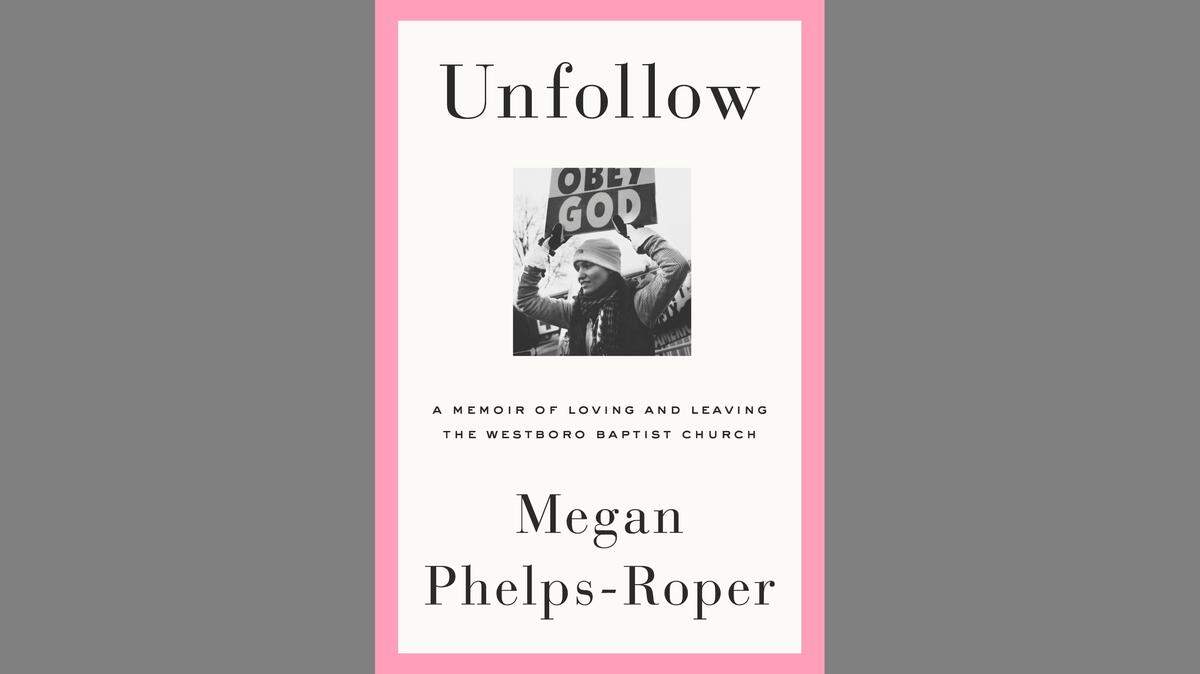
Brandon Smith of Kansas City was drawn to Phelps-Roper’s journey away from the church. “Her stories about conversations she had while playing Words With Friends. She had fast and deep conversations, particularly with one man. He really gave her space to think and question. His patience with her was incredible,” he said.
Hanna Cusick of Kansas City felt Phelps-Roper may have reached the decision to leave on her own. “My thought is she would have left the church eventually, but not as easily. It would have taken longer, and it would have been harder,” she said.
Jessica Packard of Kansas City pointed out that it was the lack of conversation and communication within the church that started the author’s critical examination of her beliefs. “It was someone from the inside undermining the power structure of the church,” Packard said. “The new council of elders took away the power and reshaped the community by shutting down the communication. Megan wasn’t respected or given a voice. That really bothered her. Her lifeline was all those social media connections.”
Readers enjoyed diving into the way those social media conversations helped shaped Phelps-Roper.
“Chad (who eventually became Phelps-Roper’s husband) was willing to talk to her about other ways of human thought,” Cusick noted.
Timmons said, “Megan’s husband showed her how to convert someone’s heart — through patience, time, pure kindness, listening.”
Smith said, “This ties into the current political situation. How do we change the minds of people we don’t agree with? Listening openly to others is true evangelization.”
Cusick said, “Speech hits people so differently. How you absorb a message is so connected to the way you’re raised — your age, your mental health and mental capacity. Words are incredible tools. Manipulated correctly, words can influence hundreds of people.”
At this point Phelps-Roper joined the conversation via FaceTime.
Phelps-Roper laughed when asked if she still plays Words With Friends with her husband. “Oh, no. We text now!” she said. “I play with (author) Nick Hornby, though.”
Having conversations and communicating made Phelps-Roper’s walkaway moment somewhat easier for her than for her siblings.
“Other than my sister and I leaving together, it was only one person leaving at a time. You don’t feel like you can trust anyone since you’re full of questions and doubts. But I had to talk to someone. I had to talk to my sister, Grace,” Phelps-Roper said.
She said she tries to stay in contact with members of the Westboro Baptist Church. “They won’t have anything to do with me,” she said. “I keep up with them on Twitter and I send them messages that don’t get responses. But I did have a conversation recently with an uncle on social media, and he admitted some of the things the group did were wrong. It was a great conversation.”
Smith asked if Phelps-Roper’s decision to leave the church was an idea always present in her consciousness.
“Several people I had conversations with were hugely influential,” PHelps-Roper said. “People who found internal inconsistency in Westboro’s ideology. It was the first thing that allowed me to recognize that Westboro was wrong. Every time I always had a question or doubt, I thought the problem was me. Even if these were small points of ideology. I couldn’t unsee it, and it made me ask more questions.”
The author talked about unconventional forms of community and conversation. “Twitter was an alternative community for me. A different kind of community,” she said. “I knew I was making people angry. But it didn’t matter, they weren’t my community. But the longer I was on Twitter and the more I came to know these people, to like and respect them, the more I could see the empathy and grief and sorrow they were expressing. I felt I was given permission to feel those emotions. It was the rational conversations and the emotional responses on Twitter.”
Summers closed the discussion asking about Phelps-Roper’s attitude toward her faith now.
“The things I believe in now are grace and the power of human connection to change hearts and minds and the importance of civil dialogue,” Phelps-Roper said. “I still believe, but it’s not anything supernatural now.”
Kaite Stover is the Kansas City Public Library’s director of reader’s services.
Join the club
The Kansas City Star and the Kansas City Public Library present a book-of-the-moment selection every few weeks and invite the community to read along. To participate in a book discussion led by the library’s Kaite Stover, email kaitestover@kclibrary.org. Look in the Arts+Culture section Feb. 2 for an introduction to the next selection, “Things We Didn’t Talk About When I Was a Girl” by Jeannie Vanasco.