
A beloved holiday classic you probably never heard of: ‘Child’s Christmas in Wales’
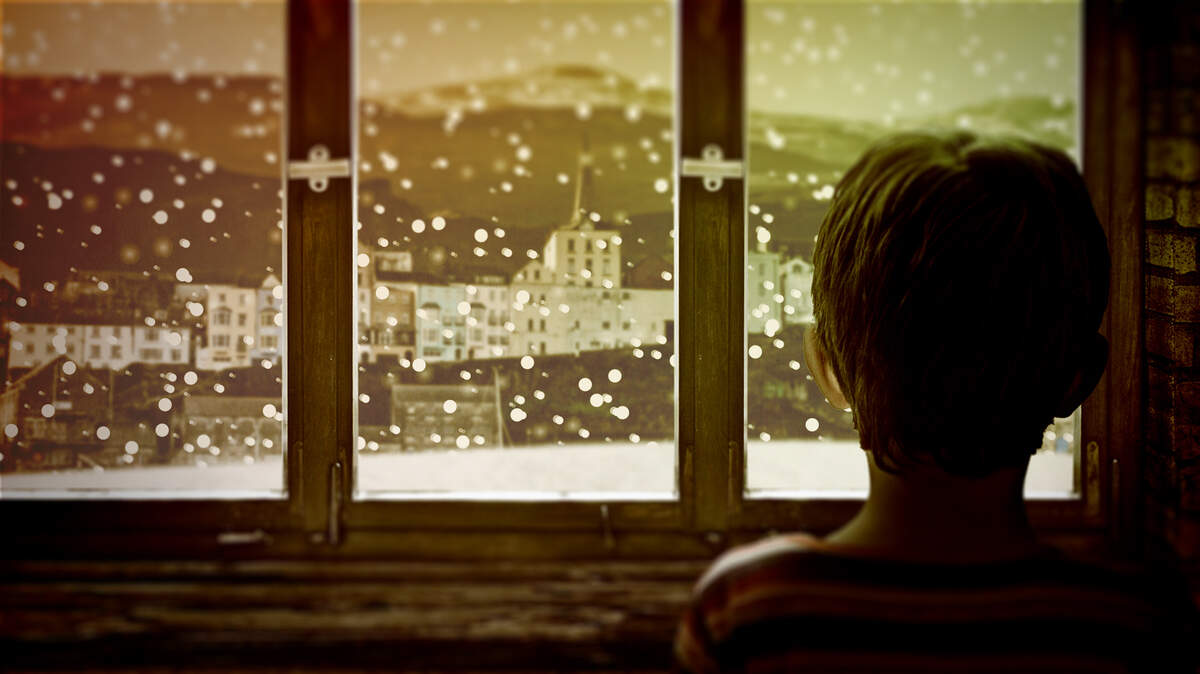
The thin little book sat among a shelf full of knickknacks outside his mother’s bedroom for years, but Kip Niven recalls that he paid it little attention. He was more into TV and movies as a kid than he was into reading.
Not until decades later did he introduce himself to “A Child’s Christmas in Wales,” listening to a recorded narration by its author, the renowned Welsh poet Dylan Thomas, somewhere along a 1,200-or-so-mile drive from Kansas City to Phoenix. Niven, now 71 and one of Kansas City’s most successful and durable actors, was spellbound.
“I thought, ‘This is magnificent,’” he says. “‘The images are beautiful. The poetry of it is beautiful — the descriptions, the memories, the Christmasy-ness.’ ”
He was immediately inspired: Bring it to the stage. Niven secured the rights and, a year ago, joined five other local actors in a script-in-hand reading of “A Child’s Christmas in Wales” at Crown Center’s Musical Theater Heritage. Response was so positive that Niven’s Equity Actors’ Readers’ Theater (EARTh) saw the makings of an annual event. They’ll return Dec. 9 with back-to-back readings at the Kansas City Public Library’s downtown Central Library.
“It doesn’t have anything like the popularity of ‘Rudolph’ or ‘The Night Before Christmas’ or ‘A Christmas Carol,’” Niven says. “But once you’ve had a taste of it, it’s something you want to hear again and again.”
Indeed, “A Child’s Christmas in Wales” — Thomas’ richly descriptive and sentimental account of Christmas Day from the viewpoint of a young boy — lacks the same place in American hearts and culture as Robert L. May’s, Clement Clark Moore’s or Charles Dickens’ holiday staples. Maybe because it harkens to Thomas’ early-1900s childhood in the seacoast town of Swansea in southern Wales. Put simply, it’s not American.
But then Dickens’ tale is wrapped snuggly in its Victorian England roots. “Child’s Christmas” may be pure nostalgia without the deeper redemptive storyline of “A Christmas Carol.” But isn’t that also true of Ralphie’s gauzy, BB gun-obsessed reminiscences in Jean Shepherd’s “A Christmas Story”?
Penne Restad, a distinguished senior lecturer in the history department at the University of Texas and author of “Christmas in America: A History,” poses an explanation.
“There’s a real sweetness in Thomas,” says Restad, whose research interests include the history of American holidays and family rituals. “I wouldn’t say ‘Child’s Christmas’ is a lament, but there’s something warm and deep in there, and my sense of our culture is that we don’t want to go into that depth. We want to move forward as fast as we can. … ‘What’s the next thing, what’s the newest thing?’ It’s youth and more youth.
“This is about lost youth.”
Thomas, best known for the radio play “Under Milk Wood” and the poem “Do Not Go Gentle Into That Good Night,” combined a couple of Christmas-memory pieces he’d written previously into “A Child’s Christmas in Wales.” Published in Harper’s Bazaar in December 1950 as “A Child’s Memories of Christmas in Wales,” it was prose but read like poetry — a personal and romantic 2,903 words in Thomas’ characteristically lyrical, cadenced style. He recorded the story for Caedmon Records in 1952, a year before his death in New York at age 39.
It became one of his most popular and enduring works, inspiring live-action and animated films, worldwide stage productions and a song. Thomas captures the sentimentality of the holiday season from its opening line:
“One Christmas was so much like another, in those years around the sea-town corner now and out of all sound except the distant speaking of the voices I sometimes hear a moment before sleep, that I can never remember whether it snowed for six days and six nights when I was twelve or whether it snowed for twelve days and twelve nights when I was six.”
“I’ve always said you don’t have to be a Danish prince to understand Hamlet and you don’t have to have grown up on a cherry orchard in Russia to understand Chekhov,” Niven says. “These magnificent authors speak to the humanity in all of us, whatever the century, whatever the time. And in this case, Thomas speaks to a common feeling of joy, of wonder, of family and friends and fellowship, whether we’ve experienced it in exactly the same way or not.”
“Once you’ve read it,” Renstad says, “it will have a resonance.”
Still, Renstad concedes that American families gathering around the tree on Christmas Eve are more likely to recite “The Night Before Christmas.”
“There’s a certain way about being an American — just being straight to the point — and that piece is so Dylan Thomas. It rolls, and it tumbles,” she says.
Beyond that, she suggests, “The piece was first recorded in 1952, and I would guess that decade, for us as Americans, is what we’ve fixed as our nostalgic (period of) ‘Oh, remember what Christmas was?’ Then, somewhere in the late ’60s, our Christmas started to scatter into more parts … into Kwanzaa and other things. There was much more commercialism. One generation rejected the earlier generation. There’s not a culture cohesion.”
Without a place in U.S. culture, “A Child’s Christmas in Wales” couldn’t gain one.
If not as familiar here, Thomas’ piece also is not as well-worn as such annually read or performed classics as “A Christmas Carol” or “The Night Before Christmas” (actually titled “A Visit From St. Nicholas”). There is a freshness in discovering it.
There’s also a warmth and endearment that Niven hopes will entice audiences in Kansas City to keep coming back to EARTh’s staged readings. For him, there’s a very personal connection. His grandfather — on his mom’s side, hence the copy of “Child’s Christmas” on her shelf — grew up in Thomas’ hometown of Swansea, Wales, ultimately emigrating to the U.S.
“It doesn’t have ghosts. It doesn’t have jingle bells. It doesn’t have Santa Claus,” Nevin says of “A Child’s Christmas in Wales.” “It’s about people experiencing Christmas in this peculiar and yet familiar way … all the smells and the tastes and the wonders of the season. It’s family and friends and celebrating together.
“That’s what comes through no matter what century we’re in. The wonder of that time of year is a part of all of us.”
Steve Wieberg, a former reporter for USA Today, is a writer and editor for the Kansas City Public Library.
Join the club
The Kansas City Star and the Kansas City Public Library present a book-of-the-moment selection every few weeks and invite the community to read along. The library’s Kaite Mediatore Stover will lead a discussion of “A Child’s Christmas in Wales” by Dylan Thomas at 3 p.m. Dec. 9 at the KC Central Library, 14 W. 10th St. To attend, email Stover at kaitestover@kclibrary.org.
‘Wales’ on stage
Kansas City’s Equity Actors’ Readers’ Theatre (EARTh) will present script-in-hand performances of “A Child’s Christmas in Wales” at 2 p.m. and 3:30 p.m. Dec. 9 at the KC Central Library, 14 W. 10th St. Each presentation runs 40 minutes. Admission is free, but RSVP is requested at kclibrary.org.
An excerpt
From “A Child’s Christmas in Wales” by Dylan Thomas, originally published by New Directions:
“For dinner we had turkey and blazing pudding, and after dinner the Uncles sat in front of the fire, loosened all buttons, put their large moist hands over their watch chains, groaned a little and slept. Mothers, aunts and sisters scuttled to and fro, bearing tureens. Auntie Bessie, who had already been frightened, twice, by a clock-work mouse, whimpered at the sideboard and had some elderberry wine. The dog was sick. Auntie Dosie had to have three aspirins, but Auntie Hannah, who liked port, stood in the middle of the snowbound back yard, singing like a big-bosomed thrush. I would blow up balloons to see how big they would blow up to; and, when they burst, which they all did, the Uncles jumped and rumbled.”