How Ilia Malinin Named Himself ‘Quad God’ at 15 With Only Two Quads — Then Actually Became One
Production of this article included the use of AI. It was reviewed and edited by a team of content specialists.
Ilia Malinin didn’t wait for someone else to crown him. He did it himself at age 15, and then spent the next five years proving the name right.
The George Mason University student and lifelong Northern Virginia resident goes by “Quad God,” a self-appointed title that started as a social media username and has since become the defining identity of the most technically gifted figure skater alive. If you haven’t been paying attention to what’s happening in competitive skating, Malinin is the reason to start. He’s rewriting what the sport looks like, one four-rotation jump at a time.
The Username That Became a Prophecy
The origin story is almost too perfect. Malinin shared it with Washingtonian last year. His first social media handle was “Lutzboy,” a nod to a specific skating jump. Then, after landing two quad jumps in 2020, he decided to upgrade.
“Everyone kind of got angry at me, like, ‘Why’d you name yourself Quadg0d? You only landed two quads.’ And I was like, ‘Well, I guess now it’s time for me to land the rest of them.’ The username was my motivation.”
That kind of confidence from a teenager could easily have aged poorly. Instead, Malinin went on to become the only skater ever to successfully pack all six globally ratified quad jumps into a single free-skate program. He’s still “ilia_quadg0d_malinin” on Instagram. His website carries a gold logo reading “Quadgod by Ilia Malinin,” with the “QG” initials given more visual weight than his actual name. The nickname has even seeped into official coverage of the Olympic Games.
What the Quad Axel Actually Means
Here’s where it gets specific. The quadruple Axel is universally regarded as the toughest of the six quad jumps in figure skating. Malinin is the first and only skater to land a fully rotated quadruple Axel in international competition. While few others have even dared to attempt it, he has pulled it off with perfect rotation ten times since 2022. The most recent came during his free skate at the US championships.
That feat, combined with landing all six quad types in a single program, helped him repeat as champion of the International Skating Union’s Grand Prix last December. Before arriving at the 2026 Winter Olympics, he was already a two-time world champion.
The Olympic Picture So Far
Malinin’s start at the Games has been uneven, which makes his trajectory worth watching closely.
In the team event short program, he finished second overall with 98.00 points, falling behind Japanese skater Yuma Kagiyama. He made a few mistakes in his free skate. But those errors didn’t stop his performance on Sunday from helping Team USA earn a gold medal in the team figure skating event.
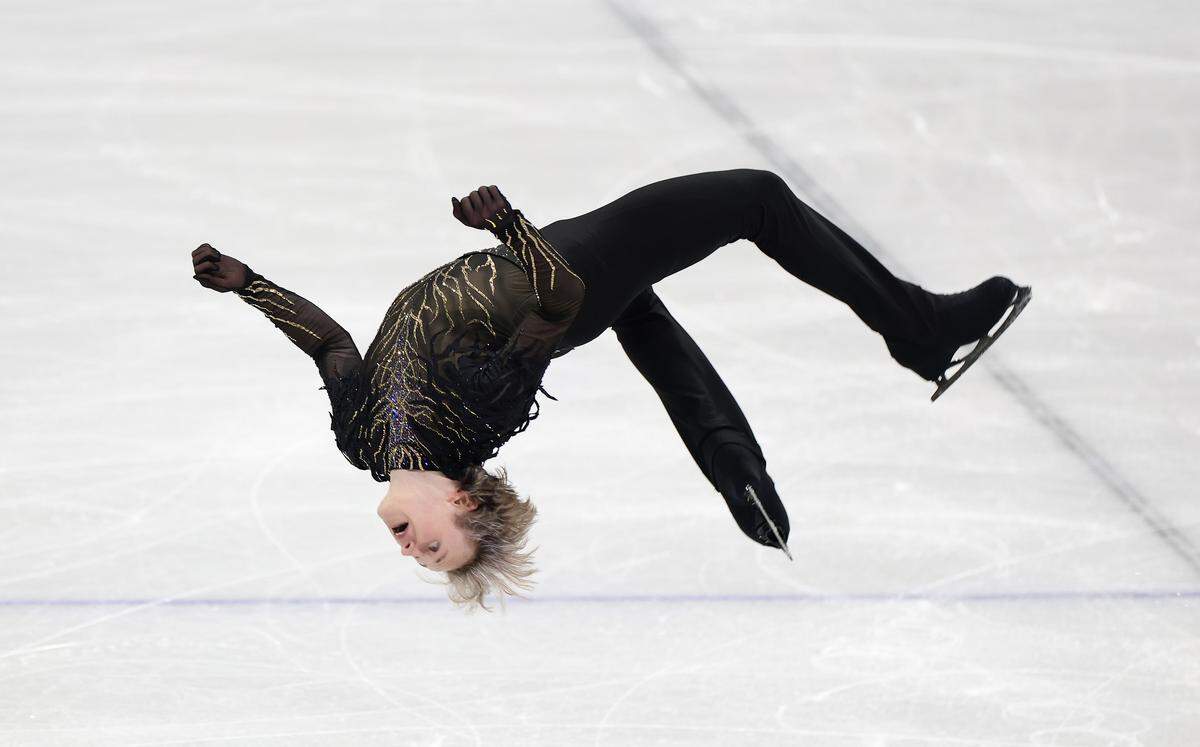
Then came a different gear. In the individual men’s short program later in the Games, Malinin led the standings with 108.16 points.
He also made headlines by performing a backflip in competition. It was the first time a backflip was legally landed at the Olympics in nearly 50 years, after the move was re-legalized by the sport’s governing body in 2024. The backflip has not contributed to technical scores but has drawn wide attention for its dramatic effect. That tension between spectacle and scoring is part of what makes Malinin such an interesting figure to follow: he’s pushing boundaries that go beyond the point sheet.
He’s yet to debut the quad Axel at the Games. Individual events on February 10 and 13 give him that window, where he’s likely to attempt the move on his biggest stage yet.
“I’m hoping that I’ll feel good enough to do it (on Friday, Feb. 13),” he told reporters on Tuesday, per Fox Sports. “But, of course, I always prioritize health and safety, so I really want to put myself in the right mindset where I’ll feel really confident to go into it and not have that as something that I’m going to risk.”
The Family Behind the Jumps
Born on December 2, 2004, in Fairfax, Virginia, Malinin grew up in a skating household. His parents are both former Olympians who competed for Uzbekistan. They began coaching him as a child and continue to coach him now. That detail matters because it helps explain the technical sophistication behind his jumps; he’s been trained by people who understand Olympic-level competition from the inside.
His routines include multiple high-difficulty jumps and signature moves, but the packaging around the performance is what makes him unusual. The “QG” branding, the backflip theatrics, the willingness to name himself before the sport could name him: these choices have made Malinin compelling to audiences who might not otherwise watch figure skating.