
Horses, gods and dreams collide in Living Room’s production of ‘Equus’
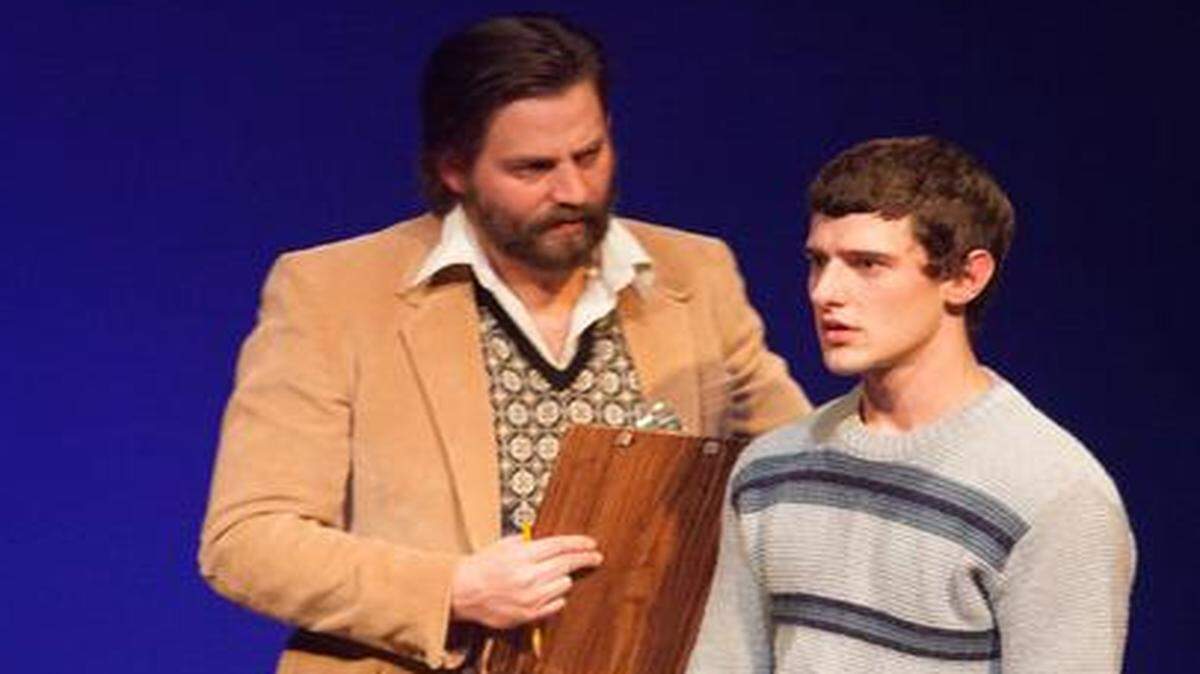
Welcome to the murky 1970s.
With “Hair: Retrospection,” KC Rep takes us back to the ‘60s, when battle lines were clear and self-expression was a political act. Now the Living Room invites us into the diffuse decade that followed with a production of Peter Shaffer’s once-celebrated “Equus,” an allegorical drama that seems to envelope itself in a cloud of ambiguity.
Without question, Shaffer was wrestling with big themes in his story of a relationship between a burned-out psychiatrist and a disturbed stable boy who has inexplicably blinded four horses. Young Alan Strang has, in effect, created his own religion that seems to find expression in sensual midnight rides that are basically orgasmic rituals. Shaffer presents the kid’s horse-worshipping belief system, if we can call it that, as inherently superior to conventional Judeo-Christian values.
The play is structured as a mystery in which the psychiatrist, Martin Dysart, tries to find out what triggered Alan’s sadistic act. But the doctor sees a kind of purity in the boy’s crazed religiosity to the point that he becomes envious of the lad’s untrammeled mania.
The Living Room production, directed by Jeff Church, tries to meet the demands of the play by striking a precarious balance between realism and overt symbolism. It’s a tough challenge, particularly at a small company with relatively limited resources.
The non-realistic aspects of the production are the most successful, thanks largely to Kate Mott’s imaginative costumes for the horses. She equips the actors with elevated metal “hooves,” black leather harness gear and elegant masks that acquire an ominous quality as the show proceeds. (The masks are credited to Mott, Church and Shawnna Journagan). The movements of the horses -- played by Jordan LaForce, Bradley Turner, Vincent Wagner and Amy Hurrelbrink -- are impressive and convincing. (Vanessa Severo was the movement coach.)
Rusty Sneary trots out a polished English accent as Dysart while Matt Lindblom, as Alan, is disturbingly convincing as the tormented youth. The role brings to mind his performance as a high-strung young American soldier in the Unicorn production of “Bengal Tiger at the Baghdad Zoo.” He maintains a level of intensity that never wavers.
Amy Attaway is poised and polished as Hesther Salomon, the magistrate who ordered psychiatric care for the boy. Bonnie Griffin is credible, if remote, as Dora, Alan’s religious mother. Forrest Attaway seems a bit strait-jacketed as Frank, Alan’s father, who dismisses religion as destructive superstition.
Rachel Leyh is appealing and convincing in an unfussy performance as Jill Mason, the girl who invites Alan to the stables for a literal roll in the hay and inadvertently triggers his violent assault on the horses. Paul Burns gives us a nicely executed turn as Harry Dalton, who owns the stables. Journagan and Hurrelbrink competently handle a couple of minor utilitarian roles.
No scenic designer is credited (although Matt McAndrews is listed as technical director), but this is another of the Living Room’s split-level productions. The action begins downstairs, with Dysart’s office as the main playing area. An upstage door at times slides away, revealing the set for the Strang home; those scenes are really too far from the viewers, forcing the actors to work harder to project their performances.
The viewers move upstairs to the Living Room’s loft space for the “big reveal,” in which Dysart compels Alan to tell exactly what happened the night he injured the animals. The audience is invited to stand or sit on hay bales. A wooden platform, with a horse positioned at each of the four corners, represents a barn loft where Jill attempts to seduce Alan. As called for in the script, the actors disrobe, but the low, atmospheric lighting subdues the potential for sensationalism.
Indeed, Shane Rowse’s lighting design, nuanced and precise, makes a big contribution throughout. The same goes for David Kiehl’s sound design.
If you can accept Shaffer’s depiction of Dysart surrendering himself to Alan’s religious vision and in effect making himself a slave to an imaginary god, then the show might carry considerable impact. But from our present-day perspective, the play invites skepticism from reasonable viewers.
To reach Robert Trussell, call 816-234-4765 or send email to rtrussell@kcstar.com.
“Equus” runs through April 19 at the Living Room, 1818 McGee St. For more information, call 816-533-5857 or go to TheLivingRoomKC.com.
This story was originally published March 29, 2015 at 1:51 PM.