
2015 GMC Canyon
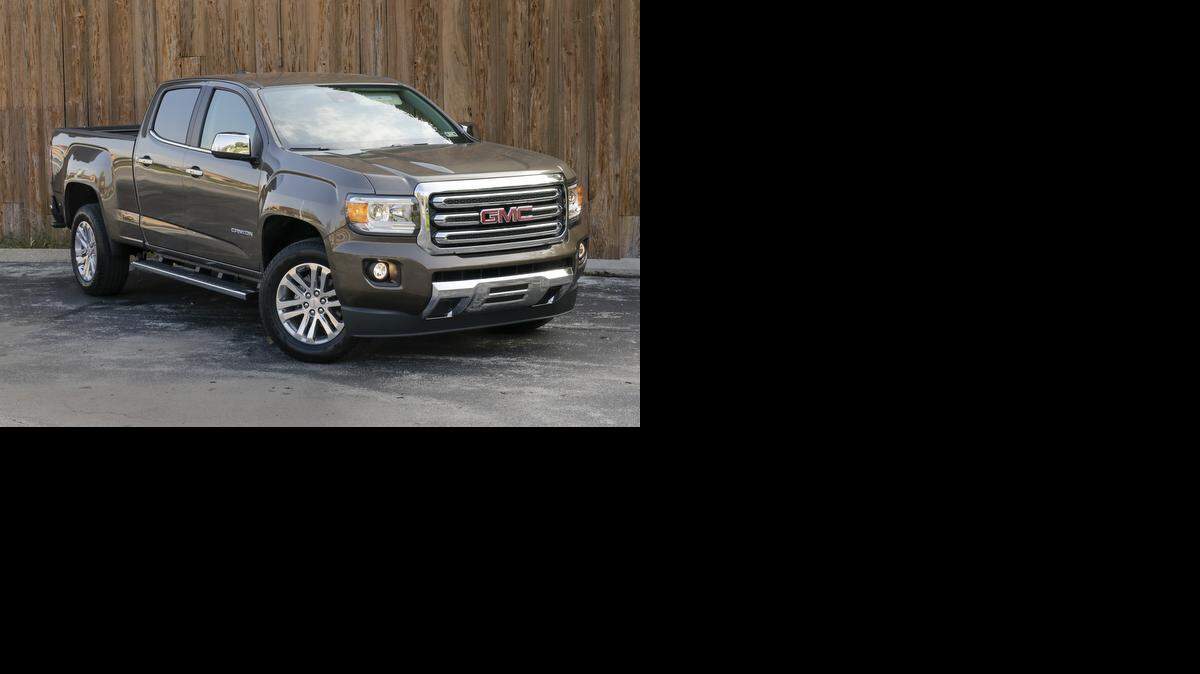
Midsize pickup trucks used to be just that, midsize, but today they have grown into vehicles that are almost as big as full-size trucks from the 1990s. Case in point: General Motors’ new twins, the Chevrolet Colorado and GMC Canyon.
The 2015 Canyon is designed as a scaled-down version of its larger sibling, the Sierra. It is similar not only in its massive front grille but also with technology such as forward collision alert, lane departure warning, rear-vision camera and a built-in Wi-Fi hotspot.
The Canyon is offered in base, SLE and SLT models, in two-wheel drive and four-wheel drive. Base prices start at $21,880 and range to $37,875. An All-Terrain package is offered on SLE models.
The test vehicle from GM’s press fleet was a two-wheel-drive SLT crew cab with a 6-foot-2-inch bed. Its 140.5-inch wheelbase is only 3 inches shorter than that of a crew cab Sierra. The extended-cab and short-box crew cab ride on a 128.3-inch wheelbase.
The over-6-foot bed is handy for carrying large items, but the longer wheelbase makes it harder to turn in tight spaces such as a parking lot. Unless I had a specific reason for the long bed I would choose the crew cab with the bed that is a foot shorter because it would be easier to drive in urban settings.
From a practical perspective, midsize trucks are better than full-size trucks for all but the heaviest of work because they are more maneuverable in cities, get better gas mileage and cost less. A two-wheel-drive Canyon with the base four-cylinder engine has a highway fuel mileage rating of 27 miles per gallon. Even the 305-horsepower V-6 is rated at 26 mpg when equipped with a six-speed automatic transmission.
The biggest functional difference between the Canyon and Sierra is payload and towing capability. The Canyon can carry 1,540 pounds or tow 7,000 pounds; the Sierra can carry 1,800 pounds and tow 9,400 pounds.
Inside, the Canyon feels much like a Sierra. The fit, finish and quality of materials is as nice as one finds in an SUV. Wind and road noise are managed well. The navigation system and rear-vision camera use an 8-inch color LCD screen that also displays audio information. The seats seemed closer to the floor than most pickups and that took time for me to get used to.
The Canyon has a built-in Wi-Fi hotspot via OnStar’s 4G LTE connection. The vehicle becomes a mobile hotspot that is on whenever the vehicle is on. It comes with a three-month/three-gigabyte data trial. OnStar has several data plans, and prices range from $5 a month to $50 a month depending on the amount of data used. GMC says that AT&T subscribers can add their vehicle to a mobile share plan for $10 per month.
The IntelliLink system, according to GMC’s press release, “extends the OnStar experience from safety and security to information and entertainment by seamlessly integrating the capability of a smartphone into the vehicle so that hand-held phones may be safely stowed while driving.”
“With Text Messaging Alerts, the driver can be alerted to new messages and can have them read aloud, view and respond to them (functionality depends on the smartphone). Siri Eyes Free enables iPhone users to access Siri via the steering wheel controls and check calendar entries, have text messages read and respond to them, place calls or call up music.”
Price
The base price of the test car was $33,420. Options included chrome side steps, Bose audio system with navigation and Intellilink, forward collision alert, lane departure warning and a 3.42 rear axle ratio. The sticker price was $36,460.
Warranty
Three years or 36,000 miles, with a five-year, 100,000-mile powertrain warranty.
Tom Strongman’s e-mail is tstrongman@gmail.com
2015 GMC Canyon
Engine: 3.6 -liter, 305-horsepower V-6
Transmission: Six-speed automatic, rear-wheel drive
Wheelbase: 140.5 inches
Curb weight: 4,200 pounds
Base price: $33,420
As driven: $36,460
MPG rating: 18 in city, 26 on the highway
This story was originally published January 2, 2015 at 6:00 PM with the headline "2015 GMC Canyon."