
BMW i3 REX: Electric urban mobility
Almost without exception, there’s one thing I tend to do when driving an electric car: Keep one eye on the miles-to-empty figure in hopes that I can get back home, or to a charging station, before I run out of juice. It’s a bit like the Seinfeld episode called the Dealership, where Kramer tries to see how far he can go on an empty tank while test driving a new car.
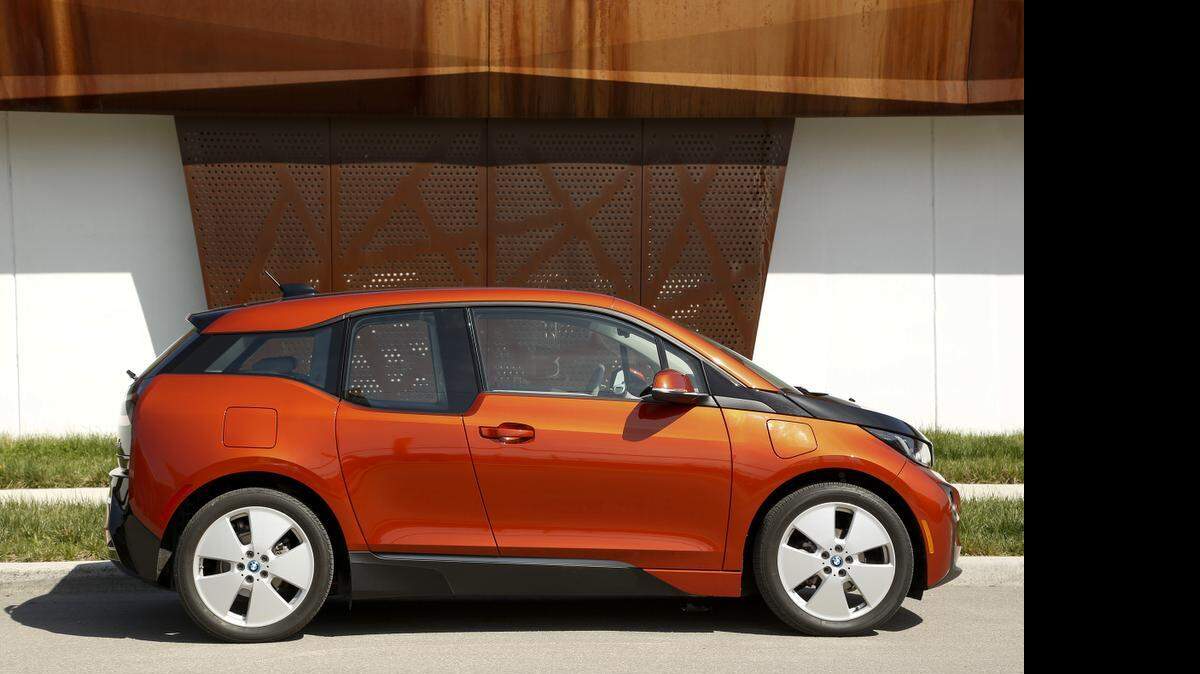
A week ago I spent four days with the 2014 model of BMW’s i3 REX electric car. REX stands for Range Extender. The innovative i3 represents BMW’s new era of electromobility. This is a car, in BMW’s words, that “offers visionary design, a ground-breaking vehicle architecture, dynamic performance and innovative connectivity.”
The i3 REX starts at $45,200 and the battery-only i3, called the BEV for battery electrical vehicle, starts at $41,350. The price does not include a federal tax credit of $7,500.
The Range Extender is a two-cylinder gasoline motorcycle engine tucked under the trunk floor next to the 170-horsepower hybrid synchronous electric motor. With a full charge and 2.4 gallons of gas the Range Extender is good for about 160 miles if you drive carefully. Carefully means you don’t romp away from stop signs, even though the i3 is amazingly quick up to 30 miles per hour; carefully means you accelerate as gently as if you had a raw egg under your throttle foot; and carefully means you select EcoPro or EcoPro+ to smooth out throttle response and limit the amount of electricity used for peripheral items such as heating and cooling.
When the batteries reach a critically low level the gasoline engine starts and charges the batteries.
So, while I enjoyed being whisked silently away from a stoplight with the instant torque of an electric motor – it hits 60 miles per hour in 7.2 seconds –I still found myself constantly calculating how far until the batteries were dead because I did not have a 220-volt home charger and had to rely on the 110-volt extension cord that takes all night and then some. A little range anxiety is part of being an electric-car newbie. Realistically, electric car owners will install a 220-volt charger in their garage, the cost of which ranges from about $1,000 to nearly $2,000. Plugged into that charger each night in the garage, the car will fully charged in three hours and be ready to go every morning.
I discovered several charging stations tucked into parking garages around town, and that eased my mind. One night we went to Park Place in Leawood, plugged in while we had dinner, and gained about 10 additional miles of juice in less than an hour. Kansas City Power and Light is committed to installing 1,000 charging stations around the region by late summer, making the Kansas City metropolitan area one of the leaders in charge station availability.
The rear-wheel-drive i3 is a new type of construction. The a carbon fiber reinforced plastic (CFRP) body sits on a flat vehicle platform that contains batteries and electrical components sits. CFRP is as strong as steel and weighs 50 percent less. The complete vehicle weighs 2,860 pounds or 3,130 with the range extender.
The passenger compartment floor is perfectly flat because the platform requires no tunnel. The interior is made from high quality renewable materials. Cloth comes from recycled plastic bottles and many pieces of door panels and dash are made from Kenaf plant fibers. The interior is rather austere, but it is quite comfortable. Instrument screens look like small iPads.
The front seats were comfortable and there was more than enough legroom. The back seat, accessible through a small side door, was less roomy but still big enough for adults.
I loved the i3’s regenerative braking system because it slows the car dramatically when you release the throttle. The electric motor becomes a generator to recharge the batteries. The regenerative braking is so strong that the car will come to a stop just by releasing the throttle. One-pedal driving is fun.
The i3 is a good example of innovative thinking and it shines in urban environments that are its natural home.
Warranty
Four years or 50,000 miles, EV battery eight years or 100,000 miles.
Price
The base price of the test car was $45,200. Options included the orange metallic paint and heated front seats. The sticker price was $47,050.
Tom Strongman’s e-mail is tom@tomstrongman.com
2014 BMW i3 REX
Motor: 170-horsepower hybrid synchronous electric motor
Transmission: Single-speed, rear-wheel drive
Wheelbase: 101.2 inches
Curb weight: 3,130 pounds
Base price: $45,200
As driven: $47,050
MPGe rating: 137 in the city, 111 on the highway
This story was originally published April 24, 2015 at 7:00 PM.