
OUR AUTO STORY
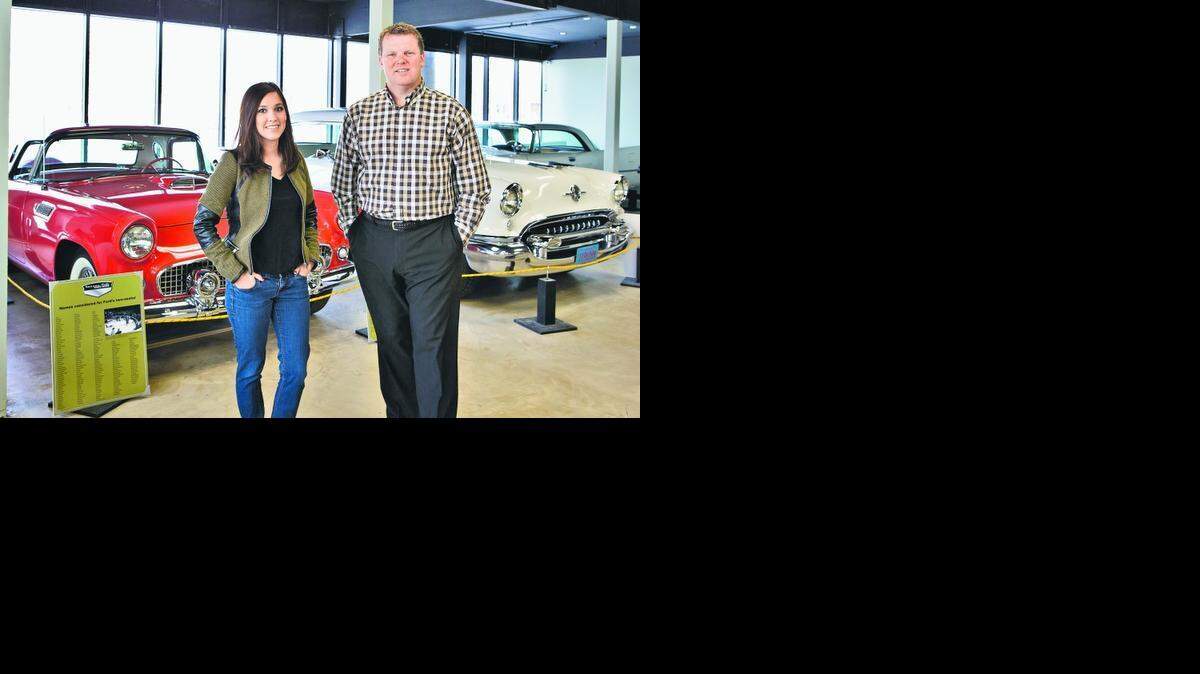
The moment you walk through the doors at the Kansas City Automotive Museum, vintage cars from a bygone era draw you in. Return four to six months later and there are 30 or so different cars.
“What makes us unique to Kansas City is we actually showcase Kansas City cars,” said Vreni Fernandez, public relations and marketing director at the museum. “All the cars in the museum are from car collections in Kansas City.”
The rotation of cars is one of the many intriguing features of the Kansas City Automotive Museum, which officially opened its doors at 15095 W 116th St., Olathe, last June on Father’s Day. Admission is $9 for adults, $8 for military and seniors (65 and older) and $7 for students. Children (5 and under) get in free.
The museum doesn’t own the collection of cars. It showcases vehicles and artifacts owned by Kansas City area residents.
Walls throughout the museum are filled with information about Kansas City auto history, facts that might escape even the most avid auto enthusiast. For instance, Masten Gregory, known as the “Kansas City Flash,” won the 24 hours of Le Mans in 1965. Gregory was also the first American to successfully compete in the European F1 Grand Prix racing in 1957.
“Kansas City has a great automotive story to tell,” said Jeff Wagoner, president of the board of directors for the museum. “The Masten Gregory story … 98 percent of Kansas Citians don’t know who he is. People don’t know, and they need to know it.”
The museum has shown the exact car the Gregory drove in the 1965 Indy 500. The body of this car will be on permanent display at the museum.
In the nine months since the museum has been open, it has displayed a wide-range of vehicles, from a 1912 Model T to a 1974 Sterling Kit car.
And then there is the fact that Kansas City is the only city in the world with a Ford plant, a General Motors plant and a Harley-Davidson plant.
Also in the automotive did-you-know category:
▪ The Country Club Plaza was the first shopping center designed for customers arriving in cars in 1922.
▪ Homer Roberts owned the first African-American car dealership in America in Kansas City. He founded Roberts Company Motor Mart in 1919.
“We have a wall of Kansas City’s first, and it shows how automobiles transformed our city that people aren’t aware of,” Fernandez said.
For children and adults alike, there is a room with four driving simulators that allows you to drive on more than 600 race tracks around the world.
“We want to be that museum that everybody in the family enjoys, no matter what their level of interest is,” Fernandez said. “A lot of times I will hear the story that the demographic for this museum is more male driven. I hear dad wants to stop at the car museum, the mom doesn’t want to go, but she goes. It doesn’t become fun for everyone. We want to revitalize the hobby.
“You see little kids come through here and you see a little spark. You see there is interest. It just needs to be nurtured a little bit. That’s what we want to do with our new facility.”
The Kansas City Automotive Museum, which occupies 12,000 square feet, is in what Wagoner calls the toddler stage. Wagoner is credited with coming up with the automotive museum in 2011.
“I take credit for the idea, but it has really been a group effort to make it happen,” Wagoner said.
A number of people have volunteered their time over the last three years to turn an idea into a functioning museum with designs on becoming much bigger.
The goal is by 2018 to either move into a new 60,000-square-foot facility in downtown Kansas City near other museums or build a museum by the Kansas Speedway.
“That can move forward or move back depending on fundraising,” Fernandez said. “I actually call this our fundraising facility. It is where we showcase what we want to do.
“The new facility will have a restoration shop there. We will have people working there, restoring cars with windows in the entire room so people can experience it and get a feel what it is really like to own a classic.”
Fernandez, a graduate of St. Pius X and UMKC, brings an abundance of enthusiasm to her job. She became the first full-time employee for the museum in December, and that is mainly to spearhead the fundraising. While going to UMKC, she was volunteering her time to the museum.
“I don’t know what I would do without her,” Wagoner said.
Fernandez jokes that in her public relations duties, she is like a politician, holding hands and kissing babies.
“I really do enjoy my job,” she said. “It is never boring and so much fun. I never have seen so much passion.
“This has been three years in the making to get our big donations. Now we are finally ready to say we can handle it now. We fine-tuned everything. Now we are ready for the rest.”
To fulfill the vision of the automotive museum, it needs donations and sponsors. The museum’s website is www.kansascityautomuseum.com. It shows coming events, provides more information about the museum and includes a place to donate.
“We have had many challenges as far as donations,” Fernandez said. “We are a not-for-profit organization so we are always looking for sponsorships. We did have one major donor to make this (current facility) possible. We are very grateful for her.”
Fernandez figures it will be a very busy summer, which includes plans for a concert series. On Feb. 28, the museum held a Dancing with the Cars event to raise money. On June 13, from 4 to 9 p.m., the museum will hold its 2nd Annual KCAM People’s Choice Car Show at Carriage Houses, 29230 W. 83rd St., De Soto.
The museum comes alive when people are taking tours, especially children’s groups. Feb. 23 was one of those days when a youth group of more than 30 toured the museum.
“When we don’t have events, it is a quiet, little museum,” Wagoner said. “I’d like for us to have three or four events a week and become that ever-changing, evolving museum that would be a point of pride for Kansas City. When friends and relatives come to town, you say we got to see it.”
Car clubs in Kansas City have already discovered the museum.
“We’ve been lucky in that,” Fernandez said. “The car clubs have been very active with us. There is a Car Club Corner. We want them to call us home. We want to be their host.”
Talk to anybody associated with KCAM and you will hear that this museum has something for everybody.
“We see a lot of enthusiasm when it comes to people who really appreciate historical vehicles and teaching the next generation where automobiles came from and where it is going,” said board member Steve Flick. “This is history.”
Luke Spence, collections coordinator at the museum, agrees.
“I was born and raised in Kansas City,” said Spence, a graduate of St. Thomas Aquinas and McPherson (Kan.) College. “Knowing we don’t have a public auto museum has really driven me to help make this place successful. Kansas City has one of the richest histories in automobiles. We should strive to have one of the best museums in the country.”
Fernandez added, “It is just a great story to tell.”
This story was originally published March 6, 2015 at 6:00 PM.