Ever wonder what kind of salary a Certified Public Accountant (CPA) can command?
Hint: It’s more than just a paycheck.
CPAs are the financial powerhouses behind businesses, handling everything from tax strategies to financial reporting, and with a 34% decrease in the number of people studying accounting, this designation makes accountants even more coveted.
Whether you’re just dipping your toes into the accounting world or you’re ready to take your career to the next level, knowing what you could be earning as a CPA is a game-changer. With salaries that can vary wildly based on experience, location, and industry, I’m here to break it all down for you.

Key Takeaways
- CPA Salary: CPAs generally command higher salaries compared to non-certified accountants, with potential earnings significantly increasing based on experience, education, and location.
- Average CPA Salary: The average CPA salary in the U.S. varies widely, often ranging from $70,000 to $90,000 annually, but can exceed $120,000 depending on industry and job role.
- Education and CPA Licensure: Advanced education and obtaining CPA licensure can lead to a notable boost in salary.
- Geographic Impact: Location plays a crucial role in determining CPA salaries, with cities like San Francisco, New York, and Houston offering some of the highest average salaries due to the higher cost of living.
- Demand and Future Trends: The demand for accountants and auditors, including CPAs, is expected to grow from 2022 to 2032, with more job openings projected each year due to retirements and career shifts.
Breaking Down CPA Salaries: What You Need to Know
When it comes to how much a CPA makes, there’s a lot more at play than just a title. CPA salaries can vary widely, and here’s why:
- Your Role Matters: Whether you’re just starting as a junior accountant or climbing the ladder to a senior position, your specific role plays a huge part in your paycheck.
- Education Pays Off: CPAs with advanced degrees or additional certifications often see higher salaries. That extra time in school? It could lead to a bigger payday.
- Experience Counts: The more years you’ve got under your belt, the higher your earning potential.
- Location, Location, Location: Where you work matters. Salaries can fluctuate based on the local economy and cost of living.
- Sector of Employment: The industry you choose—whether it’s public accounting, the private sector, or the federal government—can also affect your CPA salary.
Remember, whether you’re aiming for a career in tax preparation or financial reporting, understanding these factors can help you navigate the accounting profession and maximize your earning potential.
CPA Salary Breakdown by Role
Wondering how much a CPA makes compared to general accountants? It’s no surprise that CPA salaries generally outpace those of non-certified professionals. With a CPA license, you’re not just crunching numbers; you’re playing a key role in financial decision-making, tax preparation, payroll services, and audits—responsibilities that come with a higher paycheck.
So, what kind of CPA salaries can you expect across different roles? Here’s a snapshot:
- Vice President of Finance: $247,417
- Corporate Controller: $198,000
- Divisional Controller: $160,667
- Assistant Controller: $145,333
- Director of Finance: $112,917
- Director of Accounting: $155,083
- Treasurer: $151,667
- Assistant Treasurer: $194,167
- Director of Financial Reporting: $100,583
- Financial Project Manager: $151,167
- Forensic Accountant: $134,750
- Property Accountant: $102,250
- Plant Controller: $78,417
- Procurement Manager: $115,583
- Procurement Specialist: $103,417
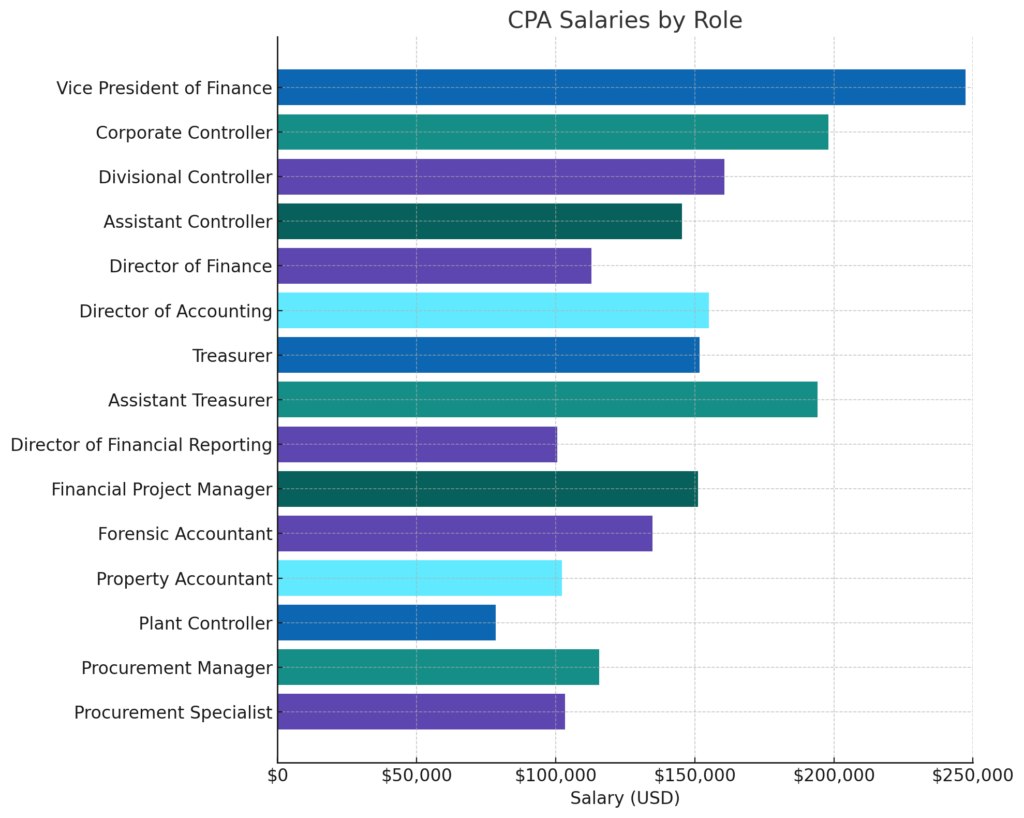
Source: Robert Half
How Education and Skills Impact the Average CPA Salary
Education is a key player in determining your earning potential. Becoming a Certified Public Accountant usually starts with 150 credit hours of accounting education, passing the CPA exam, and earning at least a bachelor’s degree. But if you’re looking to boost your CPA salary, going beyond these basics can make a big difference.
The Power of a Master’s Degree
Pursuing a master’s degree, such as an MBA, can be a pivotal move in advancing your CPA career. Beyond refining your accounting expertise, an MBA equips you with a broader business acumen and advanced management skills. This combination makes you a strong contender for higher-level positions that require strategic decision-making and financial leadership.
According to data from Indeed, earning a master’s degree can significantly boost your earning potential. Master’s degree holders often see a substantial increase in their salaries, with some fields experiencing notable growth. In the accounting profession, this advanced education can be a major factor in achieving higher salary brackets and opening doors to top-tier roles within the industry.
Boosting Your CPA Salary with Skills and Certifications
Skill-building clearly pays off: the more you invest in developing your skills, the better your paycheck as a CPA can be. Employers are always on the lookout for accounting professionals who bring specialized skills and certifications to the table. According to a Robert Half report, here are some of the most sought-after skills and certifications that can bump up your CPA salary:
- Financial Reporting: Mastering financial reporting is crucial for any certified public accountant, as it’s a core part of the job that can lead to higher salaries.
- Financial Modeling: This skill is essential for CPAs involved in forecasting and analyzing financial performance, making it a hot commodity in the job market.
- Management Experience: Leadership skills combined with a CPA license can significantly enhance your earning potential, especially in senior accountant roles.
- Data Analytics: As businesses increasingly rely on data-driven decisions, CPAs with data analytics expertise are in high demand and often command higher average salaries.
- Certified Management Accountant (CMA): Holding both a CPA and a CMA credential sets you apart, giving you an edge in financial management roles and a potential salary boost.
Building these skills and obtaining relevant certifications can be a significant investment, but they’re well worth it for the potential increase in your average annual salary as a CPA.
How Experience Shapes CPA Salaries
When figuring out how much a CPA makes, experience plays a huge role. CPA salaries are often broken down into percentiles, which help show how pay can vary depending on how long you’ve been in the game and the qualifications you bring to the table.
Here’s a breakdown of what these salary percentiles mean:
- Entry-Level (25th Percentile): Just starting out? The 25th percentile is the lower end of the salary range. It’s where you might find entry-level CPAs or those with minimal experience. It’s a great starting point, but there’s plenty of room to grow.
- Median (50th Percentile): The median, or 50th percentile, is the middle of the road. This is where the average CPA salary falls, reflecting what you can expect with a solid amount of experience and the necessary qualifications.
- Experienced (75th Percentile): If you have years of experience and some impressive qualifications, you’re looking at the 75th percentile. This higher salary range rewards those who’ve put in the time and effort to advance in their CPA career path.
Understanding where you fall in these percentiles can give you a clearer understanding of your earning potential as a certified public accountant and help you plan your career growth in accounting.
CPA Salary Ranges by Position
Curious about what CPAs earn at different levels? Here’s a breakdown of CPA salaries from the Robert Half report, showing how experience can influence your paycheck:
- Chief Financial Officer (CFO) – Corporate Accounting
- Entry-Level (25th Percentile): $176,500
- Median (50th Percentile): $265,000
- Experienced (75th Percentile): $300,750
- Vice President of Finance
- Entry-Level (25th Percentile): $143,750
- Median (50th Percentile): $203,750
- Experienced (75th Percentile): $246,500
- Corporate Controller
- Entry-Level (25th Percentile): $111,000
- Median (50th Percentile): $160,250
- Experienced (75th Percentile): $210,750
- Forensic Accountant
- Entry-Level (25th Percentile): $83,250
- Median (50th Percentile): $103,750
- Experienced (75th Percentile): $119,750
- Assistant Treasurer
- Entry-Level (25th Percentile): $76,750
- Median (50th Percentile): $104,000
- Experienced (75th Percentile): $121,000
- Director of Financial Reporting
- Entry-Level (25th Percentile): $122,500
- Median (50th Percentile): $154,000
- Experienced (75th Percentile): $177,000
- Plant Controller
- Entry-Level (25th Percentile): $102,000
- Median (50th Percentile): $117,250
- Experienced (75th Percentile): $127,500
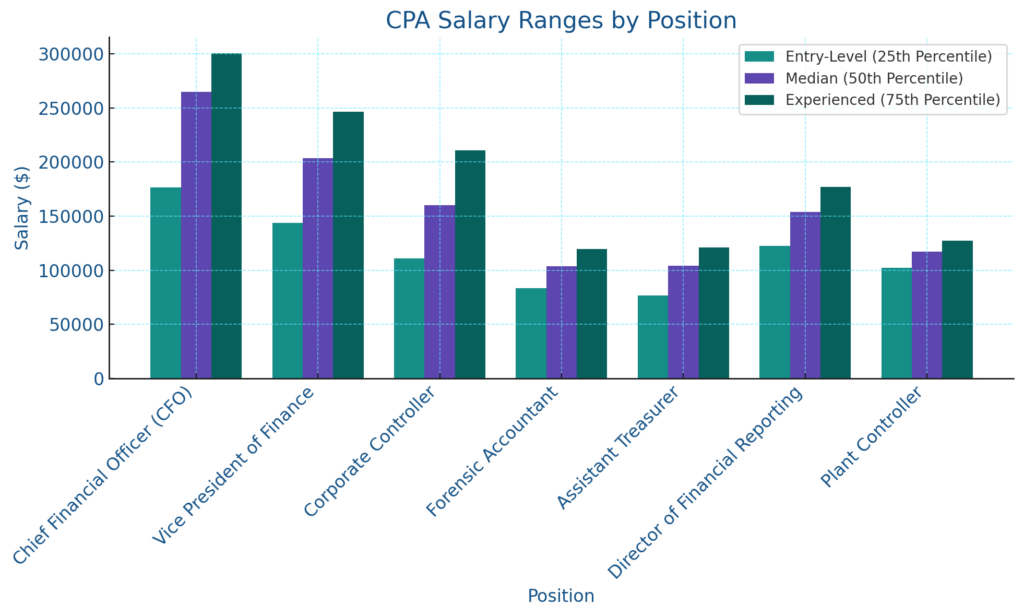
These figures give you an idea of what to expect at different stages of your CPA career. Whether you’re just starting out or have years of experience, these salary ranges highlight the earning potential across various positions in the accounting profession.
CPA Salaries by Industry
The industry you work in can significantly impact your CPA salary. Whether you’re in the private sector, government, or nonprofit, CPA salaries vary widely across different fields. Here’s a look at what you can expect in some key sectors:
- Financial Services: This sector is known for higher salaries, with CPAs navigating financial operations and risk management. The average CPA salary in financial services is around $95,505 per year.
- Healthcare: CPAs in healthcare handle complex financial transactions and ensure compliance with industry regulations. On average, a Healthcare CPA in the U.S. earns about $77,368 annually.
- Construction: CPAs in construction manage finances and budgets, ensuring projects stay on track financially. The average annual salary for a Construction Accountant in the U.S. is around $74,485.
- Government: Working as a government accountant involves ensuring financial transparency and compliance with regulations. The yearly salary for a Government Accountant is approximately $72,106.
While CPAs might start their careers in public accounting firms, many advance to higher-paying roles in the private sector, such as CFO positions. Government and nonprofit roles may offer lower salaries, but they often provide benefits like job security, work-life balance, and a strong demand for skilled professionals.
How Location Affects CPA Salaries
Where you work can have a big impact on how much a CPA makes. CPA salaries can vary widely depending on the city you’re in. According to data provided by Indeed, here’s a look at some of the top-paying cities for certified public accountants and their average annual salaries:
- Salinas, California: $120,050
- San Francisco, California: $104,616
- New York City, New York: $102,190
- Midland, Texas: $98,058
- Washington, D.C.: $95,353
- San Jose, California: $94,336
- Boston, Massachusetts: $92,074
- Seattle, Washington: $90,880
- Houston, Texas: $86,700
- Trenton, New Jersey: $86,585
- Los Angeles, California: $86,027
- Dallas, Texas: $83,896
- Austin, Texas: $83,282
- Denver, Colorado: $81,390
- Atlanta, Georgia: $81,384
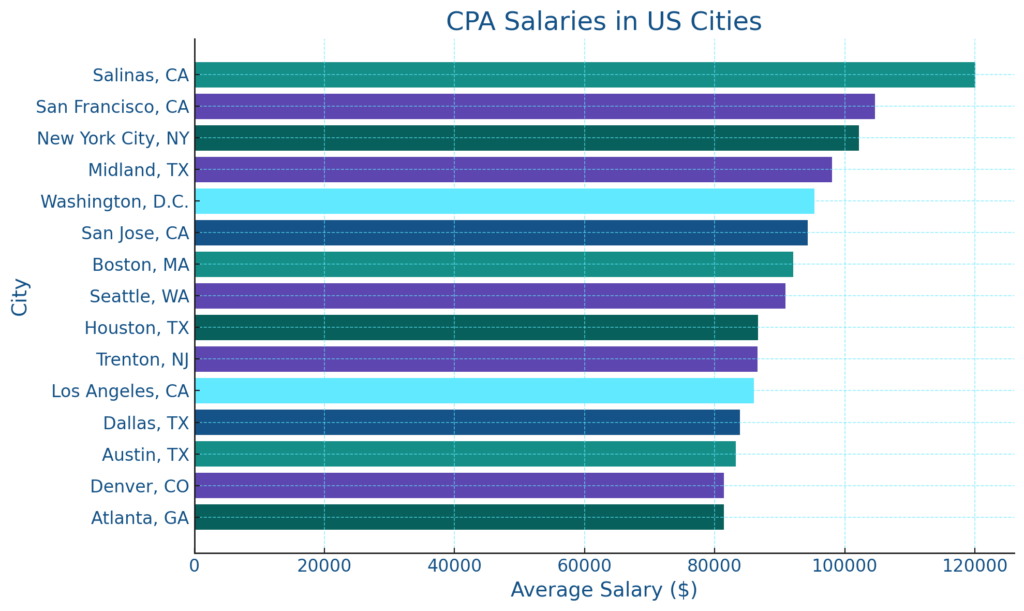
On one Reddit thread, a user shared that ‘large cities without crazy living expenses’ such as Houston, Dallas, Chicago, and Atlanta are great options for accountants looking to maximize their salary-to-cost-of-living ratio. They also mentioned that smaller cities like Detroit, Charlotte, Minneapolis, Pittsburgh, and Cleveland offer similar benefits, making them attractive alternatives for those who prefer a smaller urban environment.
Salary Trends and What’s Ahead for Accounting Professionals
The future looks bright for CPAs, with solid job prospects and growing demand across various sectors. The Bureau of Labor Statistics predicts a 4 percent growth in employment for accountants and auditors from 2022 to 2032. This aligns with the average growth rate for all occupations. With around 126,500 openings expected each year, much of this demand will stem from the need to replace workers who switch careers or retire.
Growing Demand for Accounting Roles
The demand for various accounting roles is on the rise. Whether you’re a staff accountant, financial analyst, internal auditor, or payroll manager, the need for professionals with expertise in financial reporting, compliance, and data analysis is increasing. Companies are looking for CPAs who are not just number crunchers but also have a strong understanding of analytics, technology, and operational efficiencies.
Industry-Specific Expertise
CPAs with specialized knowledge in sectors like healthcare, real estate, or technology are particularly valuable. For instance, the healthcare industry is undergoing significant financial changes, and CPAs who understand these nuances are in high demand. Similarly, as cybersecurity becomes a top priority, there’s a growing need for CPAs who can help safeguard financial data and ensure compliance with evolving regulations.
As you navigate your CPA career path, knowing about these trends can help you position yourself for higher salaries and better opportunities in the accounting profession. Whether you’re just starting or looking to advance, the future holds plenty of promise for skilled CPAs.
Final Thoughts
If you’re thinking about becoming a CPA or are already on that path, you’re in for a rewarding journey. With average salaries often ranging between $70,000 and $90,000—and potentially exceeding $120,000 depending on your role and location—the financial benefits of this career are clear. I’ve seen firsthand how getting that CPA license can open doors to higher pay, better job opportunities, and greater respect in the field.
So, take it from me: investing in your education and experience pays off big time. Whether you’re aiming for that dream job in a top city with a salary of $100,000+ or just want to boost your paycheck, understanding the factors that impact your CPA salary is key. The numbers speak for themselves—your CPA journey is one worth pursuing.
FAQs
The average CPA salary in the United States typically ranges between $70,000 and $90,000 per year, depending on factors such as location, experience, and industry.
CPAs generally earn higher salaries than general accountants and auditors due to their advanced certification and specialized skills. The average salary for CPAs is often $10,000 to $20,000 more annually than that of non-certified accountants.
A CPA’s salary is influenced by factors such as geographic location, years of experience, industry sector, and the size of the company. Additionally, higher salaries are often seen in larger cities or in sectors like finance and accounting services.
A higher CPA Exam score doesn’t directly increase your salary, but it can help you stand out to employers. Using a CPA exam review course can boost your score and improve your job prospects.
Obtaining CPA licensure significantly boosts earning potential. Certified Public Accountants typically earn higher salaries compared to non-licensed accountants, often seeing an increase of 10-15% in their average salary.
Entry-level CPA candidates can expect an average annual pay ranging from $55,000 to $65,000, depending on the region and industry.
Reliable CPA salary data can be found through the Bureau of Labor Statistics (BLS), industry salary surveys, and reports from professional accounting organizations.