942,500.
That is how many openings the U.S. Bureau of Labor Statistics expects in business and financial careers each year through 2034.
CFI is built for people who want to strengthen their financial skills without having to go back to college for every new topic. It puts lessons, certifications, quizzes, case studies, and financial models inside one platform. A long feature list sounds good, but does the actual experience hold up?
I tested the dashboard, course library, assessments, templates, and support tools myself. Here is what stood out, what confused me, and which package makes the most sense.
Could CFI Actually Work for You?
- Want to learn more than one area of finance?
You can jump between modeling, accounting, banking, FP&A, and other skills. - Learn better when you can mess with the spreadsheet yourself?
CFI gives you models and templates instead of making you watch everything. - Huge course libraries normally make you close the tab?
The certification paths help, but choosing where to start can still take a minute. - Fine studying without anyone checking your work?
Self-Study should give you more than enough. - Worried your financial model looks right but is completely wrong?
Full-Immersion includes feedback from someone who can actually check it. - Only need help with one tiny finance topic?
A full year of access may be more than you need.
What Studying With CFI Was Actually Like

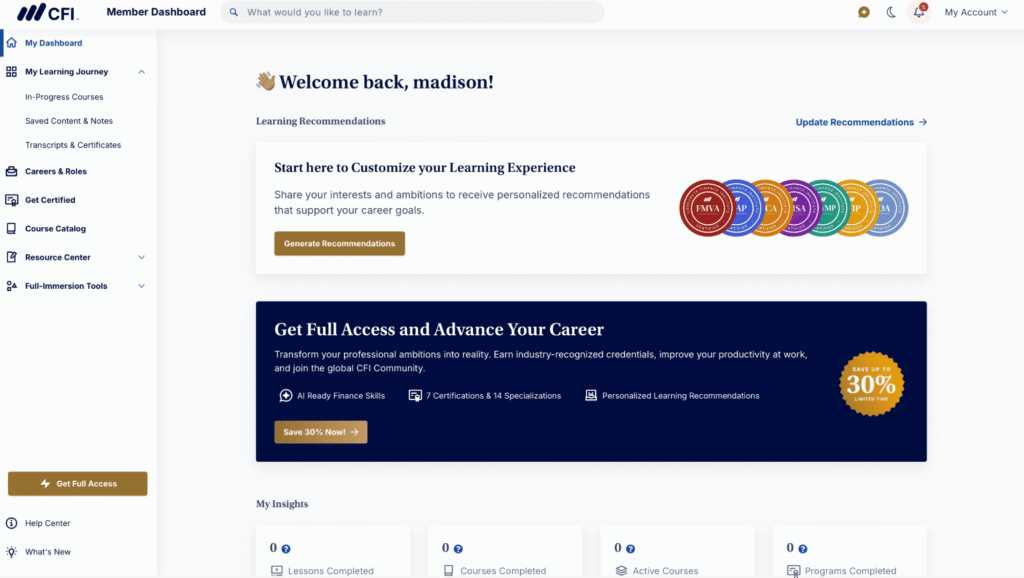
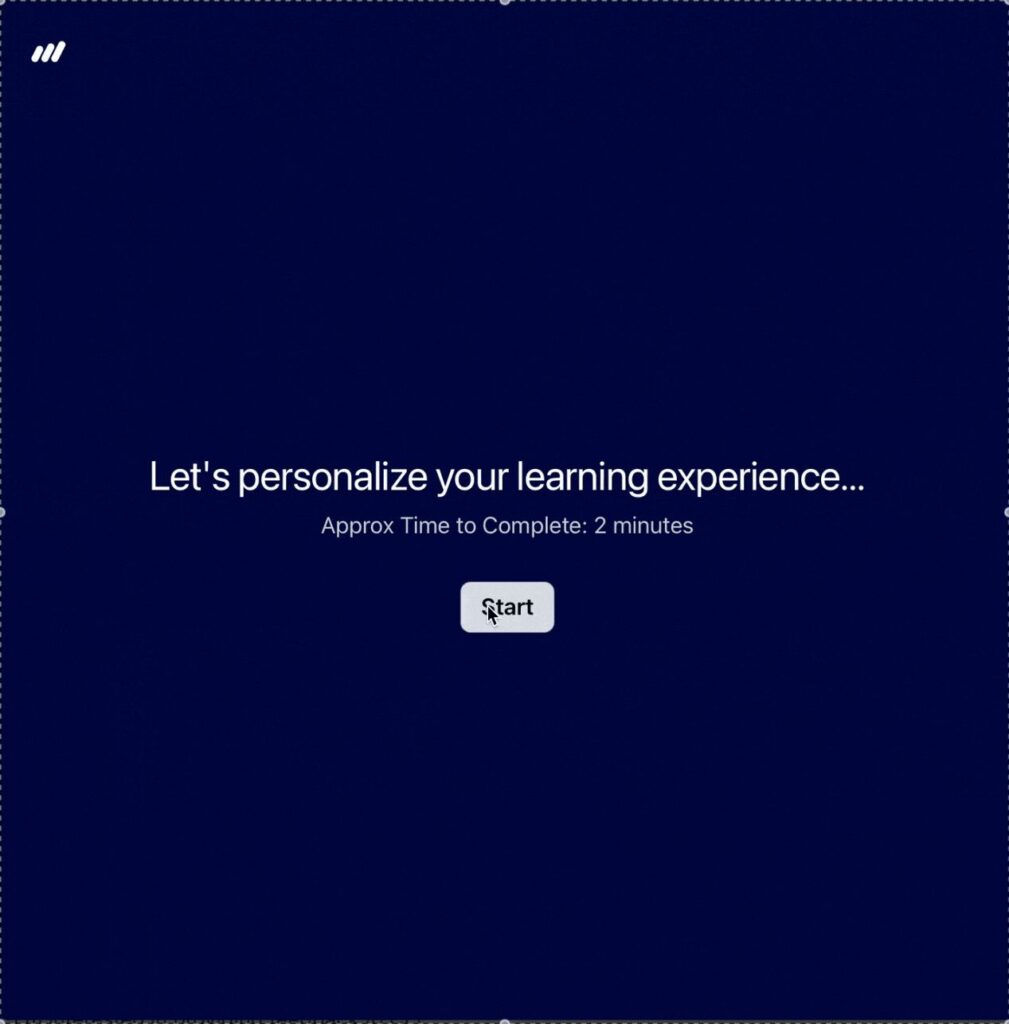
CFI is basically one huge online finance library with lessons, certifications, practice, and financial models all in the same place. The first thing CFI gave me was a short customization quiz. It asked about my interests and career goals, then used my answers to recommend what I should learn. It took around two minutes to load, which gave me a better starting point than searching through 250+ courses alone.
The dashboard was packed and honestly confusing at first. Courses, certifications, career tools, saved content, progress, and Full-Immersion features were all competing for my attention. CFI did include a quick tutorial, and that helped me understand where everything was without clicking through every menu myself.
Once I got past that first screen, the platform was easier to use. My recommendations, active courses, completed lessons, and certificates stayed together, so I could return without trying to remember what I had started.
CFI Package Comparison
| Feature | CPE Course Access | Self-Study | Full-Immersion |
|---|---|---|---|
| 250+ on-demand courses | ✅ | ✅ | ✅ |
| 550+ CPE/CPD credits | ✅ | ✅ | ✅ |
| Multilingual captions | ✅ | ✅ | ✅ |
| 7 certification exams | ❌ | ✅ | ✅ |
| 15 specialization programs | ❌ | ✅ | ✅ |
| One-on-one expert guidance | ❌ | ❌ | ✅ |
| 5 expert questions per week | ❌ | ❌ | ✅ |
| Course-integrated AI assistance | ❌ | ❌ | ✅ |
| Financial model feedback | ❌ | ❌ | ✅ |
| Premium templates and guides | ❌ | ❌ | ✅ |
| Annual membership price | $347 | $497 | $847 |
| Get Started | LEARN MORE | LEARN MORE | LEARN MORE |
The Parts of CFI That Stood Out
- Short lessons that did not feel like full college lectures
- Models I could open and change myself
- Quizzes that exposed whether I understood the lesson
- Case studies connected to realistic finance work
- Flashcards for quick formula and terminology review
- Captions that helped with unfamiliar finance terms
- Recommendations that pointed me toward the next lesson
- Certification paths with something to show at the end
- New and updated material added throughout the year
- A job board showing the skills that finance employers request
Pros
✅ Huge Finance Library: I could move between several career areas
✅ Hands-On Models: Changing the spreadsheets made concepts easier to follow
✅ Shorter Lessons: Studying never required a full free afternoon
✅ Several Learning Tools: Videos were not my only way to study
✅ Career-Based Paths: Certifications gave the library more direction
Cons
❌ Crowded Dashboard: The number of tools felt confusing at first
❌ Limited Study Direction: Recommendations never became a clear step-by-step plan
❌ Basic Lesson Visuals: Slides were not very interactive or engaging
My Honest Take on CFI’s Main Features
Tech and Ease of Use
I cannot lie, CFI was confusing when I first opened it. The dashboard was packed with courses, certifications, assessments, and career tools, but I did not know exactly where to begin.
The customization survey and tutorial helped, although I still wanted a clearer path telling me what to complete first and where to go next.
The platform itself ran smoothly. Pages loaded quickly, tools worked properly, and the search and filters made finding courses easier. The problem was the number of choices, not the technology.
Course Library and Learning Paths
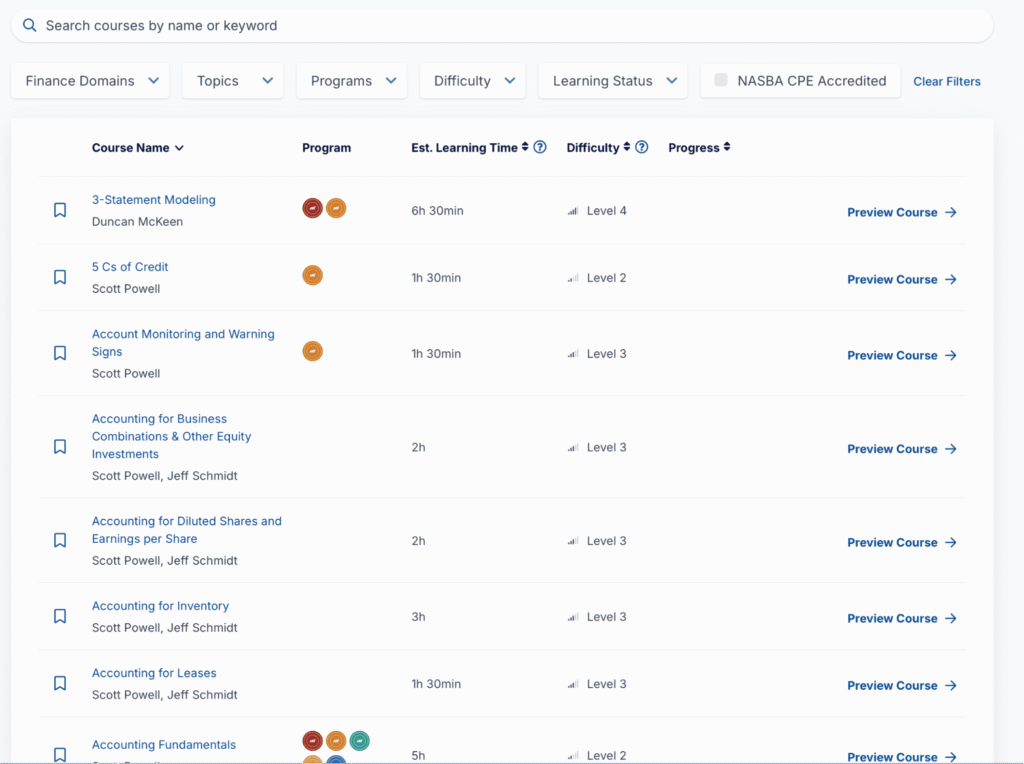
The course catalog was much easier to understand than the main dashboard. I could search by name or filter everything by finance area, topic, program, difficulty, learning status, or CPE accreditation.
Each course showed the instructor, estimated learning time, difficulty level, and my progress before I opened it. I could also preview or save one without starting it, which stopped my dashboard from filling up with courses I was only considering.
There were still a lot of options to scroll through, but the filters made finding one specific skill much faster.
Lessons, Quizzes, and Case Studies
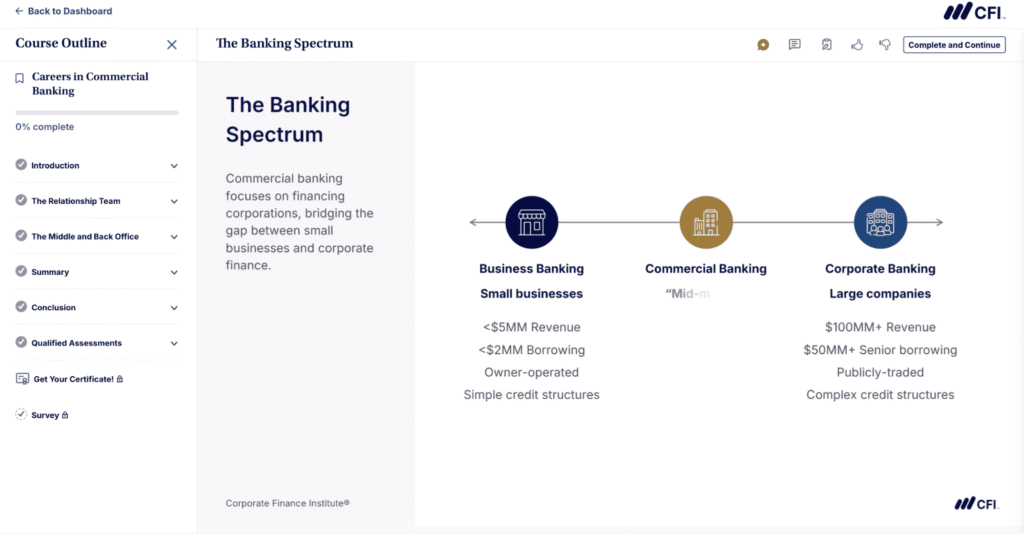
The lessons were split into shorter sections, so I could study for 20 minutes, finish a quiz, and return later without losing my place.
The quizzes checked whether I actually understood the lesson, while the case studies made me apply it to a more realistic situation.
The visuals were not very exciting, though. As a visual learner, I wanted more interactive examples, animations, or activities instead of mostly watching slides. Everything was clear, but it did not always hold my attention.
Skills Assessments and Recommendations
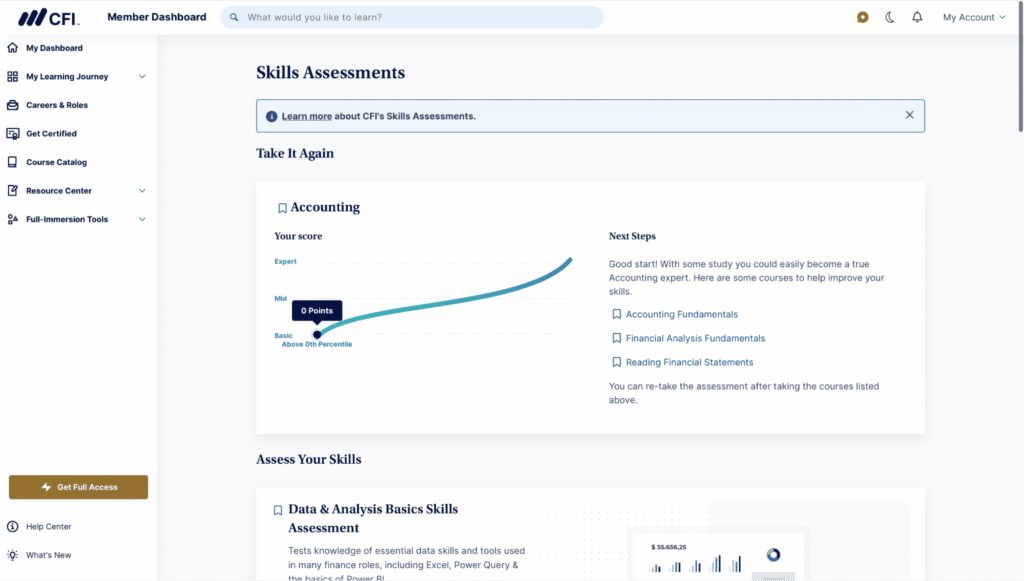
I took CFI’s accounting skills assessment, and it immediately showed my score, current level, and how I compared with other learners. It then recommended specific lessons based on the result and let me retake the assessment after studying.
It is not full progress tracking, but it gave me a clear starting point and a way to check whether my skills improved later.
Expert Help and Financial Model Feedback
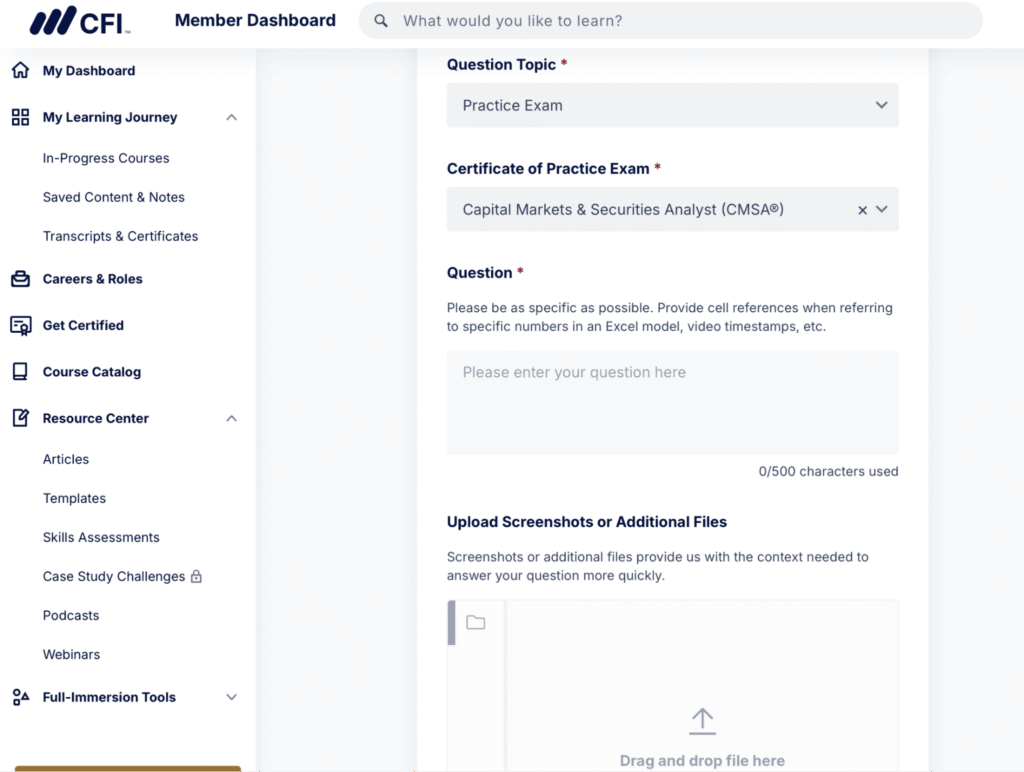
Full-Immersion gave me two ways to get personal help. I could ask up to five finance questions each week or submit a CFI course model for feedback.
The form let me explain exactly where I was stuck and upload the spreadsheet or a screenshot. CFI even asked for cell references and video timestamps, which saved me from trying to describe one random formula from memory.
This is not live tutoring, so I still had to write a clear question and wait for a response. However, being able to send the actual file made it much more helpful for specific problems.
Where CFI Lands Next to Other Finance Courses
Yeah, it is too vague and makes CFI sound equal to the partners without showing the actual tradeoffs. This version makes the differences clearer and gives the partners the better recommendation when someone needs focused training.
How CFI Compares to Other Finance Courses
AnalystPrep vs. CFI
AnalystPrep is more focused. Its study notes, video lessons, practice questions, performance tracking, and mock exams are built around professional finance exams. You spend less time deciding what to study and more time following the exam plan.
CFI gives you 250+ finance courses, certification programs, specializations, financial models, quizzes, and case studies under one membership. The downside is that it can feel scattered when you are preparing for one specific exam.
→ Choose AnalystPrep for focused exam prep and realistic practice.
→ Pick CFI for broader finance skills and hands-on models.
Kaplan Schweser vs. CFI
CFI is flexible, but it does not give you the same clear exam-day path. I had recommendations, assessments, and learning programs, but I still had to decide what to complete and when.
Kaplan Schweser provides a more structured routine with study materials, video instruction, quizzes, practice exams, and tools that guide you toward test day. That setup is easier when you want the course to organize your preparation.
→ Try out Kaplan Schweser for a guided professional-exam study plan.
→ CFI is Good for self-paced finance courses and certifications.
The ESG Institute vs. CFI
The ESG Institute stays focused on sustainability, climate risk, reporting, and ESG strategy. That narrower library makes it easier to go deeper without sorting through unrelated finance material.
CFI includes sustainability training inside a much larger finance library. You also get modeling, accounting, banking, valuation, credit, and data courses, but ESG is only one part of the membership.
→ Try The ESG Institute for focused ESG and sustainability education.
→ Go with CFI when you want ESG alongside wider finance training.
Fitch Learning vs. CFI
CFI is mostly self-paced. Full-Immersion adds expert questions and financial model feedback, but you are still responsible for creating your own study routine.
Fitch Learning offers virtual classes, instructor guidance, and a more traditional training experience. It gives you more direct support and less room to quietly fall behind on your own.
→ Consider Fitch Learning for instructor-led training and accountability.
→ Try CFI for flexible access and a larger finance library.
Should You Actually Choose CFI?
After testing it, I do think CFI holds up.
The platform ran smoothly, the lessons were easy to finish, and the models gave me real practice instead of making me watch videos all day. It was not perfect.
The dashboard felt crowded, the study direction could have been clearer, and the lesson visuals were not very engaging.
Still, the amount of practical material made up for most of that. I would use CFI to build several finance skills over time. I would skip it if I only needed one course or wanted a strict study plan telling me exactly what to do every day.
If CFI fits your goals, start with our Corporate Finance Institute coupon page to grab the best current discount before you enroll.
FAQs
What is the Corporate Finance Institute?
Corporate Finance Institute is an online finance training platform with lessons, financial models, certifications, specializations, quizzes, case studies, and career resources.
Is CFI good for beginners?
Yes. CFI includes beginner material and structured learning paths. Someone new to finance should begin with basic accounting, Excel, and financial statement concepts before moving into advanced modeling.
Which CFI package is better?
Self-Study is better for independent learners. Full-Immersion is better for someone who wants personal guidance and feedback on completed financial models.
Are CFI certifications recognized?
CFI certifications can show employers which finance skills and programs you completed. They do not replace a college degree, regulated license, or professional designation when a job legally requires one.
Is CFI suitable for someone preparing for securities licensing or CFP exams?
CFI focuses on career skills like modeling and valuation rather than securities licensing or CFP exam prep. For those exams, providers such as the Securities Institute of America or Boston Institute of Finance may offer more specialized and relevant training.
Is CFI worth the money?
CFI can be worth it when you plan to complete a certification, practice with the financial models, or study several finance topics. Someone who only needs one short lesson may not get enough use from a yearly subscription.