The best Series 66 review course is not always the one with the most tools.
You need one that makes it easier to get through the material, catch weak topics, and walk into the exam knowing what still needs work.
I went through five Series 66 courses and looked past the sales page. I used the study materials, practice tools, videos, reports, instructor help, and daily study features to see how each course actually felt to use.
In this guide, I will explain what each one does differently and show which course makes the most sense for your study style.
Best Series 66 Exam Prep Courses
- Best for a Full Series 66 Study Setup: Securities Institute of America — Puts the book, videos, calendar, and practice tools in one course.
- Best for Live Series 66 Support: Securities Training Corporation — Gives you more instructor access through classes, Q&A sessions, and the hotline.
- Best for an Adaptive Study Plan: Achievable — Changes your quizzes around what you are forgetting.
- Best for a Weekly Study Routine: Kaplan — Uses weekly tasks and check-ins to keep the course moving.
- Best for Different Learning Styles: ExamFX — Gives you different ways to study instead of forcing you into one setup.
| Best Series 66 Prep Courses | ||
 |
| GET STARTED |
 |
| GET STARTED |
 |
| GET STARTED |
 |
| GET STARTED |
 |
| GET STARTED |
My Full Series 66 Prep Course Reviews
Here is what stood out after using each Series 66 course beyond the feature lists.
1. Securities Institute of America: Best for a Full Series 66 Study Setup

At first, SIA felt like it had everything sitting on the dashboard at once, and I did not immediately know where to start. After I clicked around for a bit, it was easier than it looked. The course moved naturally from the study guide and videos into section tests, missed-question review, and bigger finals. I was not stuck studying one way the whole time. The test bank, video class, and calendar were the parts I kept going back to most.
Customizable Series 66 Test Bank
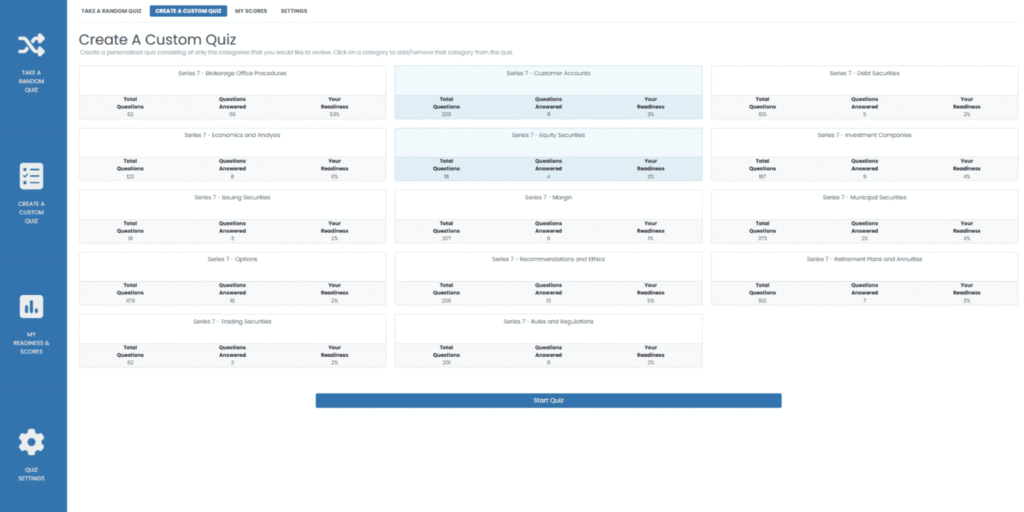
The test bank was the part I kept returning to because I did not have to take another broad practice exam every time. SIA gave me 15 ways to customize an exam, so I narrowed a session down when one topic was still getting mixed up in my head. Longer timed exams also helped me work on pacing instead of just reviewing one chapter.
There were more than 3,000 questions with explanations, unlimited topic-focused exams, and randomized simulated finals. Reopening missed questions saved me from digging through the full book for the rule again. The randomized answers also stopped me from remembering answer positions instead of reading the question.
Video Training Class
SIA’s video class followed the textbook chapter by chapter, which made it easier to use when reading a harder topic was not enough. The course included eight hours of training across nine videos and nine section tests. The lessons did not feel like random extra content added just to make the course look bigger.
I paired each video with its section test instead of saving the lessons for the end. That let me watch the explanation, answer questions right after, and see whether I understood how the topic might be tested. The videos were recorded, though, so they do not replace a regular live class for someone who wants to ask an instructor questions in real time.
Exam Plan Personal Study Calendar
The calendar gave the course an actual order. I entered my expected exam date and saw what needed to be finished next instead of jumping between the study guide, videos, and exams whenever I felt like it. That helped because SIA had enough material to make it easy to spend too long in one section and keep putting off finals.
The schedule still left me in control of when I studied. It just showed a clearer path through the course and made the dashboard feel less scattered once I started mixing videos, section tests, and full exams into the same week.
Securities Institute of America Packages
| Package | What It Adds | Best For | Price |
|---|---|---|---|
| Video Course & Practice Exam Package | Video lessons, section tests, question bank, custom exams, reports, and Greenlight Exam | Learning through videos and practice | SEE PRICING |
| Textbook & Exam Test Bank | Adds a 322-page printed study guide and ebook instead of video lessons, plus free shipping | Reading the material and practicing questions | SEE PRICING |
| Complete Exam Prep Course | Combines the book and video course, then adds Checkpoint Exams, the personal calendar, and Test Tips Video | Having the full SIA course in one place | SEE PRICING |
SIA Course Ratings
| Aspect | Rating |
|---|---|
| Content Quality | 9.5 / 10 |
| Practice Question Bank | 9.8 / 10 |
| Video Training | 9.0 / 10 |
| Study Plan and Reports | 9.4 / 10 |
| Pricing and Value | 9.5 / 10 |
| Support and Guarantee | 9.5 / 10 |
| Overall Average | 9.5 / 10 |
Pros
✅ I had both a printed study guide and ebook.
✅ Checkpoint Exams broke up the longer sections.
✅ The Test Tips Video gave me a separate last-minute review.
✅ My reports broke scores down by category.
Cons
❌ The dashboard took a little time to learn.
❌ There were no regular instructor-led classes.
❌ It may feel too self-paced if you need constant guidance.
Is This the Best Course for You?
SIA is best if you want a complete self-study course that gives you enough to stay busy without having to look for extra help somewhere else. It has a lot going on at first, but it starts to feel easy once you settle into your own routine. I would not pick it if you need live classes or someone keeping you on schedule.
2. Securities Training Corporation: Best for Live Support
STC felt more like a traditional prep course. I spent most of my time moving through the study manual, chapter quizzes, and final exams, then using the extra help tools after I got tired of reading. The instructor options were the part that made STC stand out. Between the hotline, live classes, and weekly Q&A sessions, it gave me more ways to hear the material explained by a real person.
Crunch Time Facts
Crunch Time Facts were STC’s quick-review sheets. They were better for bringing a topic back to mind before a quiz than teaching it from scratch.
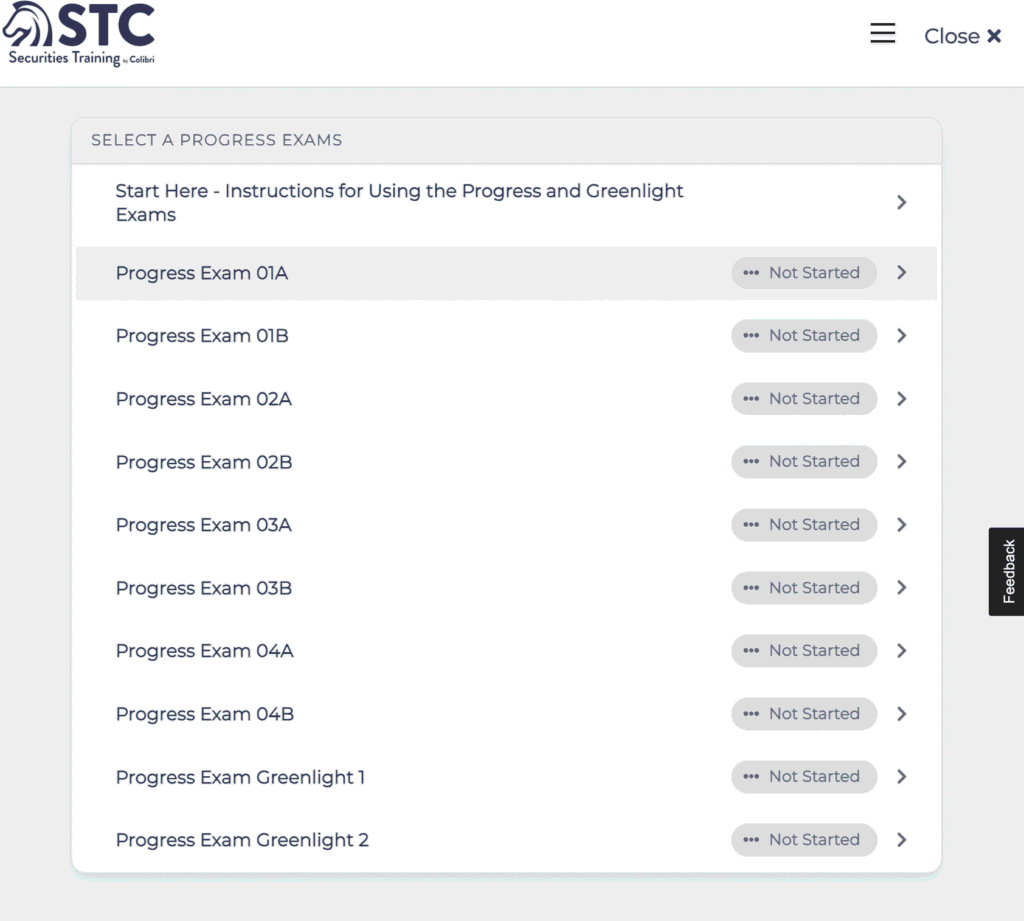
I also liked having Progress Exams and Green Light Exams in addition to chapter quizzes and finals. The platform itself looked a little dated, and it took more self-direction to move through the material. Still, the smaller progress checks made weak spots easier to catch before getting to the final exams.
STC’s Virtual Class
The virtual class was the part of STC that made the course feel the least like regular self-study. An instructor worked through Series 66 material in a scheduled setting instead of leaving me with recorded lessons and a manual. The weekly Q&A sessions gave me a second chance to bring up rules that still were not clicking after reading.
That was the biggest difference from SIA. SIA gave me more control over building my own practice, while STC gave me more actual instructor time. Recorded classes helped too because I did not lose the explanation if I missed a session.
Instructor Hotline
The instructor hotline gave me somewhere to take the little questions that sounded simple in the manual but got confusing once they showed up in a question. It did not replace a live class, but it made the course feel less like I was stuck alone with a book.
STC also included 24/7 technical support, so there was help available when the issue was with the platform instead of the material. That extra access made the course feel more supported than a basic textbook-and-question-bank setup.
Learn more in my STC review for package details and instructor support.
Securities Training Corporation Packages
| Package | What’s Included | Best For | Price |
|---|---|---|---|
| Standard | Printed and online study manual, chapter quizzes, final exams, Crunch Time Facts, instructor hotline, course updates, and tech support | Studying independently with instructor help available | SEE PRICING |
| Premier | Everything in Standard, plus On-Demand Lectures, flashcards, Progress Exams, Green Light Exams, and the STC Pass Guarantee | Having more review tools between reading and finals | SEE PRICING |
| Premier Plus | Everything in Premier, plus an instructor-led virtual class, weekly Q&A sessions, and recorded live classes | Learning with live instruction and scheduled support | SEE PRICING |
STC Course Ratings
| Aspect | Rating |
|---|---|
| Content Quality | 9.2 / 10 |
| Practice Question Bank | 9.1 / 10 |
| Video Training | 9.0 / 10 |
| Instructor Quality | 9.5 / 10 |
| Pricing and Value | 8.8 / 10 |
| Support and Guarantee | 9.3 / 10 |
| Overall Average | 9.2 / 10 |
Pros
✅ The instructor hotline gave me another place to ask questions.
✅ Live weekly Q&A sessions gave me extra instructor help.
✅ Crunch Time Facts were easy to pull up before a quiz.
✅ Course updates kept the material current.
Cons
❌ The platform felt a little outdated.
❌ Six months may feel tight if you keep putting off studying.
❌ It took more self-direction to move through the material.
Is It Your Best Choice?
STC is a solid choice if studying alone turns into rereading the same page over and over. The course still has the book-and-questions side, but the instructor access makes it feel less like you are left to figure everything out by yourself.
3. Achievable: Best for an Adaptive Study Plan

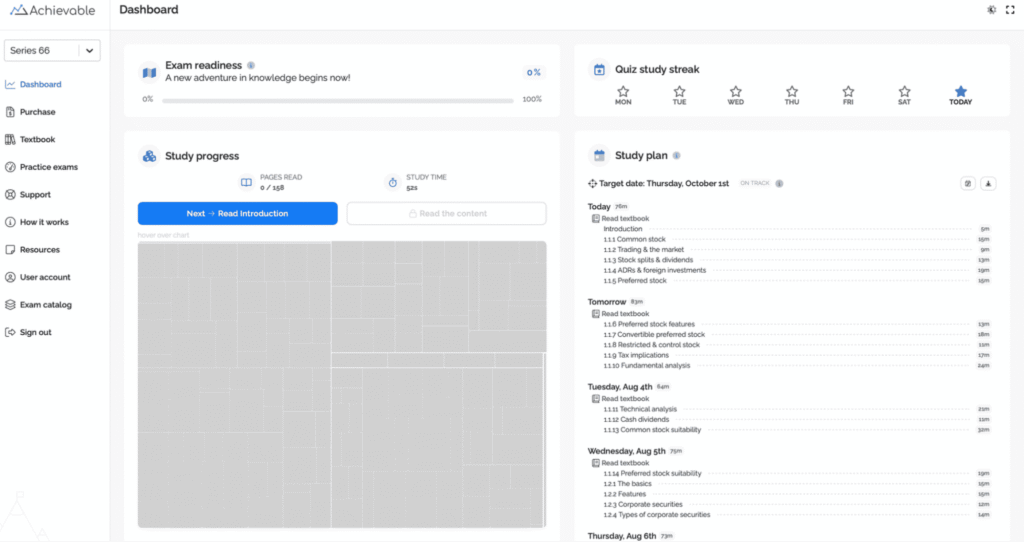
Achievable was much less cluttered than the other Series 66 courses I opened. Achievable was the least complicated one to choose. There was only one Series 66 course, so I did not have to compare different versions before getting started. The textbook, quizzes, progress screen, practice exams, videos, audio, and AI tutor were all built into the same online setup. What stood out most was that it paid attention to what I was forgetting instead of sending me through the same review in the same order every time.
Adaptive Quiz System
Achievable’s quiz system had more of a mind of its own. It tracked my retention by individual Series 66 learning objective, then kept circling back to material that was starting to fade. I was not taking the same kind of review in the same order just because the textbook had moved to the next chapter.
SIA handed me more control over the exact questions and topics I practiced. Achievable was less hands-on in that way. It made the next review decision for me, which saved time, but sometimes I wanted to choose the topic myself instead of waiting for the course to bring it back up.
Online Textbook
The online textbook was easier to get through than I expected. It used normal language, examples, and sample-question walkthroughs instead of dropping a wall of licensing terms onto every page. I opened it on both desktop and mobile, and it stayed easy to read on either one.
There were also 43 bonus videos for key topics and narrated audio for the reading. The videos helped with harder ideas, and the audio had adjustable voice and playback-speed settings. This is not a course built around long lecture videos, though. Most of the learning still happens through the reading and quizzes.
Practice Exams
There were more than 1,200 quiz questions and 26+ practice exams in my course. I took chapter quizzes first, then moved into longer exams once I had more material behind me. The math questions changed the numbers instead of repeating the exact same problem, which made me work through the concept instead of remembering an old answer.
The course also had Ask Achievable AI for quick explanations and examples around a regulation or formula. I still checked the textbook if I needed more context, but it was helpful for getting unstuck without leaving the course.
Achievable Series 66 Course Package
| Package | What’s Included | Best For | Price |
|---|---|---|---|
| Achievable Series 66 Course | Online textbook, adaptive quizzes, 1,200+ questions, 26+ practice exams, 43+ bonus videos, narrated audio, Ask Achievable AI, progress tracking, and one year of access | Studying online with an adaptive course | SEE PRICING |
Achievable Course Ratings
| Aspect | Rating |
|---|---|
| Content Quality | 9.0 / 10 |
| Practice Question Bank | 9.1 / 10 |
| Adaptive Learning Technology | 9.7 / 10 |
| Video Training | 8.5 / 10 |
| Pricing and Value | 9.2 / 10 |
| Support and Guarantee | 8.5 / 10 |
| Overall Average | 9.0 / 10 |
Pros
✅ I had a full year to finish the course.
✅ The math questions changed the numbers each time.
✅ Audio settings were easy to change.
✅ The dashboard showed my weak areas by section.
Cons
❌ There was no printed textbook option.
❌ The videos were short topic explainers, not full lectures.
❌ There were no regular live instructor-led classes.
Who Would Actually Like Achievable?
Achievable is nice if you get overwhelmed trying to decide what to review every time you sit down to study. It keeps track of the stuff that is fading from your memory and brings it back around without making the course feel complicated. I would skip it if having a physical book, a live teacher, or a bigger selection of packages is important to you.
4. Kaplan: Best for Following a Weekly Routine

Kaplan felt like it wanted to keep me moving instead of letting me sit in one chapter forever. The study plan laid out weekly tasks, and the course had check-ins built into different points of the material instead of saving everything for one final exam. I spent most of my time in the License Exam Manual, QBank, and assessment tools, but the class options and InstructorLink gave Kaplan a more guided feel than a basic self-study course.
Study Plan and Unit Videos
Kaplan’s study plan was the part that made the course feel organized. It broke the material into weekly tasks, so I was not opening the course and deciding from scratch whether I should read, watch something, or take questions that day. The intro videos gave me a quick idea of what to focus on before a unit. Then the wrap-up videos brought the main ideas back together right before the Checkpoint Exam.
I remember with Achievable, the quizzes kept bringing weak topics back up without me having to think much about it. Kaplan did not work like that. It gave me a steady weekly routine, but I still had to notice for myself when I was weak in one area and spend extra time there.
SecuritiesPro™ QBank
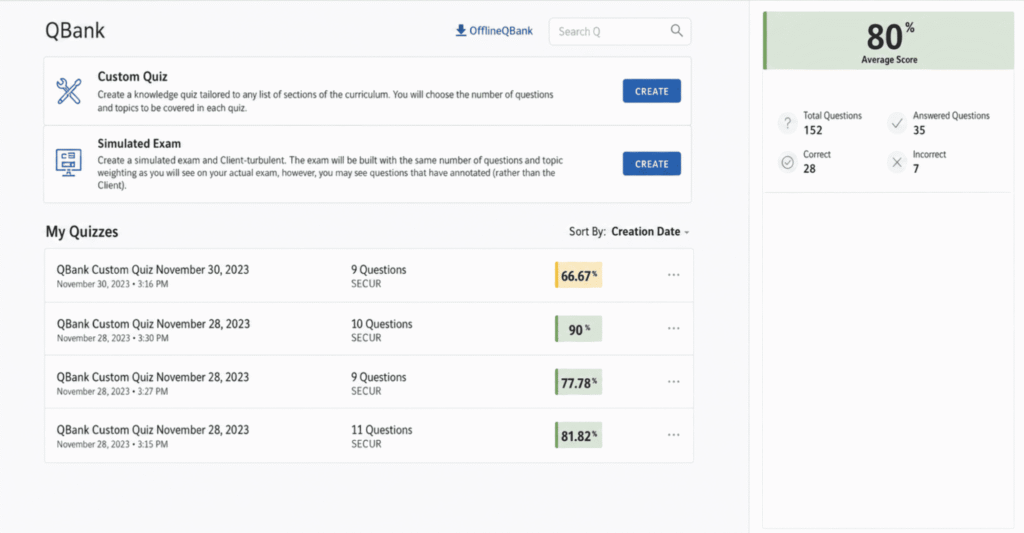
Kaplan’s QBank was where I got more specific after working through the main material. The Custom Quiz tool let me choose the curriculum sections, topics, and number of questions instead of sending me into another broad final exam. I made short quizzes around the SECUR material, and my results stayed saved in one list, so I could see the difference between my scores instead of guessing whether I was improving.
The Simulated Exam option was more serious. It used the same question count and topic weighting as the real exam, so I used that for a bigger readiness check. My QBank dashboard also tracked my average score, total questions, answered questions, and correct versus incorrect answers. It gave me the controls, then made me decide what I needed to work on.
InstructorLink™
InstructorLink was more useful than I expected, mostly because it gave me somewhere to send the oddly specific questions that were not getting answered by the book. I did not have to turn every question into a discussion-board post or wait around for a live class.
The only thing is that it was not immediate. Kaplan says answers come within two business days, so it did not help much if I was sitting there stuck on one point and wanted to keep going right then. I usually wrote the question down, moved on, and came back to it later. It was nice backup, but I would not treat it like live instructor access.
Kaplan Series 66 Course Packages
| Package | What’s Included | Best For | Price |
|---|---|---|---|
| Basic Self-Study Package | License Exam Manual, QBank, Practice Exam, Performance Tracker, study plan, exam tips and updates, and Student Community | Following Kaplan’s core self-study setup | SEE PRICING |
| Essential Self-Study Package | Everything in Basic, plus Checkpoint Exams, Midterm Exam, and unit intro and wrap-up videos | Having more structure and score checks | SEE PRICING |
| Premium Package | Everything in Essential, plus a Live Online or On-Demand class, Class Notes, Mastery Exam, InstructorLink, and Kaplan AI Tutor | Taking Kaplan with instructor help | SEE PRICING |
| Package | What’s Included | Best For | Price |
Kaplan Course Ratings
| Aspect | Rating |
|---|---|
| Content Quality | 9.0 / 10 |
| Practice Question Bank | 9.0 / 10 |
| Study Plan and Progress Tracking | 9.1 / 10 |
| Instructor Quality | 9.3 / 10 |
| Pricing and Value | 8.3 / 10 |
| Support and Guarantee | 8.7 / 10 |
| Overall Average | 8.9 / 10 |
Pros
✅ The weekly study plan kept the course moving.
✅ Unit videos made the manual easier to get through.
✅ InstructorLink answered questions within two business days.
✅ Exam Tips and Content Updates covered rule changes.
Cons
❌ Access only lasted five months.
❌ The Practice Exam only allowed one attempt.
❌ The Practice Exam did not include rationales for every answer.
Would Kaplan Keep You on Track?
Kaplan is a nice choice if you need more order than a huge question bank and a textbook sitting on a dashboard. The course has a clear rhythm from reading through score checks, so it is easier to keep moving even when the material starts getting boring.
5. ExamFX: Best for Different Learning Styles
ExamFX did not have the super polished, all-in-one feel some other courses had. But it also did not leave me staring at one manual for days. Its options made sense for different people: someone who just wants a book, someone who learns better through videos, or someone who needs live help with tougher topics. I was not forced into one type of course just because I was studying for the Series 66. The Benchmark Final, custom question tools, and live webinar were the pieces I remembered most.
Benchmark Final Exam
The Benchmark Final had a different purpose from the Standard Final Exams. It was a bigger score check after I had already spent time with the material, while the Standard Finals gave me more room to keep practicing afterward. Checkpoint Exams also broke up the course earlier, so there was not one huge jump from chapter work into a final.
I liked having different exam types because a score means more when it is not coming from the same setup every time. The Benchmark Final felt more serious, while the Standard Finals gave me more room to keep working through exam-length practice. ExamFX also had a Practice Exam that followed the real exam’s timing, format, difficulty, and topic coverage.
Custom Exam Generator
The Custom Exam Generator let me build practice around the material I needed to go back through. That was more useful than jumping straight into a full final every time. Smaller question sets helped me focus on certain topics and use the results to decide what needed more attention.
SpotCheck quizzes were much shorter than the finals and made sense after a section of reading or video. The Report Center kept the scores together, so I was not trying to remember which chapter had given me trouble. The quiz system was not adaptive, but there was enough variety between SpotChecks, question sets, checkpoints, and custom exams that it did not feel like one repetitive bank.
Focused Live Webinar
ExamFX’s live option was a three-hour webinar built around the harder Series 66 topics. It came with a fillable notebook, so I had something organized to follow instead of trying to type random notes while the instructor talked. The webinar was more focused than a full start-to-finish class.
STC had more ongoing live support, but ExamFX’s webinar got straight to the stuff people tend to get stuck on. The on-demand videos gave me more material outside the live session, while the notebook made the webinar feel less passive. I just would not expect one three-hour session to provide the same amount of instructor contact as a recurring class.
Check out my ExamFX review for a closer look at its video-first study flow.
ExamFX Series 66 Course Packages
| Package | What’s Included | Best For | Price |
|---|---|---|---|
| Textbook Package | Hard-copy textbook, study plan, practice question sets, Checkpoint Exams, final exams, Custom Exam Generator, reports, glossary, and instructor support | Reading through the material and practicing independently | SEE PRICING |
| Online Course Package | Everything in Textbook, plus on-demand video lectures, digital flashcards, online instructor support, and 180 days of access | Adding video lessons and flashcards | SEE PRICING |
| Live Online Package | Everything in Online Course, plus a live focused webinar and fillable webinar notebook | Getting live help with difficult topics | SEE PRICING |
ExamFX Course Ratings
| Aspect | Rating |
|---|---|
| Content Quality | 8.9 / 10 |
| Practice Question Bank | 9.0 / 10 |
| Video Training | 9.0 / 10 |
| Study Plan and Reports | 8.7 / 10 |
| Pricing and Value | 8.5 / 10 |
| Support and Guarantee | 8.6 / 10 |
| Overall Average | 8.8 / 10 |
Pros
✅ Phone instructor support was available.
✅ The glossary and acronyms list were easy to reference.
✅ Note-Taking Notebook was good for jotting down things during webinars.
✅ The physical textbook and digital flashcards gave me different ways to review.
Cons
❌ My study plan did not adjust around weak areas.
❌ The live webinar was only one short session.
❌ Instructor help was not as ongoing as a full live class.
Who Is ExamFX Actually Good For?
ExamFX makes sense if you learn by doing questions again and again, not just sitting through long lessons. There are enough different quiz and exam formats that studying does not turn into taking the same final ten times.
Other Series 66 Prep Resources
- Pass Perfect: I liked it for extra question practice and a more old-school securities study setup. The material can feel denser, though, and I did not find it as easy to settle into as SIA or Achievable.
- Knopman Marks: The instructor support and accountability side stood out to me. It may be more than you need if you mainly want a straightforward course to work through by yourself.
- Mometrix: I liked it as a lower-pressure supplemental option for refreshing Series 66 concepts. It did not have the same depth of practice and progress tools as the courses in my top five.
- Varsity Tutors: This is worth looking at if you know you need a real person to keep you on track. I would see it as extra help alongside a full Series 66 course, not the only resource you use.
How These Series 66 Courses Were Ranked
The rankings looked at more than how many tools each course advertised. Practice quality, course structure, instructor help, reports, access, and overall value all counted.
| Criteria | Weight | What It Measured |
|---|---|---|
| Practice questions and exams | 25% | Question variety, explanations, and different ways to check exam readiness |
| Course content | 20% | How easy the book, lessons, and explanations were to get through |
| Learning tools and study structure | 15% | Calendars, study plans, adaptive quizzes, and overall course flow |
| Instructor access and support | 15% | Live classes, Q&A, instructor help, and ways to get unstuck |
| Reports and progress tracking | 10% | Whether weak topics and score patterns were easy to spot |
| Price and overall value | 10% | What was included compared with what most people would actually use |
| Access length and guarantee | 5% | Study time, extensions, and pass support |
The higher-ranked courses had more than a book and a few finals. They offered better practice options, stronger support, or a clearer path through the material. The lower-ranked courses still had enough content and questions to prepare for the Series 66, but they left out some of the guidance, flexibility, or support that made the top choices easier to stick with.
How to Choose a Series 66 Course
- Does reading the same book and taking the same kind of quiz every day make you lose interest?
➡️ Go with SIA. It gives you a study guide, videos, section tests, missed-question review, cheat sheets, a calendar, and full finals, so the course does not start feeling like one long routine. - Do you get hung up on a rule and need somebody to explain it out loud?
➡️ Go with STC. The live class, weekly Q&A sessions, and instructor hotline give you more human help than the other self-study options. - Do you keep forgetting material you already reviewed?
➡️ Go with Achievable. Its quizzes track weak learning objectives and bring those topics back instead of making you decide what needs another review. - Do you put studying off because you do not know what to do next?
➡️ Go with Kaplan. The weekly plan, unit videos, checkpoints, and score checks give you a more set routine to follow from the beginning. - Do you learn differently depending on the topic?
➡️ Go with ExamFX. It gives you a textbook, videos, short SpotCheck quizzes, custom practice, finals, and a focused live webinar, so you are not locked into one study format.
My Final Thoughts on the Top Series 66 Courses
SIA felt like the most complete course. STC was the best choice for live instructor help. Achievable made the most sense for someone who wants quizzes to adjust around weak spots, while Kaplan was better for following a weekly routine. ExamFX gave the most options for people who do not want to study the same way every day.
Choose the course you know you will actually keep opening and using, even after the first few motivated days wear off.
FAQs
STC has the strongest live support, including instructor-led virtual classes and weekly Q&A sessions. Kaplan and ExamFX also offer live instruction options.
Securities Institute of America combines a study guide, ebook, video class, section tests, 3,000+ questions, finals, reports, cheat sheets, and a personal study calendar in one course.
Yes, especially if you want adaptive quizzes. Achievable tracks the topics you are forgetting and brings them back into later review sessions.
Kaplan is a good fit if you need a weekly study routine. Its plan, unit videos, checkpoints, and score tracking give the course more structure.
Yes. ExamFX includes SpotCheck quizzes, practice question sets, Checkpoint Exams, a Benchmark Final, Standard Finals, and a Custom Exam Generator.
A self-study course can be enough if you stay consistent and take plenty of practice exams. Live classes help most when reading the material alone is not clicking.
Most people need several weeks of steady study time. The right amount depends on whether you recently took the Series 7, how comfortable you are with regulations, and how often you can study.
You can, but a textbook alone makes it harder to track weak areas and practice exam timing. Questions, final exams, and score reports usually make prep more complete.