Trans Kansans to be barred from single-sex spaces, blocked from changing gender on ID
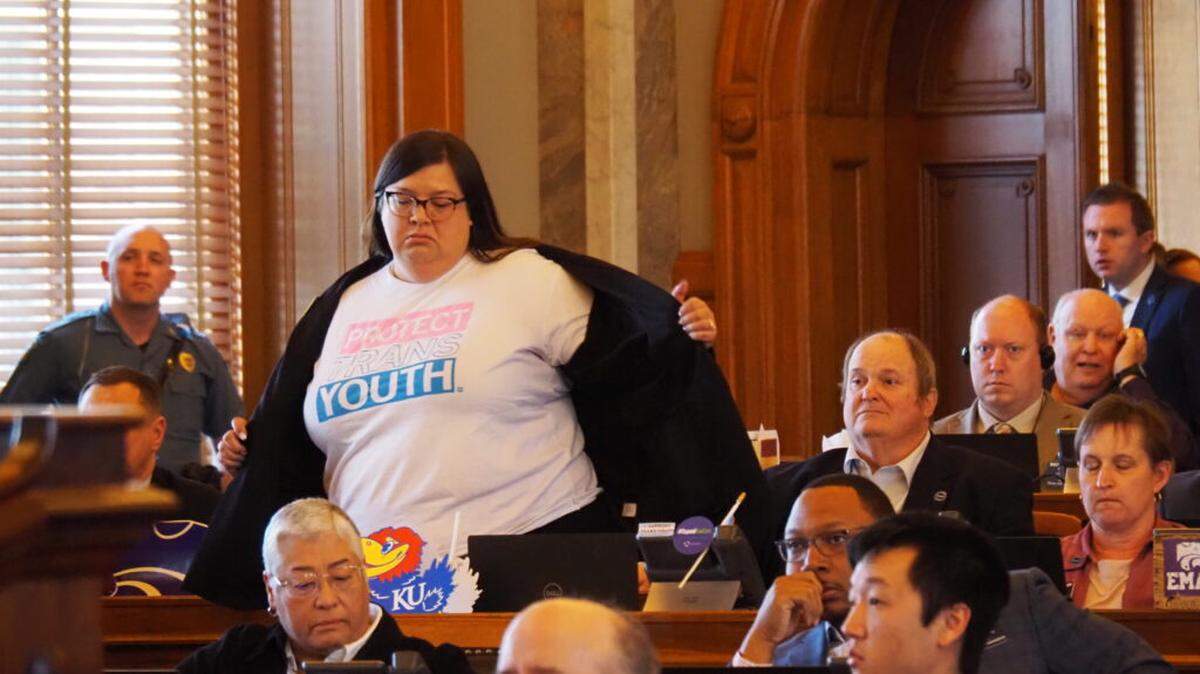
Transgender Kansans will be barred from single-sex spaces inconsistent with their sex assigned at birth after Kansas became the first state in the nation to pass a sweeping new law over Kansas Gov. Laura Kelly’s veto.
The Republican-controlled Kansas House, mostly along party lines, voted Thursday to override the Democratic governor by a vote of 84 to 41 to enact the “women’s bill of rights.” The Senate, also under GOP control, voted to override Kelly 28-12 the previous day.
The new law, which takes effect in July, will impact a wide array of services for transgender and nonbinary Kansans. For example, people will no longer be able to change their driver’s license to align with their gender identity. Some opponents of the law emphasized that transgender residents can still seek new documents for the next two months, but suggested the new restrictions will face a legal challenge.
The bill, which Lenexa Democratic Rep. Brandon Woodard called the most extreme anti-trans legislation in the country, defines man and woman in state statute based solely upon reproductive capability and explains the state has an interest in protecting spaces designated for women.
“Kansans aren’t crazy, and yet here we are with the most extreme bill in the entire country,” he said.
The bill has been pushed by the Independent Women’s Law Center and comes amid a national wave of bills regulating the rights and lives of transgender Americans. The center and its allies have said the bill is aimed at preventing judges from forcing single-sex spaces to be abolished or to admit people who were not assigned that gender at birth.
With the passage of the law, the Kansas City area now occupies a new national epicenter in the push to regulate the lives of transgender individuals. Republicans across the country have sought to advance measures aimed at transgender rights, but the Kansas City metro straddles two states where those efforts are particularly aggressive and advanced.
On one side of the state line, Missouri Attorney General Andrew Bailey is attempting to effectively ban gender-affirming care for children and adults through an emergency rule. The regulation is on pause until at least Monday while a judge considers whether to block the rule.
On the other side, transgender Kansans say they believe the new law is designed to functionally erase their identities in society.
“The fact that someone even had the balls to say this is something we should try to pass is big enough,” said Lane Rozin, a 19-year-old transgender man who attends the University of Kansas. “It shows that there are people in our government system that are trying to erase our identities.”
The ability to change a driver’s license identifier and access healthcare, he said, is lifesaving.
Proponents of the policy said it was important to preserving spaces that were created for women.
“A woman, a grandchild, should be able to walk into a restroom and know they’re in there with other females,” Rep Brenda Landwehr, a Wichita Republican, said during a meeting of the House GOP caucus. “If more gender-neutral bathrooms need to be built to accommodate, then fine.”
Speaking to reporters after honoring the University of Kansas’ women’s basketball team for winning the Women’s National Invitational Tournament, Kelly rejected the concept that the bill would do anything to protect those athletes.
“I think it’s incredibly discriminatory. I think it’s divisive. And I think it’s likely unconstitutional,” she said.
“We’re taking freedom and liberties away from folks. I think it’s very wrong.”
Possible risk to federal funding
Rep. Jesse Borjon, a Topeka Republican, cast the decisive vote to override the veto. He initially voted no, but changed his vote during a call of the House, a procedural move that extends the vote and allows legislative leaders to find missing lawmakers or exert pressure on others.
Borjon said he arrived at his vote after listening to constituents.
“The overwhelming response was that folks wanted this,” Borjon told reporters. “Personally, I’m not onboard with the bill 100% but it’s not about what I want, it’s about what my constituents in my district want.”
Kelly’s administration warned that the bill could result in the loss of federal funds for Kansas state agencies because compliance with the bill would violate non-discrimination policies. The state’s Coalition against Sexual and Domestic Violence had said state agencies serving victims could lose $14 million in federal funds.
“We’re at risk of losing a ton of federal funding for domestic violence centers,” said Taryn Jones, a lobbyist for the LGBTQ advocacy organization Equality Kansas.
The governor’s office has said that among the state programs that could be affected are substance abuse programs administered by the Kansas Department of Aging and Disability Services, and state mental health hospitals, which must comply with federal guidelines on gender identity. The Kansas Department for Children and Families also has youth residential centers and groups homes that could be affected.
Federal guidance surrounding foster care funds also supports affirming a child’s gender identity, Kelly’s office said. Kansas could also get less federal grant funding for criminal justice programs because the new law will require Kansas to violate the federal Prison Rape Elimination Act.
The veto override immediately raised the prospect that the new law will face a legal challenge. ACLU of Kansas director Micah Kubic said in a statement that the measure tries to “codify into law a right to exclude trans people” from athletics, restrooms, domestic violence shelters and other spaces, but didn’t announce a lawsuit.
The White House didn’t immediately comment on the veto override. At a press briefing last week, White House press secretary Karine Jean Pierre, said the Biden administration will do all it can to protect LGBTQ people who are under attack.
“That’s what we’ve been seeing across the country, especially in statehouses,” Jean Pierre said. “And so we’re going to fight alongside them to protect their rights. They should be allowed to be who they are, who they want to be. And they should be able to speak out against, and we should be able to speak out, and others should be able to speak out against hate and discrimination.”
During debate Thursday opponents of the bill expressed broad fear that the bill will create a chilling effect discouraging policies that seek to include gender non-conforming Kansans and that it would in fact promote violence against anyone who does not appear to match conventional gender norms.
“This bill is really about making people feel easy about this, feel comfortable about this. It doesn’t matter what it’s going to do to the children and adults its going to affect,” said Rep. Susan Ruiz, a Lenexa Democrat. “We are going to see much more harassment going on.”
Ruiz, the first openly lesbian woman to serve in the House, said she already faced harassment from men when she used a women’s bathroom because of her appearance — Ruiz has short hair and dresses in a more masculine style.
“This is going to make it much worse,” she said.
Bathroom access
Former Rep. Stephanie Byers, a Wichita Democrat who was the first transgender state legislator in Kansas, said that, contrary to the aims of proponents, the law would effectively turn single-sex restrooms across the state into uni-sex facilities.
“When this becomes law, trans men — bearded, balding people — will now be going into the women’s restroom because legally that is where they are required to go,” Byers said.
Rep. Heather Meyer, an Overland Park Democrat and mother to a transgender child, said the bill would place transgender children under greater scrutiny as they sought to live their lives. She said it would open transgender women to assault when they are forced to use spaces designated for men.
“These are just folks trying to live their lives. There’s no reason to do this and as we continue to say this doesn’t protect women at all,” Meyer said.
GOP leadership celebrated the override as a major victory. Speaking to House Republicans after the vote Wednesday, House Speaker Dan Hawkins said he was “giddy” over the caucus’ success in overriding a number of Kelly’s vetoes.
“Getting that women’s bill of rights was truly the icing on the cake,” said Hawkins, Wichita Republican.
Senate President Ty Masterson, an Andover Republican, said he was proud to see Kansas be the first state to enact the policy. He said he expected transgender individuals could still use their preferred restroom under the policy as long as they were discrete.
But he said that if someone is open about that identity they’d have to use the “proper” restroom.
“I’m actually proud to be in a state of science,” Masterson said. “The world seems to be struggling with how to define a woman and we do not have that struggle.”
Lawmakers overrode Kelly’s veto with the help of freshman Rep. Marvin Robinson, a Kansas City Democrat, who also supported a successful veto override of a bill banning transgender athletes from girls sports. Byers expressed particular frustration with Robinson’s vote.
“Had the elections resulted in individuals who actually hold to the Democratic Party’s principles, then this would have not happened,” Byers said.
The bill was one of four policies regulating the lives of transgender Kansans that Kelly vetoed last week.
Speaking to reporters in the Capitol Tuesday, Kelly referenced gender-neutral bathrooms in Kansas City’s new airport as she urged more inclusive solutions.
“There are ways to solve problems and I think it would be good if people put on their thinking caps and looked around to see if there are solutions to problems that might work for everybody,” Kelly said.
Brittany Jones, a lobbyist for Kansas Family Voice, a conservative Christian organization, applauded the successful override.
“Activist courts will not be able to misconstrue the word woman to fit their agenda,” she said.
Republicans successfully overrode Kelly on a bill requiring county jails to separate inmates by sex assigned at birth and appear poised to override Kelly on a bill requiring schools to separate students by sex assigned at birth on overnight field trips.
Lawmakers fell short of overriding the governor on a bill banning hormone therapy and gender transition surgery for minors by punishing its providers.
Lawmakers on both sides of the aisle rejected the bill, arguing it unnecessarily infringed on medical decisions. But its advocates have pledged to try again in future years.
The Star’s Jenna Barackman and Daniel Desrochers contributed to this report.
This story was originally published April 27, 2023 at 9:36 AM with the headline "Trans Kansans to be barred from single-sex spaces, blocked from changing gender on ID."