Hateful, threatening protests endanger university campuses. Kick violent offenders out | Opinion
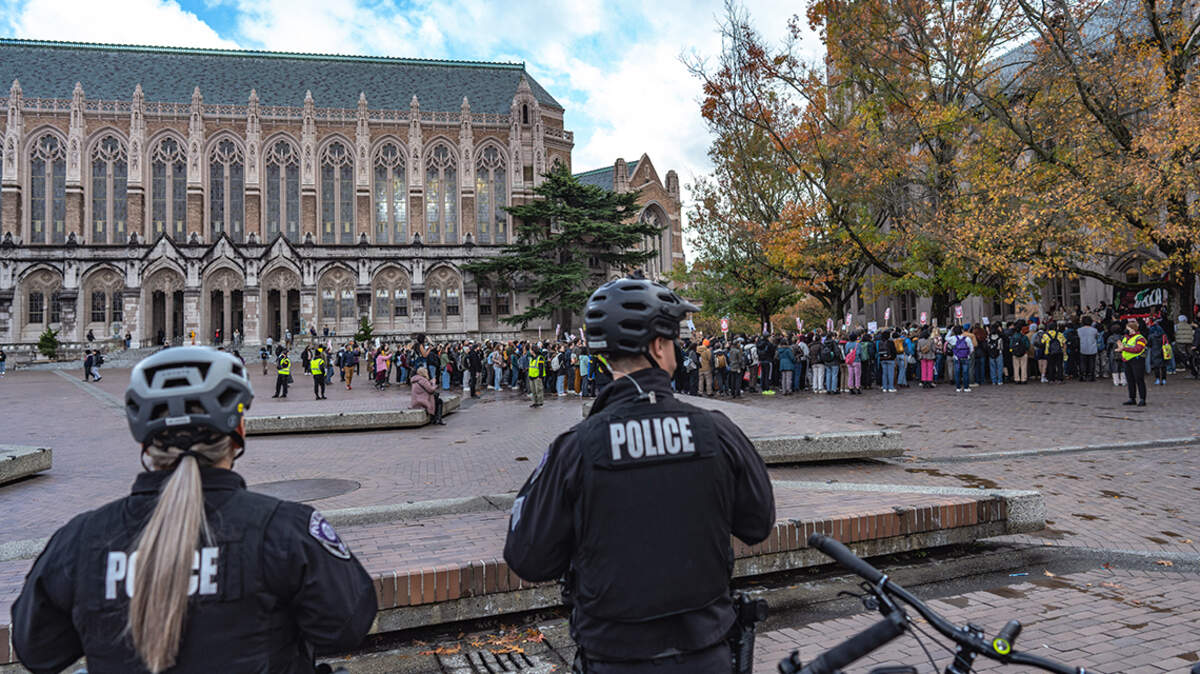
Out of hand
I believe university administrations have the right to expel any student who protests with hate, harassment, verbal or physical threats or assaults against anyone — regardless of subject. If students want to protest on a public street off campus without hate or verbal threats, that would be OK, and it would be up to police to determine whether their conduct breaks the law. However, no one should be able to harass or scare other students, faculty or staff to the point of those victims hiding or having concern for their lives.
The First Amendment gives us all the right to protest but not to threaten, harass or physically assault others. It is the law.
- William Paul Service, Overland Park
More is owed
The Kansas City Star’s reporting on the $1.8 billion judgment against the National Association of Realtors and major real estate brokers highlights a system capable of penalizing financial misconduct. (Nov. 2, 3A, “Kansas City jury awards $1.8 billion in Realtor conspiracy case”) Yet, a vital link was missing in that coverage: the undeniable parallel to the historic injustices of redlining and the case for reparations for Black Americans.
This oversight is especially poignant in light of The Star’s previous front-page advocacy for restorative justice for African Americans. Although the recent verdict offers financial redress for inflated commissions, it also inadvertently underscores the lack of similar reparative measures for decades of racial housing discrimination — practices that have contributed to the persistent wealth and opportunity gaps between Black and white communities.
The conversation on reparations cannot be relegated to history. It must include recognition of ongoing consequences and accountability for past and present wrongs. As a city at the forefront of these discussions, it is crucial that our narratives acknowledge and connect these intertwined issues.
It’s time for our public discourse to reflect the full spectrum of justice — past due and currently served. Empathy cannot sit on a bed of hypocrisy.
I wonder what our city’s Black residents could do with $1.8 billion. A lot, I imagine.
- Nicole Price, Kansas City
No respect
An open letter to Sen. Josh Hawley:
My family has lived and worked in North America and in the United States since about 1670. Family members have been in service of the U.S. military in every war or conflict since the American Revolution .
Although I don’t live in Missouri, I was born in Overland Park, and part of my family has lived in Missouri. So I feel compelled to respond to your recent line of questioning of Homeland Security Secretary Alejandro Mayorkas.
The disrespect in your testimony was embarrassing. Are you not an elected official, a decent human and a gentleman? If so, none of that was on display. I’m not sure whether your actions were theater, ignorance, politics or just simply mean, but if I were in your position, I would not treat another person with the level of vulgarity that you did.
Governance is not about winning, but finding balance and moving forward. We don’t have to agree. We don’t have to be friends, but we all need to govern and treat others with respect.
Treat folks with a bit more respect, even if you don’t agree with them.
- Rick Hughes, Eastsound, Washington
Help is here
Our electric grid’s strength, and its ability to deliver power during extreme weather, rests on the integrity of the transmission system. Our day-to-day lives and economic well-being depend on investments made in this part of our national infrastructure, though it receives little attention.
However, the Department of Energy just announced $3.5 billion for crucial transmission projects in 40 states — including Missouri — to ensure grid reliability, as transmission system upgrades are too costly and multifaceted for energy generators to undertake themselves. This includes a substantial investment in the Joint Targeted Interconnection Queue, a project to connect power across Missouri, in part by upgrading a high-voltage line in Jackson County.
As weather extremes intensify, it is important for the government to focus on local improvements to our transmission lines. The closer those improvements are made to our homes and businesses, the less likely we are to face brownouts or blackouts, which can be a matter of life and death. Transmission modernization is critical to expand renewable energy integration and reduce energy costs, and can generate thousands of jobs.
We should take a moment to celebrate, recognizing our government doing something right for the public.
- Emily Weber, Kansas City Regional Coordinator, Renew Missouri, Kansas City
Officials’ duty
Suppose our nation experienced 160 airplane crashes this year that each killed 300 people. What would Congress do?
Legislators surely would fall all over themselves to pass laws, demand answers from the Federal Aviation Administration, investigate airplane manufacturers and do anything else they could to stop the killing.
Last year, an estimated 48,000 people were shot and killed by guns. That’s equal to 160 crashed airplanes with 300 fatalities on each. Yet Congress and many of our state legislatures do nothing. The people we elect won’t even consider reinstating the ban on assault weapons.
No gun-loving legislators have reacted in horror to the 18 people shot to death in Lewiston, Maine, and pledged to stop the killings. Over the Halloween weekend, 11 people were killed by guns and more than 70 were injured in Tampa, Florida; Texarkana, Texas; San Antonio, Texas; Dodge City, Kansas; and Mansfield, Ohio, according to The Associated Press.
In the face of this ongoing disaster and the pain and suffering it inflicts on friends, relatives and entire communities, how can supposedly responsible elected officials remain silent?
- Keith Evans, St. Joseph