
Money Research Collective’s editorial team solely created this content. Opinions are their own, but compensation and in-depth research determine where and how companies may appear. Many featured companies advertise with us. How we make money.
The Everyperson’s Guide to Making Money in Trump’s America
By Adam Hardy, Jordan Chussler, Julia Glum, Kaitlin Mulhere, Leslie Cook, Paul Reynolds MONEY RESEARCH COLLECTIVE
Nobody knows what the next four years will bring, but they’ll probably be just as bumpy as the last. Use this as a financial roadmap.

***Money is not a client of any investment adviser featured on this page. The information provided on this page is for educational purposes only and is not intended as investment advice. Money does not offer advisory services.***
The American Dream comes with a steep price tag these days.
Inflation is pummeling our gas and grocery budgets. High interest rates are eroding our buying power and high-interest debt is sinking our credit. Our savings accounts are alarmingly low and our mortgage payments are egregiously high — and don’t even get us started on the price of eggs.
Our collective balance sheet feels pretty off-kilter at the moment, and no matter where you stand politically, the transition from one contentious presidency to another only adds to the unease.
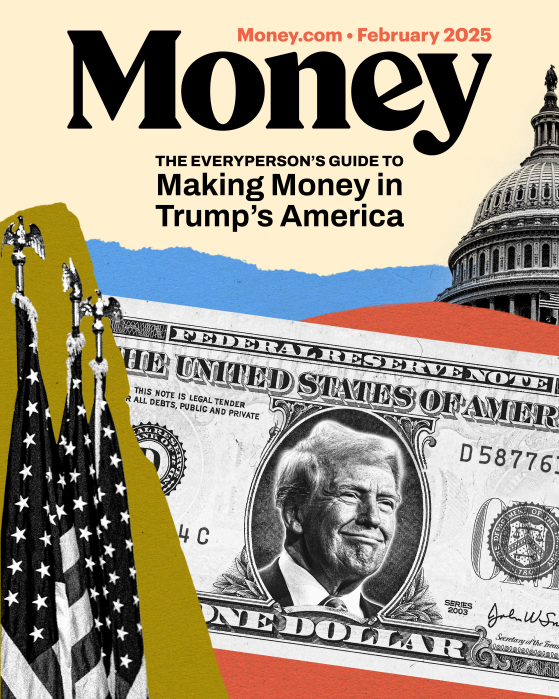
Maybe you voted for Donald Trump, hoping his policies will let average Americans loosen their purse strings. Maybe you didn’t, and economic uncertainty is just one of many anxieties clanging around your subconscious. Maybe you checked out one or two election cycles ago and simply want to get through the day.
The point is, regardless of how you feel about our 47th president — terrified, emboldened, apathetic — your wallet is probably feeling the squeeze. And the smartest thing you can do right now is get your money right.
Below, you’ll find a guide to navigating your finances in an era of Trump 2.0, crafted by Money’s expert editorial team. Much of what you’ll read here is rooted in the same guidance we’ve been sharing for over five decades, tweaked for today’s challenges.
Nobody knows what the next four years will bring, but chances are, they’ll be just as bumpy as the last. Build a stronger future for yourself, and the cultures and communities you care about, with this as your roadmap.
— Kristen Bahler
Trim your spending

With a new administration taking office and inflation starting to ease, now is the time to rethink where your money is going.
Time-tested savings advice — make a budget and cut back on nonessentials — still applies. But this year, one strategy stands out: Pay close attention to how and where the products you buy are made.
President-elect Trump has threatened sweeping tariffs on imports, particularly on goods from China. While the exact plans remain unclear, the experts who spoke to Money agree that tariffs will drive up prices for everyday Americans, especially for consumer tech, household goods and apparel. Knowing where your products are made can help you avoid costly increases by choosing alternatives not affected by new tariffs.
This habit of looking closer at your purchases — and questioning whether you need them at all — has another major perk: It’s a first step toward more ethical consumption.
Aligning your spending with your values can give you a sense of power and agency, says Tanja Hester, author of Wallet Activism. “It’s very reasonable as an individual to ask, ‘Okay, but what can I do?’” she says. Aside from political activism, “a big part of what each of us can do really has to do with our financial choices.”
Mindful spending doesn’t have to cost more. Often, it starts with buying less stuff. When you truly need something, whether it’s a home appliance or your next winter fit, consider buying used or choosing local options. These small changes can help you stay on budget and honor what matters most to you.
In 2025, trimming your spending isn’t just about saving money — it’s also about making smarter, more intentional choices that align with your values.
— Adam Hardy
Read more:
- How to Shop More Ethically — Without Breaking the Bank
- 7 Things Getting More Expensive in 2025
- Having This Shopping Habit Means Your Finances Are Probably a Mess
Get a fat raise

Talking about pay can feel taboo, but it shouldn’t.
Communicating with your boss about what you earn — and advocating for what you want to earn — is a crucial part of getting the salary you deserve. The problem? A striking number of employees — nearly 40%, according to a recent survey — have never (as in, ever) asked for a raise.
That needs to change in 2025. The winds may have shifted from the extraordinary leverage workers had a few years ago, but signs still point to a healthy job market: More than 6 in 10 companies plan to hire for new roles in the first half of the year, according to research from Robert Half. And with wages on the rise, companies are still putting more of their budget toward raises than they were pre-pandemic. Put simply: now’s the time to be bold.
“It’s a bit of a new year, new budget[s] post-election,” says Dawn Fay, operational president at Robert Half. Employees should use that to their advantage.
How can you make sure you’re one of the employees taking home a bigger check? “The simplest answer is, do a good job,” Fay says — and take notes.
Get into the habit of regularly jotting down your wins, she says, from exceeding goals and volunteering for new projects to mentoring younger employees. You’ll also want to arm yourself with research about what pay is typical for roles like yours. Then, she says, rehearse what you want to say so you’re calm and confident.
Historically, the surest way to get a big pay bump has been to move jobs. That’s still true in 2025, though the gap has shrunk recently, according to payroll provider ADP. Whether you’re a long-time employee or a new hire, have a plan B if your desired salary isn’t in the budget. That could mean asking for financial perks (like a bonus or childcare reimbursement) or lifestyle improvements (like flexible hours or remote work).
“Most companies are willing to negotiate,” Cortney Holt, senior manager of talent at the career site Glassdoor told Money last year. “But you’ll never know unless you ask.”
— Kaitlin Mulhere
Read more:
- AI Can Help You Write a Better Cover Letter (If You Use It Right)
- Job Hunting? Here’s a Free Resume Template and Tips to Boost Your Search
- These Are the 10 Fastest-Growing Jobs Right Now — and Some May Surprise You
Make the most of an uncertain housing market

If you’ve been patiently waiting for the right moment to buy a house, this year could bring the breakthrough you hoped for.
New jobs, growing families and other life events are driving homeowners to loosen their grip on sought-after housing stock, giving buyers more options (and negotiating power). With mortgage rates expected to decrease slowly throughout the year, homeownership will finally be within reach for buyers who’ve been anxiously waiting on the sidelines.
It won’t be smooth sailing for everyone. Home prices could increase by as much as 4% this year, according to housing experts, and even if mortgage rates dip, they’ll likely remain above 6% for the better part of the year.
There’s also, of course, lots of uncertainty about the impact the Trump administration will have on the housing market, and the U.S. economy as a whole. Some proposals from the campaign trail, like creating tax incentives for builders and scaling back on construction codes and regulations, could further improve the market’s inventory shortage. Other proposals, like tariffs on imported goods and mass deportations, could set the market back even further. Import taxes on lumber, appliances and other building materials could increase the cost of housing. And since roughly 30% of construction laborers in the U.S. are immigrants, progress on much-needed new inventory could be delayed if even a small portion of the labor pool is expelled.
If you plan to buy a home this year, your best bet is to be financially prepared — no matter the economic outlook. Taking steps to improve your credit score, reduce high-interest debt and save up for a sizable down payment will allow you to take advantage of opportunities when they arise.
– Leslie Cook

Read more:
- 4 Ways to Sell Your Home for More Money in 2025
- Typical Homeowners Are Now Nearly 40 Times Wealthier Than Renters
- Will Home Prices Go Down in 2025? Here’s What Experts Predict
Save for a stress-free retirement

As we enter a new presidential era, many Americans will benefit from provisions passed in the last one. Several parts of the SECURE 2.0 Act, a major retirement savings law signed by Joe Biden in late 2022, are taking effect in 2025.
Account holders between the ages of 60 and 63 snag the biggest perks here: Through a new “super” catch-up 401(k) contribution, they can put away the largest maximum annual contribution ever: a whopping $34,750. But 401(k) auto-enrollment and coverage for part-time employees are expanding, too, and a new federal database recently launched to help people find their lost and forgotten retirement benefits.
These policies build upon a slate of changes that aim to make saving smoother for the 4.1 million Americans expected to retire this year. SECURE 2.0 has enabled employers to match workers’ student loan payments in a 401(k), 403(b) or SIMPLE individual retirement account; loosened restrictions around hardship withdrawals; encouraged companies to create pension-linked emergency savings accounts and more. In December, Congress passed a separate law expanding Social Security benefits for millions of people with pensions. Oh, and did we mention Trump has proposed eliminating taxes on Social Security income?
There’s a lot happening, and it should all motivate you to start preparing for your golden years ASAP. Whether that means consulting a financial planner, joining the record-high number of 401(k) millionaires or making this the year you actually open a Roth IRA, put in the work now. You’ll thank yourself later.
— Julia Glum
Read more:
- It Might Be Time to Ditch These Two Retirement ‘Rules’
- 4 Major Changes That Could Reshape How You Save for Retirement in 2025
- Why the Number of 401(k) Millionaires Just Hit a Record High — Again
Tap into alternative investments
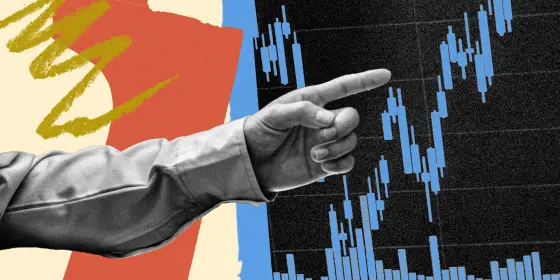
When gauging the incoming administration’s impact on traditional investments, the only certainty is uncertainty. Take, for example, Trump’s expected tariffs. Those would adversely impact consumer prices, most experts agree, but how they would materialize in the stock market is less clear. And while his plans to boost the economy by deregulating the financial sector are bullish, the effect could be stymied if the Federal Reserve shifts its interest rate policy.
In spite of his “drill, baby, drill” mantra, energy stocks are facing a difficult year as the oil and gas industry grapples with record-high production and waning demand. And despite rubbing elbows with Elon Musk, Mark Zuckerberg and other Silicon Valley bigwigs, Trump’s anticipated antitrust agenda could see the breakup of tech monopolies — a sector that’s overdue for a price correction.
Enter alternative assets. Expect gold to continue its historic run as geopolitical instability — perhaps aggravated by a president who’s expressed interest in annexing Canada, Greenland and the Panama Canal — drives up the price of precious metals even further. If inflation begins to tick up, that’s also good news for gold. (Investors can get exposure with the physical metal itself, but also with gold mining stocks and gold ETFs.)
On the crypto front, Trump’s deregulatory platform — including support for bitcoin mining and opposition to the development of central bank digital currencies — has been a catalyst for the alternative asset class. Last month, the price of bitcoin crossed $100,000 for the first time, and the cryptocurrency is up around 40% since Election Day. Investors who are more comfortable with equity markets can gain exposure through spot bitcoin ETFs like the iShares Bitcoin Trust ETF (IBIT) or the VanEck Bitcoin ETF (HODL), both of which are up over 101% in the past year and likely to continue rallying under Trump.
Financial advisors recommend allocating no more than 5–10% of your overall portfolio to alternative investments like gold and crypto. But for now, there’s more clarity on those two asset classes’ projected near- and medium-term performances than there is for any of the stock market’s 11 sectors. With the unpredictability of Trump’s policies, the performance of traditional asset classes have a more cloudy future, and as a result, alts may be able to post outsized gains.
— Jordan Chussler
Read more:
- Is 2025 the Year of ‘Sector Investing?’
- 4 Stock Market Predictions for 2025
- Why Investors Are Pouring Money into Bitcoin ETFs Right Now
Protect your assets

Desperation over rising rates is driving more people to skip insuring the biggest assets they own. But this is one trend you shouldn’t join in 2025, no matter your financial situation.
Double-digit growth in home insurance premiums has driven down the number of uninsured homes in the U.S. – to more than 6 million, according to the Consumer Federation of America, which represents more than 7% of all homes. Car insurance has also risen in cost — over the last few years, experts say, the average payment has gone up by about 25%. In some states, premiums are up by more than 50%.
Resist all temptation to join either uninsured group, even if rates rise further, as some analysts predict. A home that lacks insurance exposes its owners to everything from forced-place insurance by their mortgage lender to liability lawsuits, foreclosure and homelessness. Driving without insurance also comes with financial peril, including the risk of fines and a suspended license if you’re caught “driving naked” – industry lingo for taking the wheel without insurance.
Instead of eliminating vital coverage, take steps to reduce its cost. Weigh the financial loss you could bear in the event of losing your wheels or your home, and adjust your deductible to that amount, thus reducing your premiums. Then, shop around for coverage — prices vary significantly between carriers — and consider bundling your home and auto insurance for a discount.
— Paul Reynolds
Read more:
- Americans With Bad Credit Pay 35% More for Home Insurance
- How Your Driving Behavior Could Be Affecting Your Car Insurance Premiums — Without You Realizing It.
- Why California’s Wildfires Could Make Your Home Insurance Pricier — Even if You Don’t Live There
Polish your paper trail
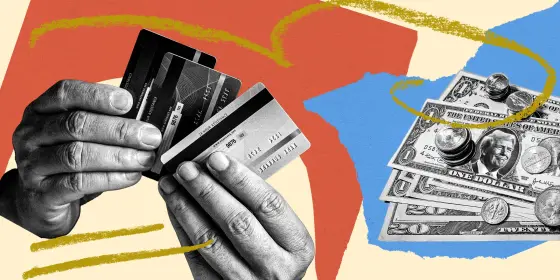
There’s no reason for you not to know exactly what’s in your credit history: You can pull one free credit report from each of the three major credit bureaus weekly using AnnualCreditReport.com. And because those reports are used to generate your credit scores, which lenders rely upon to determine your worthiness as a borrower, it’s crucial to monitor them.
Don’t like what you see? Make improving your credit a 2025 pet project. After you’ve checked your credit report for errors and addressed any inaccuracies, try reducing your utilization ratio, downgrading a little-used card or becoming an authorized user on someone else’s account. Take the time to understand what your annual fees go toward and re-evaluate whether your current cache of cards makes sense for your life.
You’re not alone — although income growth has helped lessen the sting for many borrowers, the U.S. is pretty firmly in a debt crisis — and you’re certainly not powerless, especially when it comes to arming yourself with information. In 2025, this means keeping an eye on the news coming out of Congress, which is gearing up for a battle over expiring Tax Cuts and Jobs Act provisions that could impact your wallet for years to come. Might we suggest subscribing to Money’s daily newsletter for the latest on this and other key issues? Just an idea.
— Julia Glum
Read more:
- Congress Is Gearing Up for a Fight Over Trump’s Tax Cuts
- Have Medical Debt? Your Credit Score Could Increase Under New Policy
- 3 Signs That America’s Debt Crisis Is Growing
Adam Hardy is Money's lead data journalist. He writes news and feature stories aimed at helping everyday people manage their finances. He joined Money full-time in 2021 but has covered personal finance and economic topics since 2018. Previously, he worked for Forbes Advisor, The Penny Hoarder and Creative Loafing. In addition to those outlets, Adam’s work has been featured in a variety of local, national and international publications, including the Asia Times, Business Insider, Las Vegas Review-Journal, Yahoo! Finance, Nasdaq and several others. Adam graduated with a bachelor’s degree from the University of South Florida, where he studied magazine journalism and sociology. As a first-generation college graduate from a low-income, single-parent household, Adam understands firsthand the financial barriers that plague low-income Americans. His reporting aims to illuminate these issues. Since joining Money, Adam has already written over 300 articles, including a cover story on financial surveillance, a profile of Director Rohit Chopra of the Consumer Financial Protection Bureau and an investigation into flexible spending accounts, which found that workers forfeit billions of dollars annually through the workplace plans. He has also led data analysis on some of Money’s marquee rankings, including Best Places to Live, Best Places to Travel and Best Hospitals. He regularly contributes data reporting for Best Colleges, Best Banks and other lists as well. Adam also holds a multimedia storytelling certificate from Poynter’s News University and a data journalism certificate from the Investigative Reporters and Editors (IRE) at the University of Missouri. In 2017, he received an English teaching certification from the University of Cambridge, which he utilized during his time in Seoul, South Korea. There, he taught students of all ages, from 5 to 65, and worked with North Korean refugees who were resettling in the area. Now, Adam lives in Saint Petersburg, Florida, with his pup Bambi. He is a card-carrying shuffleboard club member.
Since joining Money in 2023 as an investment editor, Jordan has specialized in a wealth of finance topics, ranging from traditional equities (stocks, mutual funds and ETFs), income investment vehicles and alternative assets to retirement savings, debt-based fixed-income securities and commodities, with a specific focus on gold and other precious metals. He takes pride in combining his personal interests and professional experience in finance and education to help readers increase their financial literacy and make better investment choices. Jordan has worked in digital publishing for 17 years after graduating from Lynn University as a member of both the Kappa Delta Pi International Honor Society and the U.S. Achievement Academy's All-American Scholar Program. He previously served as managing editor of Weiss Ratings, where he worked alongside a team of investment writers, editors and analysts to produce educational finance content and daily, weekly and monthly market news alerts. As a contributing writer for BetterInvesting Magazine, Jordan covered topics focused on the fundamentals of investing, technical and fundamental analysis, mutual funds, debt securities, dividend investing, retirement savings strategies and passive income generation. His bylines can also be seen in Apple News, Money Crashers, The Charlotte Observer, Fort-Worth Star Telegram and a dozen other newspapers.
Julia Glum is Money's managing editor for news and email, keeping her finger on the pulse of financial trends that affect Americans' wallets. She also writes Dollar Scholar, a weekly newsletter that teaches young adults how to navigate the messy world of money. A 2014 graduate of the University of Florida's journalism school, she previously covered breaking news, politics and education at Newsweek and International Business Times. Julia joined Money in 2018; during her time as a reporter, she wrote frequently about Amazon, passive income, stimulus checks and creative ways people make money online (think: Vine compilations, Cash App Friday and Facebook gift groups). As an editor, she oversees Money’s tax coverage, which includes extensive reporting on tax credits, year-to-year policy changes, tax refunds and the IRS’s ongoing efforts to modernize. For several years, Julia has assisted with Money’s annual Best Colleges rating and Best Places to Live rankings. Recently, she also led Money’s 50th anniversary celebrations, producing the Money Classic newsletter and rolling out Changemakers, a project profiling 50 innovators working to revolutionize personal finance. Julia has interviewed National Taxpayer Advocate Erin Collins, actor Danny Devito, Nobel Prize-winning economist Robert Shiller, rapper Killer Mike, real estate guru Ryan Serhant and many others. Her work has been cited or otherwise shared by the New York Times, Washington Post, Vox, theSkimm, Mashable, CNBC and POLITICO. She’s appeared on Good Morning America, CBS News, PIX11, WGN, the Mountain West News Bureau and more. Julia is based in New York City. You can find her at juliaglum.com.
Kaitlin Mulhere is an editor at Money.com, where she oversees the website’s higher education coverage, including stories on student debt, college costs and financial aid, and the value of a college degree. She also runs Money’s annual Best Colleges ranking. In a previous role at Money, Mulhere ran the magazine’s franchise rankings, including Best Places to Live, Best Banks and Best Places to Travel. In her time at Money, she’s written about everything from the incredible costs tied to training as an Olympic figure skater to tips for women to afford freezing their eggs to fantasy football-inspired investing. Over the years, she’s participated on several panels on college topics hosted by the Education Writers Association, National Association of State Treasurers and National Press Club; and she’s talked about Money’s work in media outlets including Good Morning America, The Chronicle of Higher Education, Newsday, Great Day Washington and more. Before joining Money in 2015, Mulhere wrote about college news for Inside Higher Ed and covered local education at The Keene (N.H.) Sentinel. She’s a graduate of the University of Florida, with bachelor’s degrees in journalism and political science.
Leslie Cook is Money's lead real estate editor, covering news stories about mortgages and how rate movements affect the housing market and writing and editing stories that inform our readers about real estate trends and how they affect homebuyers and sellers. Leslie writes a weekly newsletter, Money Moves, that covers a wide range of real estate topics in addition to her weekly articles. Her work has been featured on Apple News, MSN and ConsumersAdvocate.org. Leslie has been covering the mortgage and real estate industry at Money since 2019 and has interviewed industry leaders, such as Lawrence Yun, chief economist at the National Association of Realtors, and Glenn Kelman, CEO of brokerage Redfin. She has been a guest on the This Morning with Gordon Deal radio show, interviewed by The Mortgage Note, and served as moderator for ServiceLink’s State of Homebuying webinar. While at Money, Leslie has contributed to several of Money’s rating and ranking features, including Best Places to Live, Best Places to Travel and Changemakers. She has also played a major role in researching and selecting Money’s Best Banks rankings for the past four years. Before joining Money as a staff writer, Leslie was a reporter for Caribbean Business Newspaper in San Juan, Puerto Rico, covering human resources, telecommunications and computers. She graduated cum laude from Bryn Mawr College in Pennsylvania with a bachelor’s degree in history. The research and interviewing skills learned there have contributed to Leslie’s ability to provide accurate information on her area of expertise and elicit informative responses from her interviewees.
Paul Reynolds is the Special Projects Editor at Money.com, with responsibilities that have included launching franchises in best autos and best airlines. Prior to his current role, he joined Money in 2020 as its insurance editor, overseeing life and auto insurance content as well as the site’s coverage of policies for pets, autos, businesses, travel and more. Paul’s 30-year-plus career encompasses two decades at Consumer Reports, where he edited reports on appliances, home services and wine before co-leading a project to re-engineer editorial workflow to better meet the challenge of internet competition. He then served for eight years as Consumer Reports’ first Electronics Editor, with successes that included initiating an investigation into the antenna shortcomings of the iPhone 4, which became the biggest consumer-technology story of 2010. He’s also held the Editor-in-Chief position at both TopTenReviews.com and Canadian Consumer and was Content Editor for ValuePenguin.com. He’s written and edited on a range of personal finance topics for Investopedia and the Wall Street Journal Customer Studio and made more than 100 media appearances on consumer topics, including repeat engagements on CNN, Good Morning America, the Today Show and CBS This Morning and interviews by the New York Times and BBC News. Paul was educated at Queen’s University in Kingston, Canada, where he earned a Bachelor of Arts degree in Psychology, and at Carleton University in Ottawa, Canada, where he earned a graduate degree in journalism. He’s also graduated from week-long in-person professional development courses at Stanford University, for mid-career magazine journalists, and at the Project Management Institute, for journalists seeking training as a project manager. A UK native, Paul has visited 30 countries – in Asia, Europe and North America – and lived in four: England, Ireland, Canada and the U.S. He currently lives in New York City.