
Communal music is ‘where the magic happens.’ Students embrace school’s modern approach
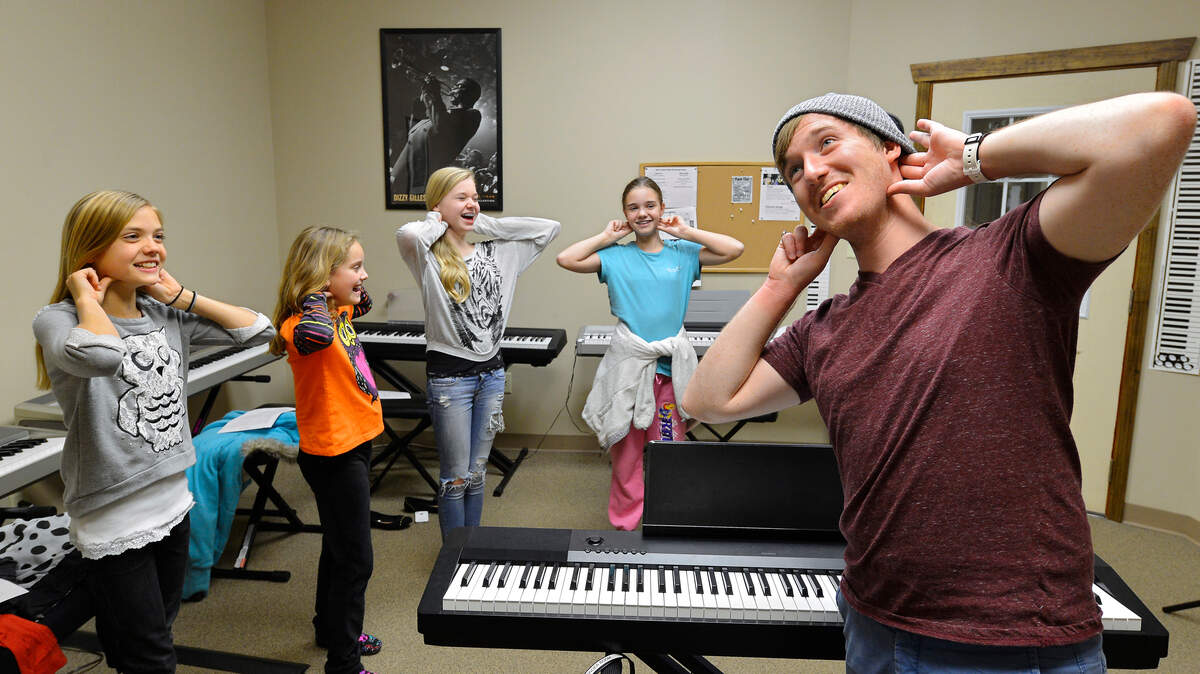
The Music House School of Music’s motto is “Experience a Modern Approach to Learning.”
The current pandemic and lockdown has forced Music House to take that motto to the next level. As the quarantine approached, Music House co-founder and executive director Aaron Sizemore and his staff put in place technological innovations that have been embraced by parents, students and teachers.
Music House has been driven by passion since it was founded in 2006 by Sizemore and his wife, Katrinka Sizemore. Katrinka, who was an oboist, was diagnosed with stage 4 breast cancer in 2009 just after turning 30. She survived for seven years.
“She continued to teach oboe lessons throughout that time and was a resilient and brave person,” Sizemore said. “The school would not have ever come to fruition without her. We started the Katrinka Sizemore scholarship fund at UMKC after she died.” The scholarship goes to a deserving oboe student every year.
Starting with only six teachers in a small house in a commercial district in Overland Park, Music House has expanded to three locations in Overland Park, Lenexa and Prairie Village with 26 teachers, 27 administrators and 700 students. The school teaches students from age 4 to adult. What makes Music House unique, said Sizemore, is the school’s emphasis on community.
“Before we even say we teach music, we say we build community,” Sizemore said.
That means education at Music House means more than just a student coming in once a week for a private lesson with a teacher in a solitary room, going home to practice and then coming in the following week to do it all again.
“Every musician knows that is pretty much missing the whole point of what music is about,” Sizemore said.
“Music is probably the most social art form there is and it is literally a form of communication. We wanted to create a space where students could interact and meet other musicians, be exposed to students who were on their level: students who weren’t as advanced and students who were more advanced. Not just one, monolithic teacher who represents an unobtainable goal.”
The students at Music House take part in group classes and ensembles and give performances in the school’s auditorium. Professional musicians regularly visit the school to play for the students and the students play for the professionals. Specific classes are also offered to cover topics in addition to their regular lessons.
“The students are always getting input that feels very communal,” Sizemore said. “You can ask any musician: That’s really where the magic happens.”
But how can that magic be maintained under quarantine when face-to-face contact is impossible? Luckily, Sizemore and the staff at Music House were already in the process of adding online enhancements to their offerings before COVID-19 was even an issue. The pandemic, however, accelerated things.
“We knew we had to have tools in place that facilitate connection and communication,” Sizemore said. “Obviously, we wanted streaming video so that students could interact, not only with their teachers, but also other students. But how could they collaborate?”
The problem was the latency issue with streaming video. It doesn’t matter how good your connection is, there’s going to be a slight delay, and that makes it difficult for people to play together.
So Music House put together an online multi-track recording platform for students to stream video and collaborate in recording music. The school also created community forums where students could ask questions of teachers and one another, and post their own videos for other students to watch. Students present their video projects once a month, and teachers and students vote on their favorites. The winners get prizes.
“It’s been a whirlwind,” Sizemore said. “Getting teachers trained, building the software, planning the phases we were going to roll these things out, getting it communicated to all the parents and students, helping them with tech support. It’s just been crazy. Luckily, the staff and faculty are an idealistic bunch. Musicians tend to be energized by problem-solving and innovating. It’s in their DNA.”
According to Sizemore, the innovations have been welcomed by parents and students.
Sarah Malinowski, whose 13-year-old daughter, Stella, is taking guitar and upright bass lessons at Music House, says the school “hasn’t skipped a beat” in making the online transition. She says her daughter has embraced the new technologies, as well.
“I don’t think she’s been set back at all by this experience,” Malinowski said. “If anything, it challenges her to even work a little harder, especially when she has to make a video of herself and then upload it. She really wants to work hard perfecting what people are going to see.”
But Stella, who plays the upright bass in the Kansas City Youth Orchestra, says the online experience isn’t always a perfect substitute. For example, she was looking forward to playing in the Youth Orchestra’s final concert of the season in the Kauffman Center for the Performing Arts.
“That’s a bummer,” she said. “But I think I’m adapting. I like using the software to put all the parts together.”
Sizemore says that when the pandemic and quarantine are over, he anticipates that all of the innovations Music House has put in place will remain to enhance the “community” that he sees as so vital to the school’s mission.
“We by no means want to be a virtual music school,” he said.
“But all these tools can be used to improve the one-on-one interactions. To allow a student to be able to ask questions between classes, to be able to log into their dashboard and see exactly what they’ve been working on, what their future goals are and what their fellow students are doing will only inspire them when they get a chance to interact face-to-face. None of it will go away, it will simply be integrated into what we’ve always done to make it better.”
For more information, visit www.musichouseschool.com.
You can reach Patrick Neas at patrickneas@kcartsbeat.com and follow his Facebook page, KC Arts Beat, at www.facebook.com/kcartsbeat.