With several dozen FINRA exams available, it can be tough to figure out the right exam pathway to achieve your goals, especially with similar exams. So, when you’re comparing exams like the Series 65 vs. Series 66, how do you make the right decision?
Both can be routes for becoming an investment adviser representative, but there are pros and cons worth weighing before starting your prep. Let’s dig into the key differences and what each exam lets you do.
Key Takeaways
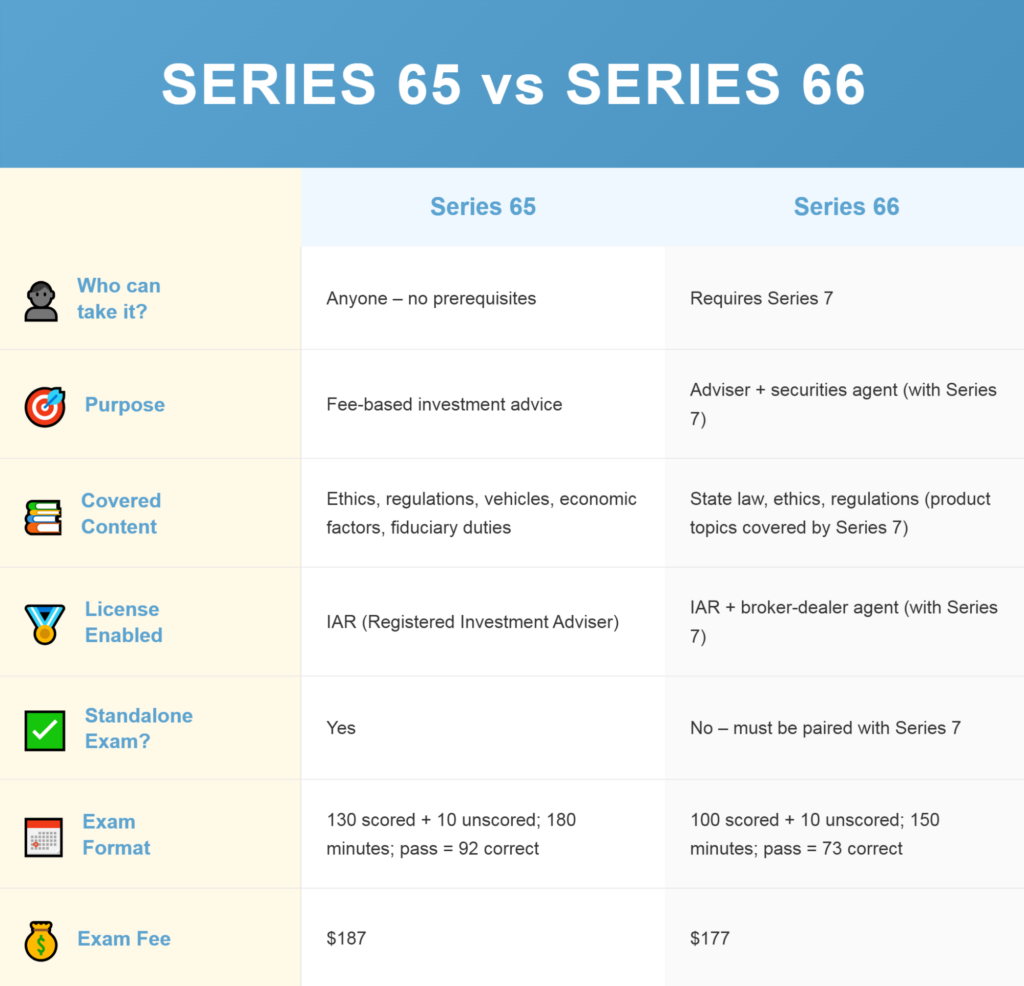
- Series 65 lets you provide investment advice as a registered investment adviser without needing any other exam.
- Series 66 pairs with the Series 7, and together they let you sell securities and give clients investment advice.
- Series 65 covers more on products, economic factors, and fiduciary duty, while Series 66 focuses on state securities law and ethics.
- The Series 65 exam is longer (130 scored questions, 180 minutes) than the Series 66 exam (100 scored questions, 150 minutes).
- Passing one doesn’t equal being licensed. You still need to register through your state regulator, often via Form U4.
What The Exams Actually Qualify You For
Think of it this way: if you want to offer fee-based investment advice without worrying about selling investment products, the Series 65 is the easiest path. Passing it grounds you as an investment adviser representative (IAR) in most states. There’s no broker-dealer tie‑in, and no Series 7 needed.
On the flip side, if you fancy being a dual threat—someone who can recommend investments and also execute securities transactions—then the Series 66 works well in tandem with the Series 7. It effectively covers both IAR and securities agent duties, but won’t do anything unless you’ve also passed the Series 7.
Exam Format and Difficulty
Here’s how the two compare when you look under the hood.
Series 65 (Uniform Investment Adviser Law Exam)
- There are 130 scored multiple‑choice questions + 10 unscored pre‑test questions.
- It lasts 180 minutes, and you need 92 correct to pass (~70%).
- It covers the financial industry’s laws, ethical practices, investment vehicle characteristics, retirement planning, economic factors, fiduciary responsibilities, etc.
Series 66 (Uniform Combined State Law Exam)
- Includes 100 scored questions + 10 pre‑test, with 150 minutes to finish and a minimum of 73 correct (~73%).
- Since this exam is paired with Series 7, it skips deep product and analysis content, focusing instead on securities regulation, state securities laws, the Uniform Securities Act, and ethical business practices.
Registration And State‑Level Bonding
Passing the test is just half the battle. Here’s where the financial industry regulatory authority and state securities laws come into play:
Once you pass Series 65 or Series 66 (with Series 7), your broker‑dealer or RIA firm typically files your Form U4 to register you with your state regulator. This is where you become an investment adviser representative or securities agent in practice.
Keep in mind exam results expire after two years if you’re not registered. However, some states allow you to extend that via NASAA’s Exam Validity Extension Program (EVEP) if you meet continuing education requirements.
Choosing Based On Your Professional Goals
Here’s how to choose the right Series exam based on your career goals:
If your goal is purely financial advising, the Series 65 is your best bet. It’s independent, has no prerequisite exams, and is designed for people focused on investment advising, especially on a registered investment adviser platform.
If you’re on the path to becoming a traditional securities agent—say, you want to sell mutual funds, handle securities sales, or be involved in a broker-dealer—then go with Series 7 + Series 66. You’ll get both advisory and transactional capabilities without having to take the Series 63 separately.
Final Thoughts
You’re the one steering your financial advising or securities business future. If your heart is set on offering investment advice without handling sales, go with the Series 65. But if you want to advise and sell, and you don’t mind adding the Series 7 to your study pile, then the Series 66 (with 7) is the better choice.
Whatever you decide, as long as you choose the right prep course, follow a solid plan, and do a few practice exams, you’ll be licensed before you know it.
FAQs
Yes, especially if you want to provide investment advice without needing a broker‑dealer. It qualifies you as an IAR directly.
If you already have the Series 7 or plan to get it, then yes. It bundles advisory and sales capabilities.
Many states waive the Series 65 for some credentials like CFP®, CFA®, ChFC®, etc., but you should always check your state’s rules.
It’s considered challenging since it covers ethics, investment strategy, and economic factors, but pass rates hover around 65–70%, according to some sources.
Not by much. Series 65 is only $10 more than Series 66.