Confused about whether you need the Series 63 or Series 7 license to start your financial career? You’re not alone.
As someone who helps candidates prepare for these exams, I’ve seen firsthand how overwhelming it can be to navigate FINRA’s licensing maze, including the different exams, sponsorship requirements, and state regulations. It’s easy to get stuck before you even begin.
This guide breaks it all down, what each license covers, who needs it, and how to choose the right one for your career goals.
Key Takeaways
- Series 7 Covers Federal Laws: Focuses on investment company products, variable contracts, and mutual funds.
- Series 63 Focuses on State Rules: Tests knowledge of Blue Sky Laws and ethical practices.
- SIE Exam Comes First: Builds essential securities knowledge before registration.
- Sponsorship Matters: A FINRA member firm or broker-dealer must approve you for the Series 7.
- Together They Complete Licensing: The Series 7 lets you sell securities, and the Series 63 keeps you compliant across state lines.
What Is the Series 63 Exam?
The Series 63, officially called the Uniform Securities Agent State Law Exam, measures your knowledge of state securities laws, ethical conduct, and fiduciary duties designed to protect investors. It’s created by NASAA and administered by FINRA.
Key Topics:
- State registration requirements and Blue Sky Laws
- Ethical and prohibited practices
- Client communication, agreements, and account handling
- Fiduciary duties for broker-dealers and investment advisers
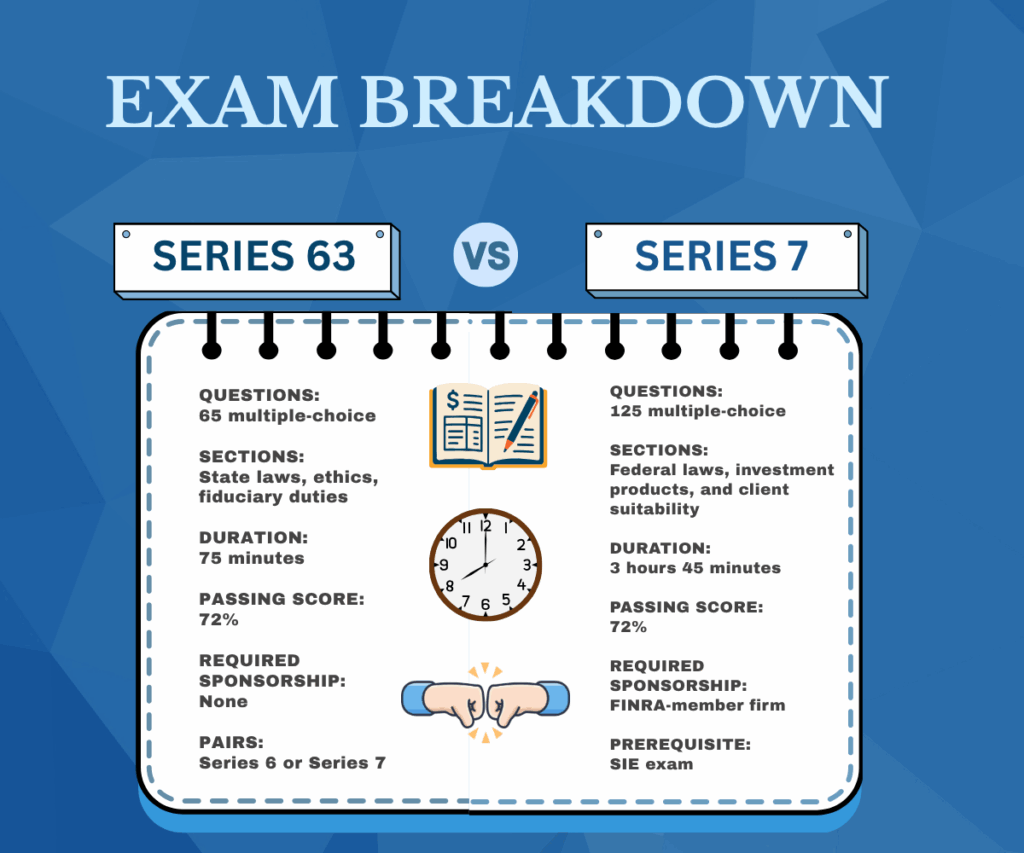
Exam Facts: 65 questions • 75 min • 72% to pass • No sponsorship required
It’s essential for securities agents and registered representatives who work across state lines. The Series 63 is typically paired with the Series 6 or Series 7 since it covers laws, not product sales.
What Is the Series 7 Exam?
The Series 7 exam, or General Securities Representative Exam, is the main federal license for anyone in securities sales. It qualifies you to sell securities products like mutual funds, municipal securities, variable annuities, government securities, and investment company products through a FINRA-member firm.
Key Topics:
- Federal securities laws and self-regulatory organization rules
- Variable contracts, investment company products, and direct participation programs
- Evaluating customers’ financial profiles and investment objectives
- Sales instructions, confirmations, and maintaining appropriate records
Exam Facts: 125 questions • 3 hr 45 min • 72% to pass • Requires SIE exam + member firm sponsorship
Passing the Series 7 grants you general securities registration and qualifies you for roles as a registered representative within the financial services industry.
Which Exam Is Harder? Series 65 or 7
I’ve heard many say the Series 7 is harder, and in some ways, that’s true. It’s longer, more detailed, and dives deep into products, recommendations, and FINRA rules. But the Series 63 isn’t exactly easy either. It’s shorter, sure, but it tests your grasp of state laws, ethics, and fiduciary responsibility, and that can trip people up.
Knowing securities products is one thing; understanding the legal obligations around selling them is another. That’s why both exams challenge you in different ways, and why mastering both matters in the real world.
Series 63 vs 7 Comparison
| Feature | Series 7 | Series 63 |
|---|---|---|
| Price | $300 | $147 |
| Focus | Federal securities and investment products | State securities laws and ethical practices |
| Administered by | FINRA | FINRA for NASAA |
| Exam Length | 3 hrs 45 min (125 Qs) | 75 min (65 Qs) |
| Purpose | Qualify to sell securities products nationwide | Comply with state regulations and ethical obligations |
| Scope | National | State-level |
| Sponsorship Required |  FINRA member firm |  |
| Difficulty Level | More comprehensive and technical | Shorter but law-focused |
Head-to-Head: Series 7 vs Series 63
Scope:
- 🆚 Series 7– Covers federal securities laws, investment company products, and variable contracts under FINRA oversight.
- 🆚 Series 63– Covers state securities regulations, Blue Sky Laws, and ethical responsibilities for doing business across state lines.
Who It’s For:
- 🆚 Series 7– Registered representatives and broker-dealer agents involved in securities sales and direct participation programs.
- 🆚 Series 63– Securities agents and investment adviser representatives who must meet state registration requirements.
Exam Details:
- 🆚 Series 7– 125 questions, 3 hrs 45 min, 72% passing score, sponsorship required.
- 🆚 Series 63– 65 questions, 75 min, 72% passing score, no sponsorship needed.
Job Functions:
- 🆚 Series 7– Evaluate customer profiles, make suitable recommendations, process transactions, and maintain appropriate records.
- 🆚 Series 63– Apply state laws, prevent prohibited practices, and protect investors.
In short, the Series 7 lets you sell, while the Series 63 lets you do it legally within your state.
Choosing the Right License
Your choice depends on where you’re headed in the financial industry:
- Joining a wirehouse or full-service brokerage?
➤ Go for Series 7 + 63 – ideal for roles like financial advisor, stockbroker, or investment consultant. These positions involve broad securities sales and multi-state clients. - Working in insurance or selling annuities/mutual funds?
➤ Series 6 + 63 is usually perfect for insurance agents, retirement specialists, and annuity salespeople focusing on packaged investment products. - Looking to become an investment adviser or work with a robo-advisor?
➤ Consider Series 65 or 66 – these are best for registered investment advisers (RIAs), wealth managers, and robo-advisor representatives offering fee-based advice, not product sales. - Only working with clients in one state?
➤ Series 63 alone might work, but many financial professionals still add other exams like the Series 6 or 7 to expand their offering and increase flexibility.
Pro Tip: If your job involves selling investment products and working with clients across multiple states, you’ll almost always need both the Series 7 and Series 63.
My Final Verdict
If you’re building a career in financial services, whether as a broker, registered rep, or financial consultant, you’ll probably need both the Series 7 and 63.
The Series 7 lets you sell a wide range of securities, and the Series 63 keeps you in line with state laws when offering investment advice.
Each one has its limits on its own. Together, they’re the core licenses most securities professionals rely on to do the job right.
Take the first step, and choose the license that actually fits how you want to work.
FAQs
Yes, a Series 6 license is enough if you’re selling mutual funds, variable annuities, and insurance-based investments. It doesn’t let you sell stocks or bonds. Most pair it with the Series 63.
Not always, but most firms require it since client situations often cross state lines. It’s better to have it for flexibility.
Yes, if you’re planning to take the Series 6 or Series 7. The SIE is the first step toward securities industry registration for most sales-related roles.
A FINRA-member firm or broker-dealer must sponsor you to sit for the test as part of the registration process.
Yes, many take both close together when getting registered. You’ll need both to sell securities and meet state law requirements.