Starting a career in finance?
You’ll need the right license to match your goals, whether you’re selling securities or providing investment advice. As someone who reviews exam prep materials, I’ve seen many candidates struggle to choose the right license. Plus, it doesn’t help that with so many exams listed on FINRA, it’s easy to get confused about which one aligns with their career goals.
The Series 63 and Series 65 are two key exams that determine whether you’ll sell securities as a broker-dealer agent or give investment advice as an adviser representative.
This guide compares the Series 63 and Series 65 exams side by side, helping you understand the scope, structure, and purpose of each license so you can make the best choice for your future in the securities industry.
Key Takeaways
- Two Distinct Paths: The Series 63 and 65 fulfill different state licensing requirements for sales representatives and investment advisers.
- Series 65 Covers More: It includes investment analysis, portfolio management, and client strategy for adviser representatives.
- Distinct Roles: The Series 63 suits broker-dealer agents; the Series 65 fits investment advisers.
- NASAA Oversight: Both are developed by the North American Securities Administrators Association and test ethical standards under the Uniform Securities Act.
- Combined Option: The Series 66 merges both licenses for dual registration with securities administrators.
Series 63 vs 65 Comparison
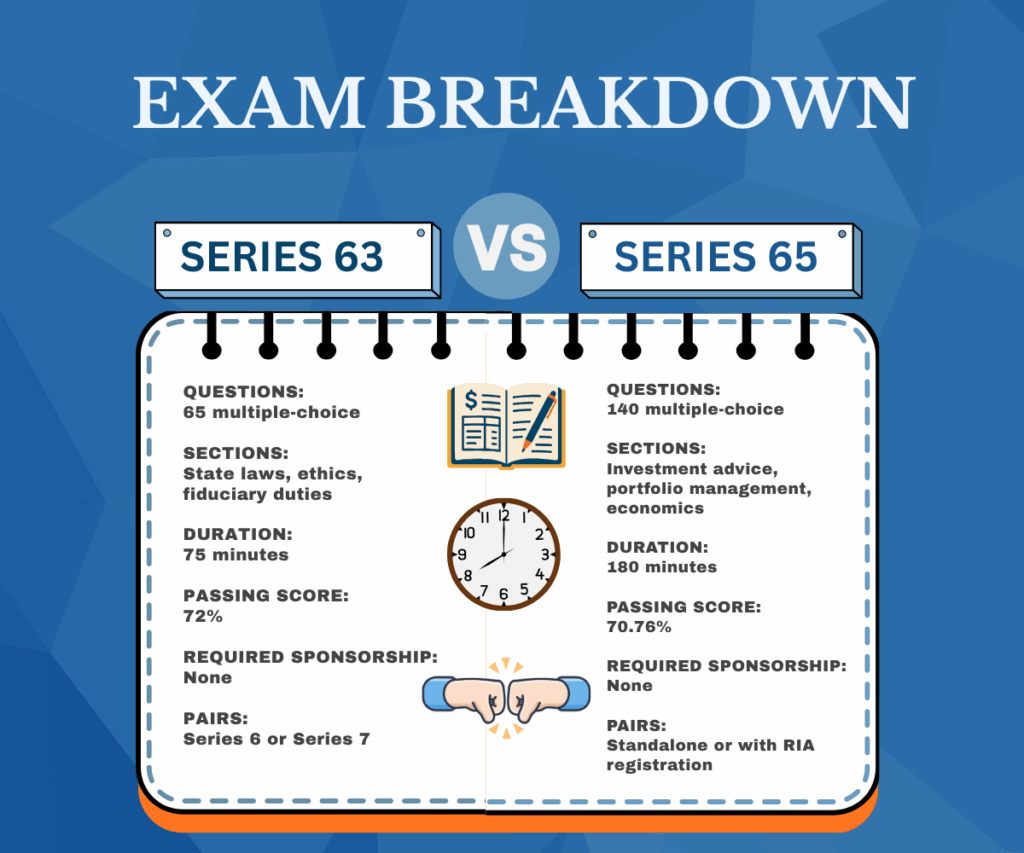
| Feature | Series 63 | Series 65 |
|---|---|---|
| What It Covers | State securities laws, ethics, and registration rules | Investment advice, economics, portfolio management, and client analysis |
| Who It’s For | Broker-dealer agents and sales reps | Investment adviser representatives and financial planners |
| Exam Time | 75 minutes | 180 minutes |
| Total Questions | 65 (60 scored + 5 unscored) | 140 (130 scored + 10 unscored) |
| Passing Score | 43/60 (72%) | 92/130 (70.76%) |
| Sponsorship | Required through a broker-dealer | Not required |
| Exam Style | Memorization-heavy and rule-based | Analytical and scenario-driven |
What’s the Series 63 Exam?
The Series 63 exam is your ticket to the sales side of the securities industry. It’s what lets you legally talk to clients, open accounts, and sell securities at the state level through a broker-dealer.
Quick Series 63 Facts
- 60 scored + 5 unscored questions
- 75 minutes
- Passing score: 43/60 (72%)
You’ll need this license if you plan to sell stocks, bonds, or mutual funds and work directly with clients as a registered representative. It’s designed for sales roles—direct, rules-based, and focused on transactions rather than advice.
💡 Heads-Up: It’s all about state securities laws and ethical practices under the Uniform Securities Act. Memorize those rules cold—that’s the key to passing.
What’s the Series 65 Exam?
The Series 65 exam is the license for the advice side of the financial services industry. It qualifies you to provide investment advice, manage client portfolios, and work as an investment adviser representative under a registered investment adviser (RIA) firm.
Quick Series 65 Facts
- 130 scored + 10 unscored questions
- 180 minutes
- Passing score: 92/130 (70.76%)
If you’re helping clients plan, invest, or manage money long-term, this is your license. It’s built for advisers who focus on guidance and strategy, not just transactions.
💡 Heads-Up: No sponsorship required here. The 65 is heavier on economic factors, investment vehicle characteristics, and client strategy—less about memorizing, more about thinking like an adviser.
Which Exam Is Harder: Series 63 or 65?
The Series 63 is shorter and focused on memorization of state laws, ethics, and what’s allowed under regulations. The Series 65 is longer and more analytical, requiring you to apply investment principles to client scenarios.
If you like memorizing clear-cut rules, the 63 feels simpler. If you prefer reasoning through financial advice, the 65 will challenge you more. Both are respected and essential for different finance paths.
To help you pass either exam, check out the top Series 63 study materials and best Series 65 courses.
💬 “I’ve taken and passed the SIE, 6, 63, 65 & 7. Time is something you’ll need to focus on for sure when preparing, but content-wise it was probably the easiest one of the bunch I took, with maybe the exception of the SIE, but it’s close.”
Student Review
Sales or Advice: What Your License Means for You
- Series 63 → Sales
This license puts you on the broker-dealer side of the business. You’ll handle transactions, open accounts, and make sure every trade follows state securities laws. It’s the entry point for most sales roles, ideal if you’re starting out as a registered representative or joining a brokerage firm. - Series 65 → Advice
This one’s for the investment adviser side. You’ll manage client portfolios, build long-term financial plans, and provide fee-based investment advice through a registered investment adviser (RIA). It’s perfect if you want flexibility, independence, or your own advisory practice.
Do You Need Both?
Usually, you don’t. You’ll take the Series 63 (often with the 6 or 7) if you’re selling securities through a broker-dealer, or the Series 65 if you’re providing investment advice through an RIA.
You’d only need both if your role combines sales and advisory duties common at hybrid firms, where advisers earn both commissions and fees.
If your career involves both selling securities products and managing client portfolios, check with your compliance officer to confirm the right registration mix.
Quick Quiz: Which Exam Fits You: Series 63 or 65?
Still not sure which one sounds best for you? Here’s a quick little quiz to narrow it down.
| Question | 🅐 Option A | 🅑 Option B |
|---|---|---|
| 1. Your workday looks like: | Talking to clients, opening accounts | Giving advice and planning investments |
| 2. You prefer: | Memorizing rules | Analyzing client goals |
| 3. Dream job: | Broker-dealer agent | Independent adviser or portfolio manager |
| 4. Work setup: | Sponsored by a broker-dealer | Independent or RIA |
| 5. Exam length you’ll tolerate: | 75 minutes | 180 minutes |
Quiz Results:
✅ Get Mostly A’s? → Series 63 (sales-focused, transaction-driven)
✅ Have Mostly B’s → Series 65 (advice-focused, analytical path)
Final Thoughts
Both exams open doors to professional growth: one through securities sales, the other through personalized financial advice. The Series 63 shows you can operate ethically within state rules, while the Series 65 demonstrates analytical depth and client insight.
Choose the license that fits your long-term goals: executing trades or guiding investments. Either way, both paths lead to trusted, impactful careers in finance.
FAQs
The Series 63 and 65 exams are developed by NASAA and administered by FINRA in coordination with state securities regulators.
A broker-dealer executes securities transactions for clients and supervises broker-dealer agents who sell investment products under state registration requirements.
Securities administrators enforce state securities laws, oversee registration, and ensure compliance among securities agents and investment advisers.
The Series 65 is for securities industry professionals seeking to become investment adviser representatives or independent advisers. It’s ideal for those who plan to provide investment advice or manage client portfolios for a registered investment adviser (RIA).
To enter the securities business, you’ll need to meet different approval steps. The Series 63 requires sponsorship from a broker-dealer, while the Series 65 can be taken independently through a registered investment adviser (RIA) or on your own.