Trying to understand how the LSAT compares to the Bar Exam? You’re in the right place.
As someone who has reviewed LSAT prep courses and bar review programs, I can tell you these two exams feel nothing alike in format, pacing, or preparation. Both tests can be essential steps in a legal career, but they happen at very different stages.
After all, the LSAT is the only admission test accepted by every ABA-approved law school in the United States and is designed specifically to measure the reasoning and reading skills needed for law school while the Bar Exam, taken after earning your degree, tests legal knowledge and practical skills for licensure.
In this exam breakdown, I’ll explain the key differences so you know exactly what each exam involves and how to prepare for them.
Key Takeaways
- LSAT is for law school admissions: It focuses on reasoning, analytical, and reading comprehension skills, not legal knowledge.
- Bar Exam is for attorney licensure: Tests substantive legal knowledge, legal principles, and practical lawyering skills.
- Preparation timelines differ: LSAT prep often takes several months; Bar Exam prep is usually 8–10 intensive weeks after earning a law degree.
- 2025 LSAT update: No logic games; now has two Logical Reasoning sections, one Reading Comprehension section, and one unscored section.
- Bar Exam changes: California is fully in-person as of July 2025; the NextGen UBE launches in July 2026 with a shorter, skills-focused format.
What Is the LSAT?
The LSAT is a law school admission test required by most U.S. law schools and created by the Law School Admission Council. It evaluates arguments, logical reasoning, analytical reasoning, and reading comprehension. Admissions committees use LSAT scores with GPA and other application materials to assess a candidate’s ability to succeed in legal education. It does not test specific legal topics like criminal law or constitutional law.
As of 2025, the LSAT Includes:
- Two scored Logical Reasoning sections
- One scored the Reading Comprehension section
- One unscored section (either LR or RC)
- An unscored online Argumentative Writing task completed within 8 days of the multiple-choice portion
What Is the Bar Exam?
The Bar Exam is a licensing test taken after earning a law degree. It measures whether a candidate is competent to provide legal services and practice law.
Most states use the Uniform Bar Examination (UBE), which includes:
- Multistate Bar Examination (MBE): 200 multiple-choice questions on topics like constitutional law, contracts, torts, criminal law, and civil procedure.
- Multistate Essay Examination (MEE): Essays applying legal knowledge to fact patterns.
- Multistate Performance Test (MPT): Practical lawyering skills such as drafting memos or client letters.
Some jurisdictions add state-specific sections. The passing score and content vary by location.
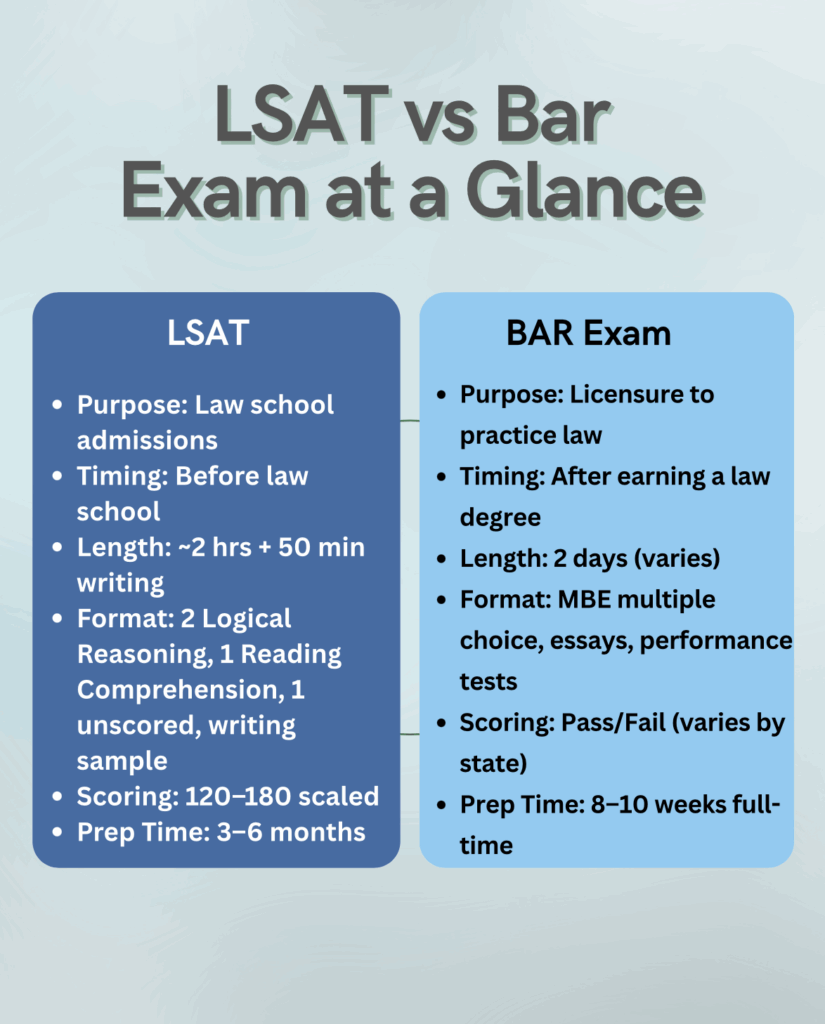
| Feature | LSAT | Bar Exam |
|---|---|---|
| Purpose | Law school admissions | Licensure to practice law |
| Timing | Before law school | After earning a law degree |
| Content Focus | Logical reasoning, analytical reasoning, and reading comprehension | Substantive legal knowledge, legal principles, and practical skills |
| Format | 3 scored sections + 1 unscored section + separate online writing sample | Multiple choice, essays, performance tests |
| Length | About 2 hours, 2 minutes (multiple choice) + 50 minutes writing | 2 days (varies by jurisdiction) |
| Scoring | 120–180 scaled | Pass/Fail (passing score varies) |
| Prep Timeline | 3–6 months | 8–10 weeks full-time |
| Retakes | Limited per year/lifetime | Allowed, offered 1–2 times/year |
| Impact | Admission and scholarships | License to practice law |
How to Prepare for Each
I’ve noticed that the biggest score jumps come from consistent, targeted practice that closely mirrors test conditions.
LSAT Prep (3–6 months typical):
- Build Familiarity with Practice Tests: Use multiple timed exams to learn the question styles and pacing.
- Sharpen Your Core Skills: Target logical reasoning accuracy and improve reading comprehension with focused drills.
- Master the Clock: Develop strategies to stay on pace in every section.
Bar Exam Prep (8–10 weeks typical):
- Commit to a Proven Study Plan: Follow a structured bar review schedule that covers all tested areas.
- Simulate Exam Conditions Often: Complete full sets of MBE questions, essays, and performance tests under timed limits.
- Balance Knowledge with Skills: Rotate daily between reviewing legal topics and practicing practical lawyering tasks.
💡 Pro Tip: For the LSAT, track your accuracy by question type to spot weak areas early. For the Bar Exam, practice under timed conditions at least twice a week to build endurance.
Which Is Harder: The LSAT or the Bar Exam?
From an exam reviewer’s perspective, the Bar Exam is harder because it requires mastery of years of legal education, a wide range of legal topics, and practical application. However, many prospective law students find the LSAT more intimidating at first because it is their introduction to legal testing and plays a major role in admissions outcomes.
LSAT Scoring vs Bar Exam Results
- LSAT Scores: Range from 120 to 180. Higher scores improve chances of admission to top law schools and may qualify for scholarships.
- Bar Exam Results: Reported as pass/fail. A passing score grants eligibility to become a licensed attorney in that jurisdiction. Some states allow score transfer if they use the UBE.
Bar exam pass rates depend on the state and how tough its exam is. In recent years, the national average for first-time takers has been around 70% to 80%. States like California often post lower averages because of stricter grading and more complex questions.
Final Thoughts
From reviewing both LSAT prep courses and bar review programs, I’ve seen how differently these exams challenge students.
Both the LSAT and the Bar Exam are essential steps in a legal career. The LSAT opens the door to law school, while the Bar Exam opens the door to legal practice.
With the LSAT’s updated 2025 format and the evolving Bar Exam structure, understanding the role of each test in your career path is key. Whether you are preparing for the LSAT or ready to tackle the Bar Exam, thorough preparation and targeted practice will be critical to success
FAQs
In most states, no. A few allow law office study, but it’s rare.
Yes, it no longer includes logic games.
Core legal topics like criminal law, constitutional law, and civil procedure.
July 2026 in select states.
It’s usually offered twice a year.