Passing the bar exam is a major milestone—but it’s far from guaranteed. In 2025, about 75% of first-time takers in one UBE state passed the exam, which still means one in four didn’t. It’s a clear reminder that while success is within reach, it takes focused effort and the right prep strategy.
For example, dedicating at least four hours a day to structured study can boost your retention and confidence.
In this guide, I’ll walk you through the exact steps to raise your chances. You’ll get practical tips, realistic goals, and checklists you can put to use right away. By the end, you’ll know exactly what to study, effective practice methods, and reliable ways to track your progress.
Key Takeaways
- Start Early and Plan: Set clear milestones from day one. A structured study schedule keeps you on track.
- Practice Under Test Conditions: Do daily drills and full mock exams. Timed multiple-choice and essay practice builds stamina and highlights weak spots.
- Organize Your Knowledge: Break topics into bits, such as flashcards, outlines, and review them often. Active recall makes rules stick.
- Write Clear Answers: In essays and performance tests, use issue-spotting and IRAC. It will help you organize answers that identify facts, state the law, and show your reasoning.
- Stay Healthy and Positive: Take breaks, sleep 7–9 hours, eat well, and move your body. Remember: a rested, calm mind passes better exams.
What Exactly Is the Bar Exam?
Most U.S. bar exams today use the Uniform Bar Exam (UBE) format. That means there are three main parts: the Multistate Bar Exam (MBE), Multistate Essay Exam (MEE), and Multistate Performance Test (MPT).
- The MBE is a 200-question multiple-choice test with two 3‑hour sessions and 100 questions each. It covers big subjects, like Contracts, Torts, Civil Procedure, Criminal Law, Constitutional Law, and Evidence. Practice lots of MBE questions as they account for about half your score in UBE states.
- The Essay exam (MEE) usually has six essay questions, each 30 minutes long. Essays can come from many areas, such as Contracts, Torts, Trusts & Estates, etc. Each question tells you a task, like write a memo or discuss liability, and you must answer just what it asks.
- The Performance Test (MPT) gives you a case file and a library of laws. You’ll have one or two 90-minute tasks that mimic real-lawyer work. It tests practical skills, not new legal rules.
Every state varies a bit. Some states add local essay questions or split parts differently, but this UBE structure covers most of the country. If you’re not doing the UBE, check your state’s site. Figure out how many hours, how many questions, and which subjects to focus on.
How to Create A Study Schedule?
The bar exam is huge, so a schedule is your superhero. I learned early that a loose plan leads to panic. Procrastinating just piles on stress and makes you feel you’re always behind. Instead, sketch a timeline from Day 1 of prep to exam day.
Make a weekly and daily routine. Break the day into chunks: morning review, afternoon practice questions, evening review of mistakes. The Aspen schedule suggests something like:
- Weekdays: 4–6 hours. A mix of reading, lectures, and practice.
- Saturday: Take one or two practice exam blocks, like essays or MBE.
- Sunday: Light review or rest.
And a sample day could be:
- 9–11 AM – Learn new material
- 11–12 – Flashcards or quiz drills
- 1–3 PM – Do practice MBEs or essay questions
- 3:30–5 – Review errors and notes
It doesn’t have to be exactly that, but be consistent. Build a detailed list of topics for each week. Some people “spin” subjects daily; others block-study one subject for a few days. Either way, cover every subject and then loop back. Always slot in a regular review of old topics, so nothing slips through the cracks.
Finally, integrate your life: if you work or have commitments, plan around them. Maybe study an hour before work or late at night. The goal is to make a study routine that fits you. Once you find a flow, stick to it. Even if some days are short (hey, life happens!), a consistent schedule beats frantic cramming at the last minute.
When Should You Start Studying?
This is one of the first questions I always get. The typical recommendation you’ll hear is to dedicate about 10 weeks to full-time study, which means around 40 to 50 hours per week. If you’re taking the July exam, that means starting in mid-to-late May. For the February exam, you’d be looking at a December start.
But what if you can’t study full-time? Many people have jobs, family commitments, or other responsibilities. If that’s you, you’ll need a longer runway. Plan for part-time study over 4 to 6 months, putting in about 15 to 25 hours per week.
Now, you might be tempted to start even earlier, thinking more time equals better results. That can be true, but only if you use that extra time wisely. Consider starting earlier if:
- You’re working full-time or have significant family duties.
- You struggled a bit during your 1L year. Since the bar heavily tests those foundational subjects, extra review time can be a game-changer.
- You didn’t take many key bar-tested subjects in law school.
However, there are potential downsides to starting too early. The biggest ones are burnout and forgetting what you learned weeks or months prior. Bar prep is intense, and it’s hard to maintain that level of focus for an extended period.
If you do decide on an early start, my advice is to set very specific, limited goals. For example, you might aim to review one unfamiliar subject in depth or complete and self-critique three MPTs before your main bar review course officially kicks off.
Ultimately, the “when to start” decision is deeply personal. It requires an honest look at your academic background, how much time you can realistically dedicate each week, and your own learning pace.
There isn’t a magic number of weeks that guarantees a pass. However, underestimating the time commitment is a common mistake I see students make, and it can lead to a very stressful final few weeks of cramming. Quality of study over a realistic timeframe is what you’re aiming for.
Mastering the Exam Components: Tactics for Each Section
Alright, let’s get into the nitty-gritty. Each part of the bar exam requires a slightly different approach. Knowing these specific tactics can make a big difference in your score.
Decoding the MBE: Strategies for Multiple-Choice Success
The MBE is a beast of 200 multiple-choice questions, and you’ve got an average of just 1.48 minutes to tackle each one. Speed and accuracy are key.
Here’s a proven method for approaching MBE questions that I’ve seen work wonders :
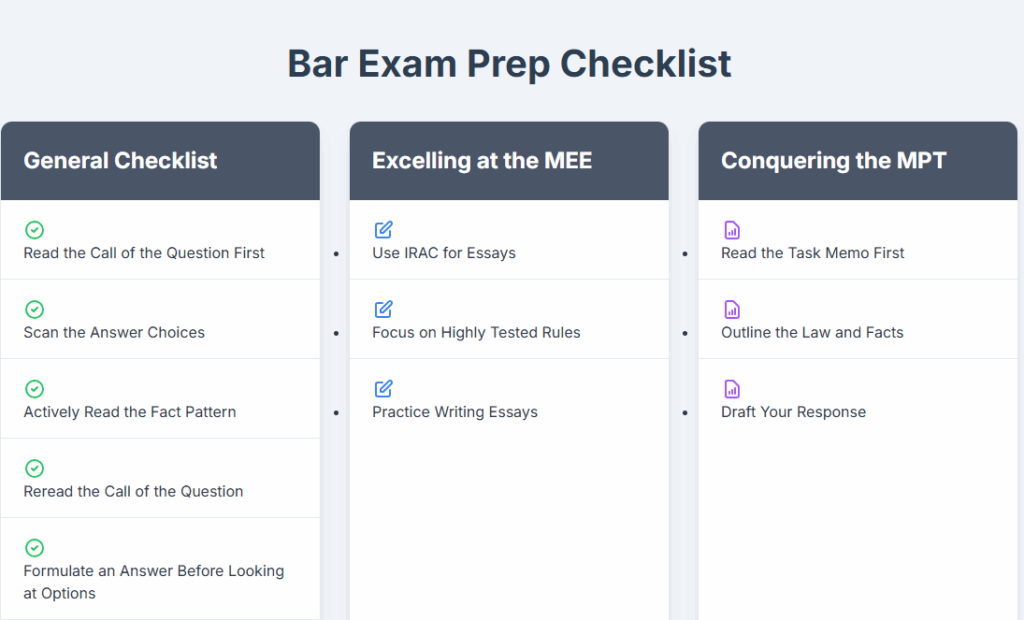
- Read the Call of the Question FIRST. Before you even glance at the long fact pattern, jump to the very end and read the actual question being asked. This gives you immediate clues about the subject area and what specific legal issue you should be looking for.
- Quickly Scan the Answer Choices. If the call of the question is vague, a super-quick scan of the answer choices can give you more context or buzzwords related to the topic. Don’t analyze them yet; just get a feel.
- Actively Read the Fact Pattern. Now, go back and read the scenario carefully. Since you know what the question is asking, you can read with more focus, highlighting or noting key facts, dates, and parties relevant to that question.
- Reread the Call of the Question. Just to be sure you’re crystal clear on what’s being asked, now that you have the facts.
- Formulate an Answer in Your Head BEFORE Looking at the Options. This is a game-changer! Based on the facts and your knowledge of the law, what do you think the answer is?
- Read ALL Answer Choices Carefully. Now, compare your pre-formulated answer to the options provided. Even if option A looks perfect, read B, C, and D. You’re looking for the best answer, and sometimes the choices are designed to be tricky. The best answer might not be a perfect statement of the law, but it will be the most correct of the imperfect options.
A few more MBE tips:
- Eliminate incorrect answers. Often, you can confidently rule out one or two choices, which significantly improves your odds if you have to guess.
- Don’t assume facts that aren’t given. Stick strictly to the information provided in the fact pattern.
- Practice, practice, practice! The more real MBE questions you do, the better you’ll get at recognizing patterns, common distractors, and the way the examiners test certain concepts.
The MBE tests not just your knowledge but also your strategic test-taking skills. That step of formulating an answer in your head before looking at the choices is powerful because it prevents you from being easily swayed by cleverly worded wrong answers. You approach the options with a clearer idea of what you’re looking for.
Excelling at the MEE: Writing Powerful Essays with IRAC
For the MEE, you’ll be writing six essays, with about 30 minutes allotted for each one. Organization and clarity are paramount here.
Your absolute best friend for MEE success is the IRAC method: Issue, Rule, Analysis, Conclusion. Here’s how to use it effectively:
- Issue: Start by clearly and concisely stating the specific legal issue raised by the facts.
- Rule: Next, lay out the relevant black letter law. Be precise and accurate.
- Analysis: This is where you earn the big points! Don’t just recite facts and then jump to a conclusion. You need to apply the rule you just stated to the specific facts of the problem. Explain how the facts support each element of the rule, or why they don’t. This is your chance to show the grader you can think like a lawyer.
- Conclusion: Briefly answer the question posed by the issue, based on your analysis.
To make your essays easy to read and score:
- Use clear headings for major issues if a question has multiple parts.
- Use paragraph breaks for each component of IRAC. This visual separation makes your answer much easier to follow.
- Bold or underline key legal terms or case names within your rule statements or analysis. This helps the grader quickly see that you’ve hit the important points.
- Focus your study time on the highly tested essay rules first. You don’t need to know every obscure nuance, but you do need to be solid on the core principles that come up frequently.
- Practice writing full essays under timed conditions. This is crucial for developing speed and learning how to apply IRAC efficiently.
Graders have very limited time for each essay. A clean, well-organized IRAC structure isn’t just about neatness; it’s a powerful communication tool. It makes your reasoning transparent and allows the grader to quickly see that you’ve identified the issues, know the relevant law, analyzed the facts, and reached a logical conclusion, maximizing your chances of getting all the available points.
Conquering the MPT: Applying Lawyering Skills Under Pressure
The MPT consists of two 90-minute tasks where you step into the shoes of an associate and complete a common lawyering assignment. The beauty of the MPT is that it’s a “closed universe”. All the facts and all the laws that you need are provided. You don’t need to have any outside legal knowledge memorized for this section.
Common MPT tasks include drafting:
- An objective memorandum
- A persuasive brief
- An opinion letter to a client
- A demand letter to opposing counsel
- Other practical documents, like contract provisions or closing arguments.
Success on the MPT hinges on a systematic approach and good time management. Here’s a strategic way to tackle each 90-minute MPT :
- Read the Task Memo FIRST (3-5 minutes): This is your instruction sheet from the “supervising attorney.” It tells you what document you need to draft, who your audience is, the tone you should adopt, and often, the specific issues to address or the format to follow.
- Quickly Skim the File (2-5 minutes): Get a general overview of the factual documents. Don’t get bogged down in details yet, just get a sense of the story.
- Carefully Read the Library & Outline the Law (20-25 minutes): Now, dive into the provided statutes, cases, or regulations. As you read, outline the relevant legal rules, standards, and elements. This is your legal toolkit for the task.
- Thoroughly Read the File & Outline/Connect the Facts (15-20 minutes): With the law fresh in your mind, go back and read the factual documents carefully. This time, actively connect the specific facts to the legal rules and elements you just outlined from the Library.
- Organize Your Answer/Create a Detailed Outline (3-5 minutes): Based on the Task Memo’s instructions and your understanding of the law and facts, create a clear outline for the document you’re about to write. This is your blueprint.
- Draft Your Response (Remaining ~45 minutes): Now, write! Focus on clear, concise language. Apply the law from the Library to the facts from the File, following the structure you outlined and the instructions from the Task Memo.
A few more MPT pointers:
- Pay close attention to formatting, tone, and audience as specified in the Task Memo. Are you writing an objective memo to your boss or a persuasive brief to a court? The style will be very different.
- For persuasive tasks, use the provided cases effectively. Analogize the facts of your case to helpful precedents, and distinguish your case from unhelpful ones. Explain the facts in a way that supports your client’s position, and try to minimize the impact of unfavorable facts.
- Many experts recommend a 45/45 minute split: spend the first 45 minutes reading, analyzing, and outlining, and the second 45 minutes drafting your response.
The MPT is all about thinking and writing like a lawyer using the materials you’re given. It’s less about what you know and more about what you can do with the information. Consistent practice is the only way to get comfortable with the timing, the different task types, and the systematic approach needed to succeed.

The Art of Issue Spotting
Effective issue spotting is the cornerstone of a good answer on both the MEE and the MPT, and it even plays a role in understanding MBE questions. If you can’t see the legal problems presented by the facts, you can’t apply the rules correctly.
Here’s how to become a better issue spotter:
- Start with the Call of the Question: As I mentioned for the MBE and MEE, the call of the question is your roadmap. It often explicitly tells you which legal areas or specific claims to discuss. Don’t ignore these clear instructions!
- Look for Arguments the Parties are Making: In essay fact patterns, if a party is making a specific legal argument or claim, that’s a strong signal that you need to address it, even if the argument seems weak.
- Go Back to the Facts: If you’re unsure what the issues are, reread the fact pattern carefully. Certain facts or combinations of facts are classic triggers for specific legal issues. For example, dates might trigger statute of limitations issues, or specific actions might suggest an intentional tort.
- Be Aware of Highly Tested Areas of Law: The bar examiners have their favorite topics within each subject. As you practice, you’ll start to see patterns. Knowing these highly tested areas can help you anticipate and spot issues more quickly.
- Practice Consistently: Issue spotting is a skill that sharpens with repetition. The more practice essays and MPTs you work through, the more adept you’ll become at sifting through a fact pattern and identifying the legally significant points.
Think of issue spotting like being a detective. The call of the question is your assignment, the facts are your clues, and your legal knowledge is your toolkit to figure out what’s legally important in the scenario.
Balancing Work and Study
If you’re working full-time while studying, hats off to you; it’s tough but doable. The key is efficiency and honesty with yourself and maybe your boss. Create a mini-schedule around your job. For example, use early mornings or commute time for quick review, like flashcards or listening to lecture podcasts. Every hour you get should have a purpose. Even 30 focused minutes beats an unfocused hour.
If possible, let your employer know you have the bar coming up. Some jobs may allow slightly flexible hours or reduced overtime. In any case, protect your weekends for bigger study blocks as much as you can.
One friend told me he “studied on lunch breaks and resisted weekend plans” – sacrifices, yes, but short-term. Remember, balance also means a bit of rest. Don’t burn out by studying 12 hours every single day.
Use your work skills. At work, you have deadlines and to-dos; apply that discipline to your studies. And leverage resources. If your company has a quiet room or even a subscription to an education site, use it.
And be sure to enroll in a solid bar exam course—whether it’s a self-paced online program or live-review class—so you’re following a proven study plan and making every minute count.
Here are some of my recommendations:
Pick the best course that fits your schedule and learning style to keep you motivated and on track. Many have passed while working. It’s about small, consistent wins: an extra 20 questions here, an outline revision there. On test day, you’ll be tired, but confident that you used every available minute.
Final Thoughts
That’s it—a clear, practical game plan to help you tackle the bar exam with purpose and confidence. It’s a big challenge, no doubt. But you don’t need to be perfect or have it all figured out from day one.
Passing the bar is about showing up for yourself consistently. It’s about putting in the work, finding what study methods actually work for you, and staying steady—even when it gets hard. People from every background and learning style have done this, and you’re just as capable.
So take a deep breath, set your pace, and keep going. You’ve got this.
FAQs
If you’re studying full-time, aim for about 6-8 hours per day, over an 8-10 week period. If you’re studying part-time, you’ll need around 4-6 months with 15-25 hours of study per week.
Some of the most common pitfalls are underestimating the sheer amount of time and consistent effort required, just passively reading or watching lectures instead of actively learning and doing lots of practice questions.
If you prefer curated materials and expert lectures, then a commercial bar review course can be incredibly beneficial. However, if you are extremely disciplined and organized, it’s possible to self-study using high-quality free resources.
It’s more common than you might think. Many successful attorneys didn’t pass on their first attempt. If this happens, critically analyze what went wrong in your preparation or on exam day, and adjust your study strategy.
You don’t have to memorize everything, but you should know the big rules well. Use active techniques: flashcards, mnemonics, and especially spaced repetition help cement rules in memory.