


The FE Exam isn’t just another test—it’s the first major gateway between being an engineering student and stepping into the profession. Whether your goal is to become a licensed professional engineer or simply to prove you’ve mastered the fundamentals, this exam demands more than last-minute cramming. It’s a dense, computer-based, six-hour marathon covering everything from engineering economics to differential equations.
And the kicker? You only get one scheduled break.
The good news is that approximately 37,400 (68% of 55,000) of engineers pass it every year—not because they’re geniuses, but because they prepare strategically. Passing the FE is about understanding the structure of the exam, building the right habits early, and walking into the testing center with confidence. Here’s how to do exactly that.
Key Takeaways
- Know the Structure: Understand the FE Exam format, timing, and how to flag questions so you can manage your pace.
- Plan Early: A clear, steady study schedule beats last-minute cramming every time.
- Practice Like It’s Real: Full-length practice exams build speed, endurance, and confidence.
- Master the Handbook: Knowing exactly where to find formulas in the NCEES Reference Handbook saves precious time.
- Strategize on Test Day: Smart time management and staying calm under pressure make a huge difference.
Understand the FE Exam Structure
Before you open a single study guide, you need to know what you’re up against. The FE Exam is administered by NCEES and is computer-based, offered year-round at testing centers across the U.S. It lasts about six hours, which includes a brief tutorial, the actual exam, a scheduled break, and a short post-exam survey.
The actual exam itself is five hours and twenty minutes long, consisting of 110 multiple-choice questions. The questions cover a wide range of FE exam topics—everything from mathematics, probability, and statistics to discipline-specific material like structural analysis or thermodynamics, depending on the version you take (e.g., FE Civil Exam, FE Mechanical Exam, etc.).
The format is adaptive in one sense: you can flag questions to revisit later, but once you move to the second half of the exam after your break, you can’t go back. Understanding this structure up front helps you pace yourself and manage the pressure effectively on exam day.
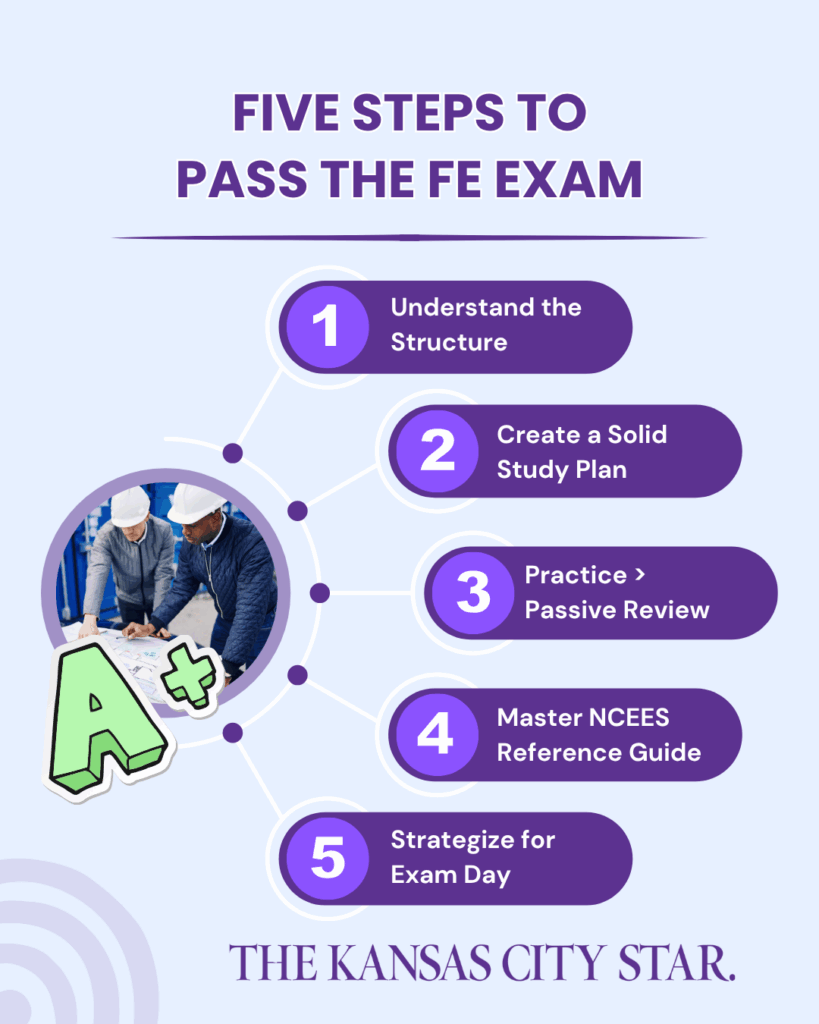
Build a Realistic Study Plan
You don’t pass the FE by winging it. Successful candidates typically invest between two and three months in thorough preparation, though this can vary depending on how recently you graduated and how comfortable you are with core concepts.
Start by visiting the NCEES website and downloading the official FE Exam specifications for your discipline. This will tell you exactly which knowledge areas are tested and how heavily each is weighted. From there, break your study plan into manageable weekly goals—covering the most challenging or heavily weighted topics first.
Treat studying like training for a long race: steady, consistent progress beats short bursts of panic-driven cramming. Schedule regular review sessions, ideally in shorter, focused blocks (e.g., 60–90 minutes) several times a week. This not only builds retention but also helps you avoid burnout as exam day approaches.
Prioritize Practice Over Passive Review
Here’s the truth: rereading your old textbooks won’t cut it. The FE Exam is designed to test applied problem-solving, not rote memorization. The single most effective strategy is working through practice problems and full-length practice exams.
Start with diagnostic tests to identify your weak areas. Then focus on targeted practice in those topics until you can solve problems quickly and accurately. Time yourself as you go—this is crucial for building the speed and stamina you’ll need during the actual exam.
In the weeks leading up to test day, complete at least one full-length practice exam under timed conditions. This helps you get used to the pacing, the computer-based interface, and the mental fatigue that comes with solving problems for more than five hours straight. Simulating the real experience in advance will give you a significant edge.
Master the NCEES Reference Handbook
One of the most overlooked aspects of FE prep is the NCEES Reference Handbook. This digital resource is the only reference material you’re allowed during the exam. It contains the formulas, tables, and key information you’ll need—but here’s the catch: if you don’t know where to find things, it can become a time sink.
During your study period, get familiar with its structure. Learn where your discipline’s most common formulas live. Practice solving problems while referencing the handbook, just as you’ll do on test day. Knowing how to navigate it efficiently can easily save you 10–15 minutes during the exam, which could be the difference between passing and failing.
Strategize for Exam Day
The day of the test isn’t the time to figure things out. Plan your testing center logistics ahead of time: know how to get there, what to bring, and what to expect when you arrive. Use the scheduled break wisely—eat a snack, stretch, and reset mentally. Don’t use it to second-guess the first half of the exam.
During the test, flag questions you’re unsure about and move on. It’s far better to answer every question and come back than to burn time on a single tricky one. Keep a close eye on the clock and make sure you have enough time to review flagged questions in the first section before your break.
Remember: this is a five-hour problem-solving marathon, not a sprint. Keeping a calm, methodical pace is one of the best ways to avoid careless mistakes.
Why Passing the FE Exam Matters
Passing the FE isn’t just about bragging rights. It’s the official first step toward becoming a licensed professional engineer. Once you pass, you can call yourself an “Engineer in Training” (EIT) or “Engineer Intern” (EI), depending on your state, putting you on the path toward the PE Exam and full licensure.
This credential signals to employers that you take your profession seriously and have mastered the fundamentals. It can also open doors to better job opportunities, higher starting salaries, and a faster route to leadership roles in engineering.
Final Thoughts
Passing the FE Exam is challenging, but it’s absolutely doable with focused preparation, lots of practice, and a smart strategy. Start early, master the tools you’ll use on exam day, and give yourself enough time to build confidence. When the big day arrives, you’ll be ready—not because you crammed, but because you prepared like a professional.
FAQs
Most candidates spend two to three months preparing, studying several hours per week. Recent grads may need less time, while others benefit from a longer plan.
FE pass rates vary by discipline, but first-time takers typically see success rates above 70% if they test within a year of graduation.
Yes, most FE exams are difficult—but not because it’s impossible. The challenge lies in the breadth of topics and time pressure. With consistent practice, it’s very passable.
Focus on active practice, not passive review. Use diagnostic tests, targeted problem sets, and full-length timed exams to build skills and stamina.
Not exactly. You’ll have the NCEES Reference Handbook during the test—but you need to know where everything is. Familiarity beats memorization here.



![PPI2Pass Review [FE and PE Exam Prep Courses]](https://www.kansascity.com/careers-education/wp-content/uploads/sites/7/2025/10/PPI2Pass-Review-feature-img.png)
