So, you’re thinking about the CPA exam? Good move.
Becoming a CPA opens doors and boosts your earning potential. But here’s the big question: how long should you study?
I’ll tell you this: cramming doesn’t cut it. Research shows you actually remember more when you spread your study sessions out over time. That’s why having a plan matters way more than burning yourself out in one big push.
There’s no one-size-fits-all answer. Some people power through faster, others need more time. What matters is building a schedule you’ll stick to. I’ve looked at the research, what candidates really do, and what actually works, and I’ll break it all down for you here.
Key Takeaways
- Total Study Hours: Most candidates spend 300–400 hours total for all sections of the CPA exam.
- Per Section: Expect 80–120 hours per exam section, depending on the content.
- FAR Takes Longer: The Financial Accounting and Reporting (FAR) section usually needs the most study time.
- Practice Counts: Taking practice tests and working through multiple-choice questions is the fastest way to improve.
- Consistent Study Plan: Studying a little every day beats cramming at the last minute.
How Many Hours Do You Need to Study for the CPA Exam?
If you want a ballpark figure, most CPA candidates need about 300 to 400 hours total. That’s not all at once, of course. It’s spread out across the four sections of the CPA exam.
Think of it like training for a marathon. You don’t run 26 miles on the first day you train in chunks. Same idea here. Plan your hours over weeks or months, and it’ll feel a lot more doable.
Study Time by CPA Exam Section
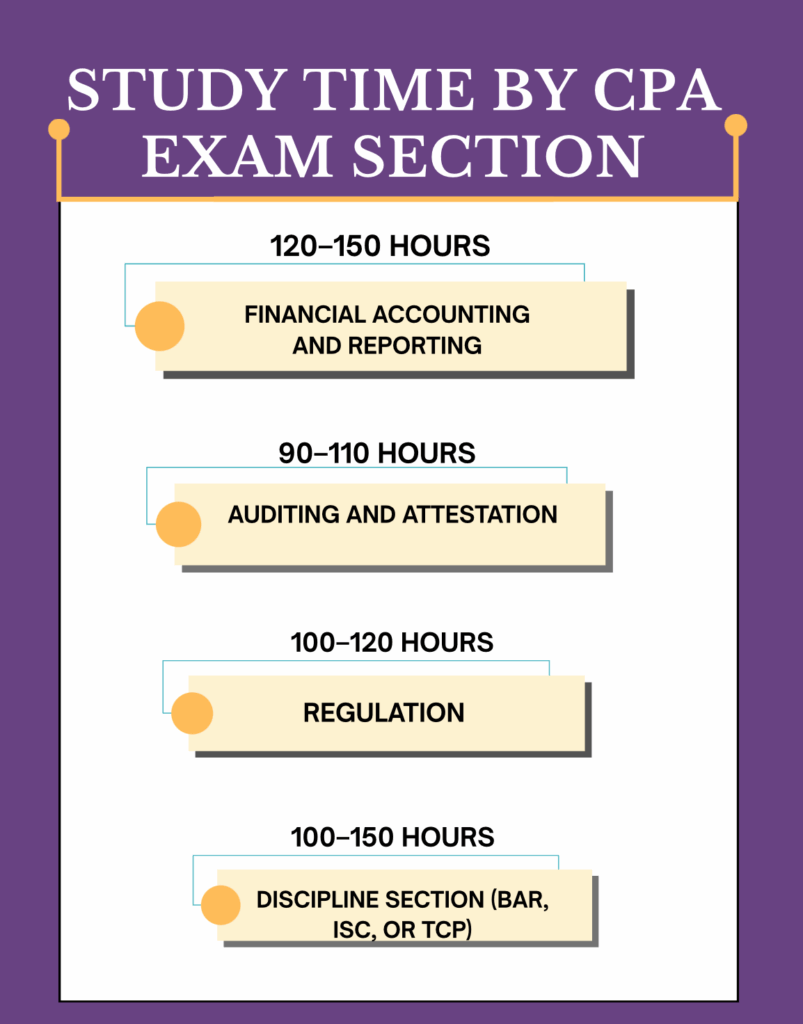
Each exam section is different. Here’s what most people aim for:
- FAR (Financial Accounting and Reporting): 120–150 hours. It’s packed with complex technical accounting topics and needs the most study time.
- AUD (Auditing and Attestation): 90–110 hours. You’ll cover professional responsibilities, auditing standards, and plenty of task-based simulations.
- REG (Regulation): 100–120 hours. Federal taxation, business law, and tax compliance and planning are the big focus here.
- Discipline Section (BAR, ISC, or TCP): 100–150 hours. Each has its own advanced topics like business analysis, information systems and controls, or advanced tax compliance.
If you’re stronger in one area because of school or work, you might shave off hours. If you’re less confident, add more.
How Long Do Real CPA Candidates Study?
While “300–400 hours per exam” is often cited, actual CPA candidates report a much wider range of study patterns depending on their energy, schedule, and ability to retain material. The common theme? Consistency beats cramming.
What Candidates Say Works
According to candidates on popular Reddit threads, here is what works:
- 1–2 hours on weekdays, longer on weekends: Many working professionals shared that two focused hours after work was their realistic maximum.
One candidate explained:
“Two hours a day was my limit where I could actually retain info. Otherwise, I started to forget, cut corners, and just zone out.” To balance this, weekends became “the money makers” with 4–5 hours of review time.
- Morning study vs. evening study: Some found evenings draining after spreadsheets and client work all day.
One candidate said:
“Try to start the morning off with studying. I found that when I studied after work, I was just too drained.” Those who carved out 60–90 minutes in the morning often felt sharper and more consistent.
- Short study cycles (1–3 months per exam): Several candidates noted that dragging out the study over too many months can backfire:
“The longer you take to study, the higher the chance you’ll forget previous material.”
Many recommended aiming for a concentrated 8–12 week window per exam, ramping up intensity in the final 2–3 weeks. - Breaking it up during the day: Sneaking in study during lunch breaks or playing lectures while doing chores helped some maximize limited time. As one candidate put it:
“I’d let the lectures play while I worked… when I got to the MCQs later, I realized I’d absorbed more than I thought.” - Protecting mental health and sleep: Several emphasized they refused to sacrifice sleep, instead focusing on quality over sheer hours:
“I get ready for bed at 7:30 so I can wake up at 5 a.m. refreshed. I will not give up sleep hours.”
Typical Ranges Reported
- Weekdays: 1–2 hours (sometimes split between morning and evening).
- Weekends: 3–6 hours, with some using Sundays for lighter review.
- Total Hours: Around 120–180 hours per exam over 2–3 months was a common range, though some stretched this over a year by doing less daily.
CPA Study Schedules: What Works Best?
| Study Routine | Typical Hours | Pros | Cons |
|---|---|---|---|
| 1 Hour/Day + Weekends | ~1 hr on weekdays + 4–5 hrs on Sat/Sun (≈120–150 hrs over 3 months) |
|
|
| 2 Hours/Day + Weekends | 2 hrs weekdays + 4–6 hrs weekends (≈150–200 hrs over 2–3 months) |
|
|
| 3–4 Hours/Day | 3–4 hrs weekdays + 6–8 hrs weekends (≈200–250 hrs in 6–10 weeks) |
|
|
| Weekend-Heavy Approach | Minimal weekdays, 6–8 hrs Sat/Sun (≈100–150 hrs over 4–5 months) |
|
|
Balancing Study With Real Life
You’re not just a CPA candidate; you’ve got work, family, and other commitments. That’s why flexibility matters.
If you work full-time, you may only get 10–15 hours a week. That means spreading your CPA study time over more months. If you’re between jobs or fresh out of school, you might push harder with 20–25 hours weekly.
Either way, the amount of time is less important than the consistency. Show up for yourself, even if it’s just a couple of hours a day.
Common Mistakes People Make
I’ve noticed a few traps CPA candidates fall into:
- Not investing in a prep course: Choose one of the best CPA review courses to study efficiently.
- Skipping simulations: Don’t just rely on multiple choice questions; task-based simulations carry a lot of weight.
- Cramming last-minute: It feels productive, but most people burn out and forget key exam material.
- Ignoring weak spots: It’s easy to re-study what you already know. Be honest with yourself and spend time on the tough parts.
- Not setting a schedule: Without one, you’ll study way less than you think you are.
Final Thoughts
Here’s the bottom line: aim for 300–400 hours total of study time. Break it down into chunks, follow a study plan, and use practice tests to guide you. You’ll probably spend around 100 hours per section, with FAR taking the most.
Don’t worry about what everyone else is doing. Focus on what works for you. If you’re steady and consistent, you’ll give yourself the best shot at passing the CPA exam and earning that license.
Stay consistent, use practice tests, and remember you don’t have to be perfect, just prepared.
FAQs
Most CPA candidates need between 300 and 400 total study hours. That works out to about 100 hours per section, with Financial Accounting and Reporting often taking the longest.
The FAR CPA exam section (Financial Accounting and Reporting) covers financial reporting, accounting topics, and complex technical accounting concepts. This section consists of multiple-choice questions (MCQs) and task-based simulations.
AUD tests professional and legal responsibilities, auditing procedures, and business ethics. You’ll see both MCQs and simulations, so make sure you practice under timed conditions.
REG focuses on taxation and regulation, including federal taxation, tax laws, business law, and tax compliance and planning. It is a core section of the CPA exam and not the same as TCP, which is one of the Discipline sections.
A strong CPA study schedule balances frequent study sessions with taking practice tests. Plan for 2–3 hours on weekdays and more on weekends. That way, you’ll keep up with exam material without burning out.