Planning to take the Series 63 exam?
You’re in good company.
This isn’t the toughest securities exam out there, but it’s definitely not one to wing. The tricky part isn’t the math; it’s the wording, legal terms, and state securities laws that test your focus more than your memory.
Whether you’re a new rep or shifting roles in the finance world, in this guide, I’ll break down what makes the Series 63 challenging, pass rates, how the scoring works, and the best ways to study so you can pass on your first try.
Key Takeaways
- Short But Dense: The Series 63 exam is just 60 scored questions, but it covers dense state securities laws and the Uniform Securities Act.
- Law & Ethics Heavy: Ethical practices, fiduciary obligations, and compliance standards take up a significant chunk.
- Pass Rate Insight: Many test takers pass on their first try. The estimated pass rate sits around 70–80%.
- Preparation Matters: Practice exams and consistent study plans are what separate those who pass from those who don’t.
- State Regulation Focus: You’ll be tested on state securities regulations, broker-dealer/agent rules, registration requirements, and administrative provisions.
What Makes the Series 63 Hard?
I’ve reviewed many other securities exams, but this one’s sneaky. It’s not about complex math, it’s about:
- Tricky Wording: The actual test will use similar phrases to test careful reading. A small shift in wording can change your answer.
- Mixed Legal and Ethical Scenarios: You’ll see questions that combine model rules, fiduciary duties, and state law. That overlap causes confusion.
- Sprinkled Surprises: Topics like investment advisers, conflicts of interest, and real-world scenarios get you when you least expect them.
Pro Tip: Don’t just memorize rules, understand why they exist. When you grasp the “reason behind the regulation,” spotting trick answers gets easier.
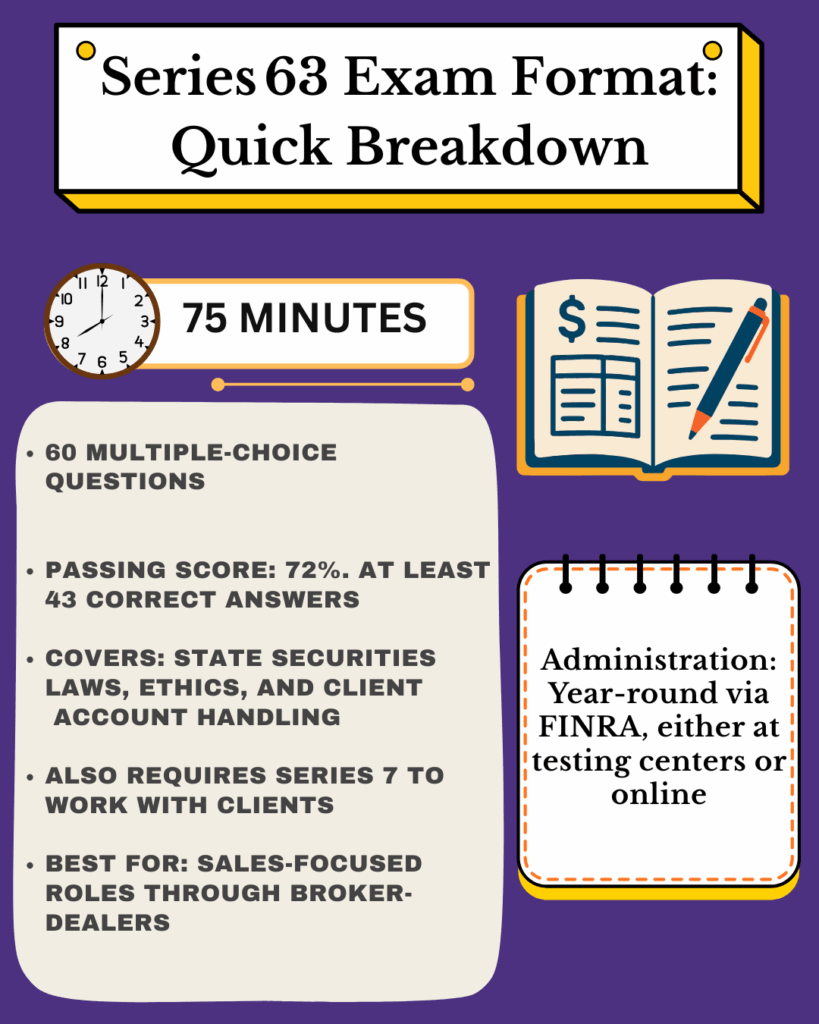
Series 63 Exam Format: Quick Breakdown
Here’s what to expect on exam day:
- Total Questions: 65 (60 scored + 5 unscored)
- Format: Multiple choice, with four options each
- Time Limit: 75 minutes
- Passing Score: 72%. At least 43 correct answers
- Administration: Year-round via FINRA, either at testing centers or online
- Core Topics: State registration rules, state securities acts, the Uniform Securities Act, ethical standards, disclosure requirements, and administrative provisions
Series 63 Pass Rate and Scoring
FINRA doesn’t publish an official Series 63 pass rate, but industry data places it between 80% and 85%. That means most candidates pass on their first attempt, but that only happens with solid prep.
To pass, you must:
- Get at least 43 of 60 questions correct
- Score roughly 72% or higher
- Finish within the 75-minute time limit
Even though the pass rate sounds high, the exam can still surprise you. It’s packed with fine details on state regulations, fiduciary standards, and compliance rules that you need to interpret accurately, not just memorize.
What You’ll Be Tested On
You’ll be examined on how well you grasp:
- Broker‑dealer and agent rules under state law
- Investment adviser / IAR obligations
- Registration requirements and disclosure responsibilities
- Conflicts of interest, fiduciary duties, and client protections
- Administrative provisions and model rules used by state regulators
Ethics and law overlap heavily. The exam will ask you to apply ethical standards in real-world scenarios. Once you recognize recurring patterns, it becomes more manageable.
Common Mistakes That Cost You on Exam Day
A lot of candidates hit the same pitfalls:
- Misreading Legal Wording: The difference between “must” and “may” can determine correctness.
- Overlooking Ethics: Don’t assume “common sense” works; ethical questions often require hard rules.
- Relying Only On Flashcards: Flashcards help define terms, but the test is scenario-based. You need practice questions to train for that.
What Real Test-Takers Say About the Series 63
If you spend any time on Reddit or FINRA study threads, one thing becomes clear fast: the Series 63 isn’t impossibly hard—but it’s sneaky. It’s short, detail-heavy, and written in legalese that’s designed to trip you up if you’re not paying close attention.
One test-taker, u/Juceman23, admitted,
“I actually failed the first time and passed the second. It’s crucial that you truly know all the little registration differences between BDs/Agents and IARs/RIAs… and everything the state administrators can and can’t do inside or outside their states.”
That “legalese” theme comes up again and again. Many candidates describe the questions as less about broad finance knowledge and more about spotting the one word that changes everything.
Another user who passed on the first try shared,
“It tested a lot of tiny details. Like 30 days, 10-day written discretion, lots of ethics, commission sharing, and administrators’ powers. I finished in 45 minutes and felt pretty confident.”
For others, pacing and reading comprehension were just as challenging as the content. u/JBoyJammy, who passed recently, warned,
“Time is going to be tight… read every question carefully. There were long ones with double negatives like ‘which of these are NOT non-exempt securities.’ Watch out for that wording.”
Several commenters also stressed the importance of repetition over luck. One veteran test-taker put it bluntly:
“Just study every part of the…books and take the practice exams over and over until you ace them… grab your coffee, study hard, and cut the distractions.”
And when it all comes together, the relief is real. The original poster later returned with two words every Series 63 candidate wants to type:
“Passed 🙏🏻”
This study plan is built to counter those mistakes:
- Study Time: 15–20 hours over two weeks, focused, not frantic
- Mix It Up: Alternate reading state statutes or the Uniform Securities Act with practice exams
- Target Weak Spots: If fiduciary duties, registration rules, or model rules confuse you, revisit them daily
- Use Practice Tests: These teach you how questions are worded and how rules are twisted
Pro Tip: Keep sessions short, consistent, and purposeful. The Series 63 exam rewards those who train their brain on pattern recognition, not rote memorization.
My Final Verdict
The Series 63 may be short, but it’s packed with fine print that can trip up even seasoned test-takers. Most people struggle not with the content but with how precisely the questions are worded. Knowing the difference between may and must can make or break your score.
If you want to pass on the first try, treat this exam seriously and invest in a solid Series 63 prep course. It helps you master the Uniform Securities Act, state administrator powers, and the ethics rules that show up again and again. Pair that with consistent practice tests, and you’ll train your brain to spot trick questions before they get you.
The key is focus and repetition—not luck. Stick to your study plan, trust your prep materials, and you’ll walk out with confidence (and a passing score).
FAQs
The Series 63 exam requires a 72% passing score, which means getting 43 out of 60 questions correct. This ensures you understand key state securities laws and ethical standards before getting your Series 63 license.
The Series 63 runs 75 minutes and includes 60 scored questions plus five unscored ones. It’s a short test, but careful reading and time management are essential for success.
The Series 63 exam is generally easier than the Series 7, focusing on state securities regulations and ethical practices instead of complex investments. Many test takers find it challenging, mainly because of the legal wording.
Use practice exams, review fiduciary duties, and study the Uniform Securities Act closely. Consistent study sessions help test takers build confidence and handle tricky question wording.
Yes, you can take the Series 63 exam without broker-dealer sponsorship. It’s administered year-round and open to anyone preparing for state registration or other securities licensing exams.